Key Takeaways
- Precarious Tenure: Data & AI Executives typically serve only 2–3 years, making their role among the most unstable in the C-suite.
- Survival Through Quick Wins: The first 6–12 months are critical. Executives must deliver visible ROI quickly to secure credibility and future investment.
- Capital Efficiency Over Technical Elegance: Boards care less about technical metrics and more about how data initiatives translate into P&L impact.
- Strategic Translation of Technical Outcomes: Effective leaders reframe technical achievements (e.g., faster query runtimes) into business narratives like saved operational hours or cost reductions.
- Triple-Bottom-Line Focus: Success is measured across revenue growth, cost optimisation, and risk management—not just technical performance.
- Governance as Competitive Advantage: Regulations like the AI Act are not barriers but steering mechanisms. Strong governance reduces risk exposure and creates a moat against competitors.
- Culture as the Hardest Barrier: Around 70% of executives cite employee resistance as the biggest obstacle. Change leadership and trust in data are essential.
- Skill Liquidity to Solve Talent Gaps: Instead of chasing “unicorns,” leaders build pipelines through dual career tracks and structured development, boosting retention and employee lifetime value.
- The Win-Win Synthesis: Mature integration occurs when organisational ROI goals and executive career sustainability align, producing measurable gains in data maturity and adoption.
Is the Data Leader’s Role Becoming too Risky?
The role of the Data & AI Executive—typically a Chief Data or AI Officer operating at SFIA Level 6-7—is currently the most precarious seat at the strategy table. While enterprise investment in generative AI and analytics has reached a fever pitch, a sobering reality remains: the average tenure for these leaders is a mere two to three years. This 1,000-day clock is not a suggestion; it is a heartbeat.
In this high-stakes reality, the gap between “technical output” and “realised business value” is where reputations go to die. Despite billions in capital expenditure, only 1% of organisations have reached mature, sustainable AI integration. For the executive, the challenge is not just the orchestration of complex models, but the translation of a raw tech landscape into a coherent fiduciary narrative. To survive, the modern data leader must move beyond being a technologist and become a Strategic Architect.
Is Data Strategy Proving Growth, not just Costs?
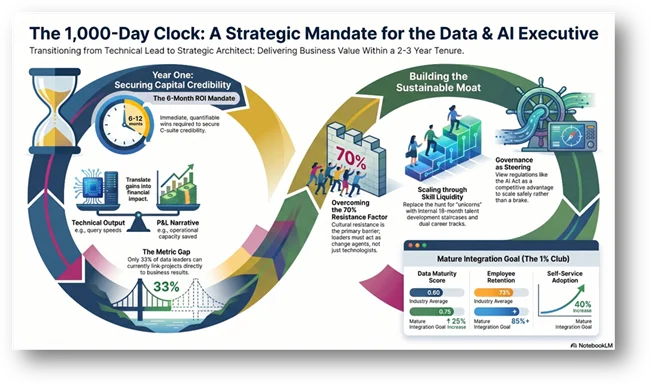
For the Data & AI Executive, immediate, quantifiable ROI is not a “nice-to-have”—it is a functional prerequisite for survival. Given the short tenure clock, credibility is the primary currency of the C-suite, minted exclusively through visible successes early in the mandate.
Successful leaders prioritise “Quick Wins” within the first 6 to 12 months to secure further investment and institutional buy-in. Technical elegance is a vanity metric at the Board level; what the Executive Committee demands is Capital Efficiency—the ability to turn raw compute and data into P&L impact.
“Only 49% of data leaders have well-defined, outcome-driven metrics for their initiatives, and just 33% can clearly link data projects to business results.”
Without this link, the mandate for long-term transformation evaporates before the foundation is even laid. The first year must prove that the data strategy is an engine for growth, not a cost centre.
How do Executives Link Strategy with Execution Effectively?
The most effective executives act as the linchpin between business strategy and execution. They have abandoned the language of “data lakes” and “model accuracy” in favour of the CFO’s language. A technical team may celebrate a 63% improvement in query runtimes, but a Strategic Architect presents that as a Delta (Δ) of 1,200 hours saved annually in operational capacity.
This transition requires a shift from technical “How” to strategic “What” and “Why.” To build consensus, initiatives must be framed through the lens of Triple-Bottom-Line objectives:
- Revenue Growth: Generating £5M+ in new revenue annually through analytics-driven customer initiatives.
- Cost Optimisation: Platform modernisation that delivers a 10% to 20% reduction in operational costs.
- Risk Management: Protecting capital and corporate reputation through robust oversight.
How does Governance Enable Safe Innovation at Scale?
In the current regulatory environment, the executive acts as the primary guardian against the chaos of unregulated data. However, at the SFIA 7 level, governance is no longer viewed as a “brake” on innovation. Instead, it is the “steering” that allows the enterprise to move at high speeds safely.
The metric of success here is the Delta of Risk Mitigation. Successful executives move their organisations from a state of high-risk exposure—often characterised by five or more major audit findings—to zero major findings. By establishing an Enterprise Data Governance Council, the executive transforms compliance (GDPR, AI Act) into a competitive moat, ensuring the organization is “ready to scale” while others are still mired in legal remediation.
What Barriers Exist in Digital Transformation Efforts?
The primary hurdle in digital transformation is rarely the technology; it is human behaviour. Approximately 70% of executives identify employee resistance as the single greatest barrier to data-driven decision-making.
The Data & AI Executive must lead as a “Change Leader” rather than a technologist. This involves driving a cultural shift where data is not just collected but converted into a shared asset that every department trusts. At this level of leadership, social and political intelligence are just as critical as analytical depth.
“My mission is to ensure that our organisation’s data is not just collected, but converted into real value… My goal is that everyone on our team trusts and leverages data to achieve these outcomes.”
How can Organisations Solve the Talent Crisis Effectively?
Talent remains the ultimate bottleneck, with 77% of organisations struggling to fill essential AI and data positions. While the market is scarce, high-performing executives have still successfully filled over 45,000 critical roles by moving away from the hunt for “unicorns” and toward building sustainable capability pipelines.
Strategic leaders solve the talent crisis through “skill liquidity”—creating an 18-month talent development staircase and dual career tracks that value both technical specialists and management paths. This approach doesn’t just fill seats; it increases the Employee Lifetime Value (ELTV) by 28% and improves retention from a baseline of 73% to 85%+.
How do we Achieve Win-Win Synthesis in Integration?
The transition from the 99% of companies “experimenting” to the 1% achieving “mature integration” requires what we call the Win-Win Synthesis. This is the intersection where the Organisational Imperative (the desperate need to move from experimentation to compounding financial value) meets the Executive Imperative (the leader’s need for career sustainability, clear authority, and a legacy-building mandate).
Mature integration is defined by a measurable 25% increase in organisational data maturity (from 0.60 to 0.75) and a 40% increase in self-service adoption. When the executive’s personal career goals and the company’s ROI targets are synthesised into a single narrative, the organisation gains a competitive advantage that outlasts any single individual’s tenure.
Is your Data Strategy a lasting Strategic Asset?
The modern Data & AI Executive is a transformational business architect, not a technical lead. Success in this role requires a delicate balance: delivering the “quick wins” necessary to survive the first 612 days while simultaneously building the talent and governance foundations required for long-term survival.
As you look at your current roadmap, ask yourself: Is your organisation’s data strategy building a foundation that will persist as a strategic asset, or are you simply running out the clock on a three-year tenure?
- Key Takeaways
- Is the Data Leader's Role Becoming too Risky?
- Is Data Strategy Proving Growth, not just Costs?
- How do Executives Link Strategy with Execution Effectively?
- How does Governance Enable Safe Innovation at Scale?
- What Barriers Exist in Digital Transformation Efforts?
- How can Organisations Solve the Talent Crisis Effectively?
- How do we Achieve Win-Win Synthesis in Integration?
- Is your Data Strategy a lasting Strategic Asset?