
Executive Summary
This webinar covers managing business intelligence and data warehousing, and makes the case for building visibility, capability, accountability, and measurability into data governance. Clear communication, understanding abbreviations properly, and structured business rules all matter for effective language and information management, and structured writing in business rule definitions pays real dividends. It also covers methods for knowledge discovery in business and building a community of practice.
Webinar Details
Title: Data Governance Needs Risk Management
Date: 17 May 2023
Presenter: Terry Smith & Mark Atkins
Meetup Group: DAMA SA User Group
Write-up Author: Howard Diesel
Journey into the Data Warehouse Field
Terry Smith started her career as an accountant in the finance department of a health insurance company, with no real background in data warehouses. A visionary boss introduced the idea of building one, and the team started by creating business process models. With help from Tara Day, they used Teradata and IMDB/DB2 to build a prototype. Additionally, Bill Inman evaluated the project and confirmed they were on the right track.
The company eventually merged with others and became the largest health insurer, with the data warehouse getting much of the credit for that success. Terry then moved into consulting for Teradata, specialising in insurance. It was while working on a data model for an insurance company in Chattanooga, Tennessee, that she met Mark.
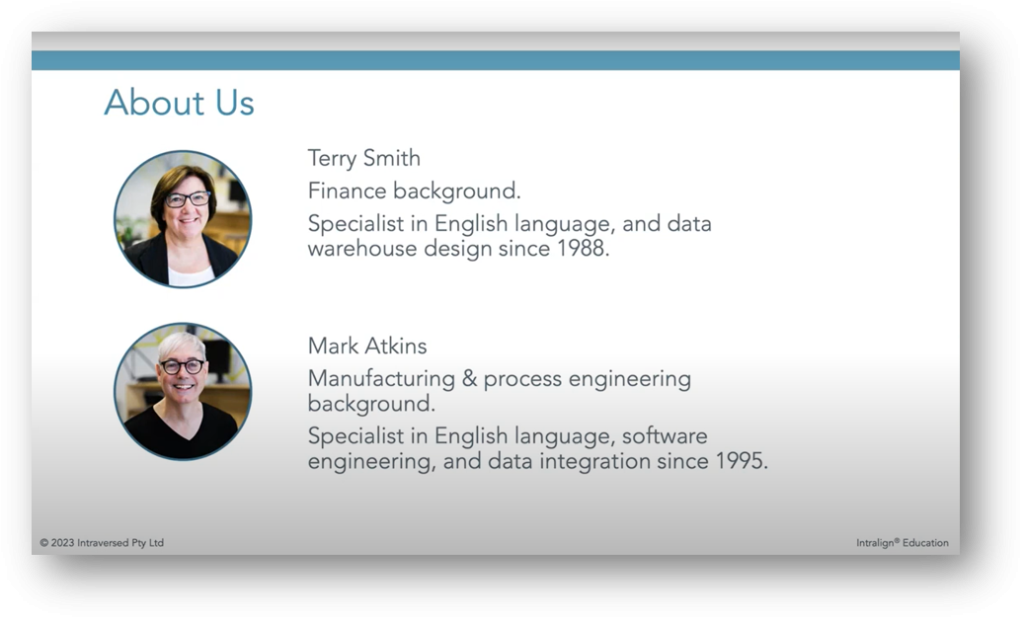
Figure 1 Meet the team
Challenges in Data Management and Knowledge Retention
The narrator met Terry during a trip to the USA in 1998, and the two soon collaborated on their first project, where Terry’s skill at data modelling stood out. By 2001-2002, they were both working for a telco company in Australia, and their combined experience in data warehousing and business intelligence let them spot what worked and what didn’t. One recurring problem was the mismanagement of organisational memory and money wasted on infotech projects with little return. Their goal became preventing regulatory non-compliance and closing the gap between IT and business through data-driven approaches that put business needs first.
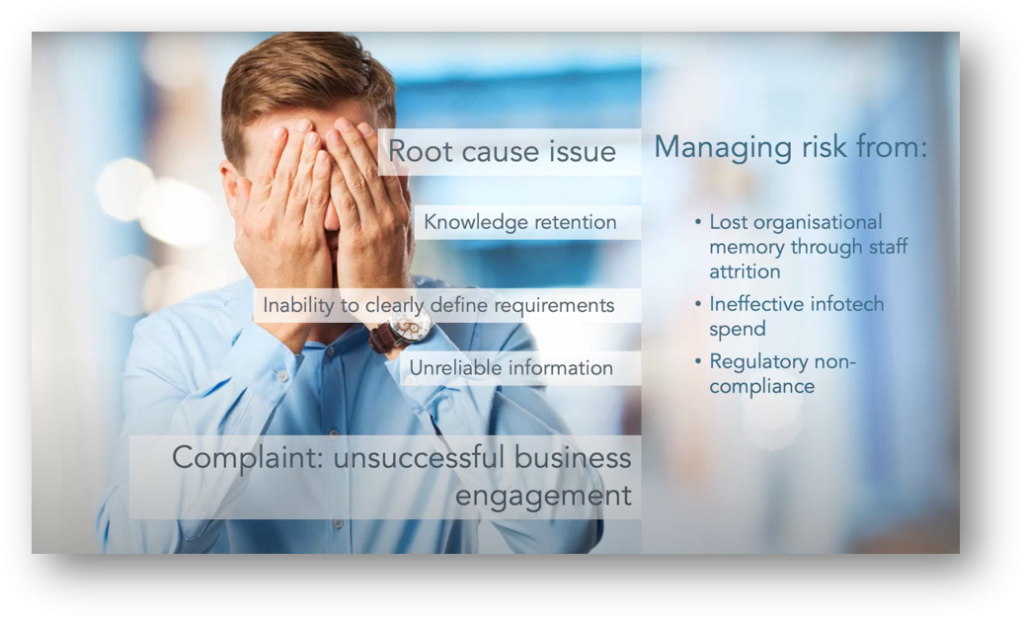
As their book points out, getting technology professionals and the business community collaborating well is genuinely hard, and it’s gotten harder since COVID, with a lot of expertise walking out the door as people leave big businesses for other careers. Knowledge retention is a real concern here, since losing it makes it harder to define needs accurately, which leads to unreliable information and regulatory non-compliance. Mark’s aim is to address that by pushing knowledge retention and data-driven approaches.

Figure 2 Challenges in Data Management and Knowledge Retention
Effective Strategies for Managing Business Intelligence and Data Warehousing
Clear communication is vital to any project’s success. 38% of project failures trace back to poorly defined information needs, and another 34% come from prioritising technology solutions over proper requirements analysis. Some technology managers also favour their preferred vendors over what the business actually needs, which is a genuinely risky habit.
The Interline ecosystem has built a winning strategy for managing risk, ensuring compliance, and handling information practically, one that was recognised for process innovation at the 2019 Australian Business Awards. The strategy is built around capturing organisational knowledge, business terms, definitions, and processes, and building communities of practice around language management and data governance is a big part of making that work.
Educating the business community on information management processes is what balanced data governance actually depends on. Promote explicit knowledge, communication, and communities of practice, and organisations end up making better-informed decisions about their technology investments.

Figure 3 Most common reasons why information system projects fail to deliver
Introduction and Purpose of the Book
Dashboards, spreadsheets, procedures, and policies are the resources a business actually needs to function well, and Mark stressed how important it is to keep them accessible and readily available. Mark also fielded a question about his whiskey, joking that he’s saving it for later, and noted the book is being printed to reach a wider audience with valuable insights.
There’s a QR code that gives access to a discounted PDF version of the book, and Mark mentioned the price in Rands along with the exchange rate against the US dollar. The book is aimed mainly at business leaders and executives, though there’s plenty in it for business analysts and data modellers too.

Figure 4 Introduction and Purpose of the Book. 4 Point Strategy to manage KSIR (Knowledge, Sociality, Infotech and Resources)
The importance of building visibility, capability, accountability, and measurability in data governance
The book’s case is that data governance requires building visibility and a culture of collaboration, where the business community can work together to resolve issues without pointing fingers. Educating people on information management and holding them accountable are both central to building data governance capability. Individuals are responsible for defining and managing their own data, and accountability is what keeps that accurate and consistent.
Measurability matters a lot for efficient implementation in data governance. Without measurable objectives, governance processes tend to lose their effectiveness. Data governance isn’t complete without proper follow-through, and measurability is what confirms it’s actually being used effectively. Mark shares that the presentation will centre mainly on knowledge, and the language used in data governance specifically.

Figure 5 Building Abilities
The Importance of Clear Language in Communication
Clear communication is what avoids misunderstandings and disputes, but ambiguity comes up a lot, especially in English, where so many words carry multiple meanings. Terminology ambiguity causes confusion and inconsistency within organisations and makes customer-focused strategies harder to implement. Written communication often lacks syntactic clarity too, which leads to misreadings and endless email threads, and even conjunctions like “and” or “but” can introduce ambiguity that needs clarifying. Abbreviations and acronyms add their own layer of confusion, leaving meeting participants bewildered and out of the loop.

Figure 6 The Importance of Clear Language in Communication
The Importance of Understanding Abbreviations
Abbreviations get used all the time without anyone really understanding what they mean. On a mobile data warehouse project involving data modelling, Terry and a colleague were concerned about whoever was coding the financial tables getting it right, so they ended up working through the weekend to make sure it was done properly. Between them, they managed hundreds of billing codes and balanced the data, and even built an audit system to handle new codes, with a specific code used to flag faulty records.

Figure 7 Ambiguous Terminology

Figure 8 Importance of Understanding Abbreviations

Figure 9 Ambiguous Terminology: Acronyms
Structured definition and business rules for a business term
The presentation walked through a structured definition format for business terms, with a worked example, and explained why a business term sentence needs a subject, object, and verb. It also covered classification and the different business rules a term might carry, and introduced modal verbs as an option at the start of a definition, each representing a different strength of relationship between the term and the concept. The benefits of building these rules line by line rounded out the discussion.

Figure 10 Structured definition and business rules for a business term
Benefits of Structured Writing in Business Rule Definitions
A structured format pays off in a business setting because it’s easy to read and understand, letting readers take each line on its own and quickly agree or disagree with it.
Structured writing also helps establish relationships between business terms, the start of a business ontology and taxonomy that cuts down on redundancy and inconsistency.
Prioritising natural-language definitions with the business community is what makes agile data modelling possible, letting data modelling stay efficient and effective while keeping pace with agile methodology.
A term like “employee,” for instance, can be defined along with its relationships to concepts like “person,” “employment contract,” and “position.” Through inheritance, a part-time employee can then be defined as an employee with a few additional rules layered on.

Figure 11 Benefits of Structured Writing in Business Rule Definitions
Methods for Knowledge Discovery in Business
In knowledge discovery, data and model data play crucial roles in supporting analysis. When it comes to data modelling, workshops prove to be a more beneficial option than one-on-one meetings. Workshops help foster a sense of community and establish a shared vocabulary. Through a series of key questions posed during workshops, classification and functional rules can be determined.
Discrepancies and disagreements arising during workshops indicate ambiguity in definitions that need to be clarified. Additionally, related terms can be identified by examining the other terminology used in discussions. To ensure clear ownership, an individual is identified as the owner for each definition through volunteering or being “Volunt-Told.” Following up with documentation after workshops is critical to leverage the insights gained effectively. Overall, workshops create a society or association that can help drive progress and innovation.

Figure 12 Method for Knowledge Discovery and QR Code for Pros and Cons of workshops versus one-on-one meetings
Building a Community of Practice for Language and Information Management
The idea is a community of practice where businesses can collaborate and build up their language and information management skills together, digging into the data and refining language and analysis around actual business needs and values, prioritising strategy and measurable success rather than technology for its own sake. Workshops and management establish ownership and clear definitions, building a genuinely active community of practice, and an insurance company’s data warehouse project serves as a good illustration of why understanding business value matters so much in decision-making.

Figure 13 Building a Community of Practice for Language and Information Management. Point 2 in KSIR strategy
Mistakes Made in Data Project Implementation
Commercial customers made up the largest share of the company’s revenue, so getting the most value from them mattered a lot. The company initially focused on the consumer side, assuming matching customer names and birth dates would give a complete view, but that side of the business was actually more complex than expected and only accounted for a quarter of revenue.
They then looked at matching Australian Business Numbers (ABNs) for commercial customers, but that strategy hadn’t accounted for how complex commercial businesses actually are, many have multiple subsidiaries and multiple ABNs. On top of that, most of their commercial business came through brokers, which made matching ABNs largely beside the point.
It would have given a different kind of 360-degree view, but the company ended up sinking significant resources into a data quality project cleaning up ABNs that didn’t really pay off.

Figure 14 Building Capability
Issues with IT Investments and Project Success
Mark raised concerns about the monthly reports tracking ABN value improvement, arguing they weren’t adding any real value to the business. Mark also pointed to the company’s inability to establish a centralised warehouse, which left the IT investment essentially worthless. Mark acknowledged the chief data and analytics officer’s leadership, but was still critical of the project itself, calling it a poor use of company funds. He also pointed to a recurring pattern: investing in IT solutions without doing a proper requirements analysis first.
To improve project success and ROI, Mark’s suggestion is to pair systems thinking with a community-of-practice approach. Improving data modelling capability matters a great deal for organisations too, he stressed. Mark also shared a client story: dashboards built without proper business definitions racked up technical debt that now needs additional spending to fix.

Figure 15 Issues with IT Investments and Project Success. Point 3 in KSIR strategy
Data Governance – Notes
Bringing the business community into data governance can add real value, and that means paying attention to both structured and unstructured data, as well as artefacts like policies, procedures, and data extracts. Those artefacts run an organisation day to day, providing information people rely on, and adding metadata to them is how you understand ownership and where the data came from. Prioritising the artefacts and business needs that matter most gives a better understanding of the underlying data. Monash University’s research recommends format-based and content-based approaches for figuring out what needs governing, and government organisations often use terms like stewardship or custodianship to emphasise ownership. Accountability for governance tends to be structured through libraries, with a head librarian at the centre of it.

Figure 16 Building Information Governance
Key Concepts in Business Writing
Librarians and curators play a key role in preserving and maintaining artefacts, and authors stay accountable for what they create, which is why collaboration between authors and librarians matters for good curation. Stakeholders have the right to be consulted and should be included in the business glossary, with ownership running from business terms and artefacts all the way down to the underlying data. The KSIR strategy centres on knowledge, language, and community building to manage risk, and communicating effectively with technical personnel is a big part of that. Structured data currently gets priority over other structured resources. There’s a 50% discount on the book available via QR code, and the organisation’s values, people-first, clarity, going beyond, extend to investing in quality education and supporting indigenous literacy. The audience was encouraged to ask questions throughout.

Figure 17 Ownership Structure
Overcoming Cultural Challenges in Data Strategy
One of the biggest obstacles to the organisation’s data strategy has been a culture problem left behind by large consulting firms that prioritise cost reduction over business value. Building communities of practice has partly overcome that, though, fostering a real sense of connection and contentment among employees in some areas.
The broader national culture presents an ongoing challenge too, which is why it’s worth spending more time understanding and verifying what businesspeople actually mean rather than assuming and getting it wrong. Promoting data literacy and building a genuinely engaged, living language within the organisation takes a community, not just a glossary of terms sitting on a shelf.

Figure 18 Overcoming Cultural Challenges in Data Strategy
Importance of a Comprehensive Glossary in Organisations
A glossary accessible to everyone in the organisation matters a lot for effective communication, especially in a fast-paced environment, but technical glossaries often fall short on both reach and effectiveness. Making the glossary available organisation-wide and actively promoting it is what actually drives engagement and accessibility, and building it into induction programs strengthens its impact further. A genuinely useful glossary also helps mitigate regulatory compliance risk by keeping communication clear.

Figure 19 Importance of a Comprehensive Glossary in Organizations
Risks and Challenges in Reporting Metrics
Intangible knowledge plays a real role in assessing and managing risk, and CFOs and regulatory compliance are often the mechanisms used to measure and mitigate it. In a telco case study, the CFO’s reporting of a key metric to the regulatory body turned out to matter a great deal, since misrepresenting an organisation carries personal, financial, and reputational risk. Identifying and addressing major risk issues and vulnerabilities is essential, and reliable reporting is genuinely hard when the same metric has multiple definitions floating around.
Accurate numbers and clear metrics are what give CFOs confidence in their own reporting. A university that failed to properly define what counts as a ‘student’ ended up with incorrect reporting and decisions built on it, which is why accurately counting applicants and accepted offers matters for understanding a student’s full life cycle.

Figure 20 Risks and Challenges in Reporting Metrics. Point 4 in KSIR strategy
Importance of Historical Examples in Assessing Risk and Data Quality
Inadequate risk assessment and poor data quality cost the business real money and left it with vacant space, and sharing examples like that is a good way to show what happens when risks aren’t identified properly. Larry English’s research on data quality found that poor quality can cost a company at least 10% of revenue every day, and practical cases like this help organisations understand why investing in data quality matters. For multinational corporations, a language strategy is critical too, one that can account for diverse cultures and languages; approaches built for English-speaking markets can often extend to other languages as well.
Writing Method Appreciation and Simplification
Mark acknowledged the challenges multinational corporations face communicating with countries that have different rules and documentation requirements. Veronica, for her part, appreciated the simplicity and structure of the writing method being discussed, saying it’s easier to start writing with a clear starting point and genuinely valuing the structure it provides. She also liked the use of simple verbs and nouns, not unlike modelling techniques, for producing precise, easily understandable writing. Additionally, Mark pointed out how important it is to make writing accessible for people with literacy issues or disabilities, and the workshop’s goal is to simplify the writing process so everyone can express themselves effectively. Understanding simple concepts, and being able to define clearly what something is and what it does, is really what effective communication comes down to, in his view.

Figure 21 Summary of KSIR Strategy
- Executive Summary
- Journey into the Data Warehouse Field
- Challenges in Data Management and Knowledge Retention
- Effective Strategies for Managing Business Intelligence and Data Warehousing
- Introduction and Purpose of the Book
- The importance of building visibility, capability, accountability, and measurability in data governance
- The Importance of Clear Language in Communication
- The Importance of Understanding Abbreviations
- Structured definition and business rules for a business term
- Benefits of Structured Writing in Business Rule Definitions
- Methods for Knowledge Discovery in Business
- Mistakes Made in Data Project Implementation
- Issues with IT Investments and Project Success
- Data Governance – Notes
- Key Concepts in Business Writing
- Overcoming Cultural Challenges in Data Strategy
- Importance of a Comprehensive Glossary in Organisations
- Risks and Challenges in Reporting Metrics
- Importance of Historical Examples in Assessing Risk and Data Quality
- Writing Method Appreciation and Simplification


