1. The Hook: Navigating the Friction Point
In the world of modern enterprise, the Data Steward lives at a permanent friction point. You are pressured by two opposing forces: the Business Domains, which demand fast answers, operational agility, and revenue-driving KPIs; and Data & Technology, which demand compliance, metadata standardization, and architectural integrity.
This often leads to a “split” identity. You are the translator between technical constraints and business realities, straddling two worlds but often feeling as though you have no clear home in either. However, as a career architect, I am here to tell you that this tension is not a career dead-end—it is your greatest strategic advantage. In the AI era, the ability to “speak both SQL and CEO” is the rarest and most valuable skill in the marketplace. You are not just a “data cleaner”; you are a catalyst for organizational maturity.
2. Takeaway 1: Your “Split” Identity is a Competitive Advantage
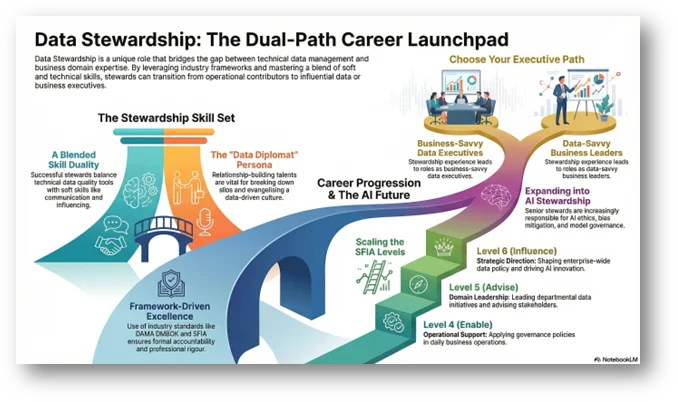
Your success depends on your ability to pivot from manual-following to strength-leveraging. Straddling the business and data worlds creates a “Dual-Path” to the executive suite. You must decide which track to optimize:
- The Left Track (The Data-Savvy Business Executive): This path leads to roles like Product Owner, Analytics Program Manager, or Business Unit Head. Your edge is “deep data credibility.” While traditional managers struggle to understand why a project is delayed or a report is inaccurate, you lead cross-functional transformations because you understand the data underlying the business processes.
- The Right Track (The Business-Savvy Data Executive): This path leads toward Data Governance Director, Chief Data Officer (CDO), or AI Governance Lead. Your advantage is the ability to tie technical data architecture directly to board-level ROI, risk mitigation, and customer trust.
“Formal accountability plus the power of relationships enables stewards to make their biggest impact.”
3. Takeaway 2: You Cannot Govern the Algorithm if You Do Not Govern the Inputs
The rush toward AI has shifted stewardship from a back-office function to a prerequisite for survival. Organizations are realizing that trustworthy AI is fundamentally reliant on rigorous data stewardship.
Senior stewards are the natural candidates for AI oversight committees because they provide the foundation for “AI Readiness”—accurate training data, documented lineage, and bias-aware sourcing. Consider the recent case of a major bank that struggled with a predictive loan model. By sourcing critical supplementary data to fill bias gaps, the data stewards didn’t just “fix data”; they vastly improved the fairness and compliance of the model, protecting the firm from massive regulatory risk.
“You cannot govern the algorithm if you do not govern the inputs.”
4. Takeaway 3: The Four Archetypes of Successful Stewardship
Your success depends on mapping your innate psychological strengths to governance execution. Stewardship is “by the people, for the people,” and generally follows four archetypes based on Gregorc thinking styles and Gallup strengths:
- The Quality Enforcer (Concrete Sequential / Executor): You thrive on developing rigorous step-by-step standards and automated quality checks. You are the bedrock of architectural integrity.
- The Data Diplomat (Abstract Random / Relationship Builder): You excel at breaking silos and building cross-functional communities of practice. Your secret weapon is the “data clinic”—informal sessions where you solve real user problems while subtly reinforcing standards.
- The Process Guide (Facilitator / Relationship & Influence): You are highly effective at mapping RACI models and calmly facilitating conflict resolution around data ownership.
- The Culture Evangelist (Abstract Random / Strategic Thinker & Influencer): You use emotional intelligence to translate technical lineage breaks into compelling executive stories about customer satisfaction risks.
5. Takeaway 4: Mastering “Governance by Stealth”
To reach the “Left Track” of business leadership, you must master the art of being non-invasive. While the DAMA DMBOK provides the “What” (accountability and responsibility), the most successful stewards use Bob Seiner’s “How”: Non-Invasive Data Governance.
This is “governance by stealth”—formalizing accountability by leveraging existing domain expertise without heavy-handed bureaucracy. Use facilitation tactics from experts like Dave Wells to handle pushback non-confrontationally. By embedding standards into existing workflows, you ensure the business remains agile while staying compliant. This “stealth” approach proves to executives that you are an outcome-driver, not a technical roadblock.
6. Takeaway 5: The SFIA Launchpad—Mapping Your Ascent
The journey from operational custodian to enterprise influencer is a structured climb. Using the Skills Framework for the Information Age (SFIA), you can map your trajectory and negotiate your next promotion:
- SFIA Levels 3 & 4 (Apply/Enable): Operational Stewards and SMEs. You apply governance policies in daily operations as a business partner who reduces rework.
- SFIA Level 5 (Ensure/Advise): Roles like Master Data Manager or Domain Lead. You move from executing tasks to setting standards and advising across teams.
- SFIA Level 6 (Initiate/Influence): The Business Data Owner or Executive Sponsor. You are now driving enterprise strategy and influencing senior stakeholders.
- SFIA Level 7 (Enterprise Influence): The Chief Data Officer (CDO). You shape the policy and vision for the entire organization’s data and AI future.
7. Conclusion: Stepping Onto the Launchpad
Modern data stewardship is the ultimate career launchpad. When you improve a key data quality metric from 70% to 95% accuracy, you aren’t just performing a routine task—you are creating faster business reporting and higher resolution efficiency.
These are not just company wins; they are concrete CV accomplishments of a future leader. They prove you can resolve longstanding discrepancies between Sales and Finance, save hours of executive meeting debate, and prepare an organization for the AI-driven future.
As you look at your current responsibilities, ask yourself: Are you treating your data tasks as a chore, or are you recognizing them as the strategic leadership foundation for the next stage of your career?
Step onto the launchpad.
- 1. The Hook: Navigating the Friction Point
- 2. Takeaway 1: Your "Split" Identity is a Competitive Advantage
- 3. Takeaway 2: You Cannot Govern the Algorithm if You Do Not Govern the Inputs
- 4. Takeaway 3: The Four Archetypes of Successful Stewardship
- 5. Takeaway 4: Mastering "Governance by Stealth"
- 6. Takeaway 5: The SFIA Launchpad—Mapping Your Ascent
- 7. Conclusion: Stepping Onto the Launchpad