

Key Takeaways
- Strategic Career Personas: Data professionals should define their career paths, as each role has distinct functions and evaluations.
- The Thought Leader’s Role: Thought leaders guide technical direction through expertise, unlike executives who have formal authority and control over resources.
- Targeted Performance Metrics: Thought leaders excel in brand capital, first-to-market prototypes, and breakthrough innovations or patents.
- Assessing Value and Perception: Organisations use dashboards and audits to assess a thought leader’s impact and correct misalignments.
- Optimising Value per Hour: Value per hour: 85% on strategic initiatives, less than 10% on non-value tasks.
- Influence Without Authority: Thought leaders engineer influence by translating complex work into compelling business narratives and building consensus.
- Strategic Capability Partnerships: StrengthsFinder helps leaders identify weaknesses and collaborate with colleagues to fill those gaps.
- Embracing AI as a Tool: AI technologies such as LLMs enhance productivity, enabling thought leaders to extract insights more effectively.
Webinar Details
Title: Know Your Value – for Data Professionals
Date: 2026-04-16
Presenter: Howard Diesel
Meetup Group: African Data Management Community
Write-up Author: Howard Diesel
Is your Career Strategy Driving Impactful Change?
In the data industry, career progression necessitates a clear strategic vision. Without this foresight, professionals risk merely performing repetitive tasks, which often lead to professional stagnation and stress. To establish a robust career strategy, it is imperative to comprehend the primary data personas: the executive, the thought leader, the practice manager, and the professional.
Executives are responsible for formulating overarching strategies, while thought leaders determine the technical trajectory, such as advocating for modern data architectures or the adoption of artificial intelligence. Practice managers subsequently translate these strategic directives into actionable plans for data professionals. Crucially, the thought leader should not be perceived as subordinate to the executive.
Prominent industry thought leaders function as vital brand ambassadors, significantly enhancing an organisation’s reputation and attracting top-tier talent. Ultimately, professionals must critically evaluate whether they are genuinely driving impactful organisational change or merely perpetuating a stagnant routine.

Figure 1 Build a Talent Strategy for Yourself and Others

Figure 2 Know Your Value (KYV) Series

Figure 3 The Data & AI Talent Ecosystem Maps Directly to Business Intent
How are Data Personas Evaluated by Different Metrics?
Performance evaluation varies significantly across data personas, with each measured by a distinct set of key metrics. Data executives are primarily assessed on the value realised for the organisation relative to the financial expenditure on talent acquisition. Conversely, data and artificial intelligence thought leaders are evaluated based on their ability to deliver first-to-market solutions, develop tangible value-adding prototypes, and generate brand capital.
Practice managers are judged by their “time to value”—the expedition of data initiative delivery—and employee lifetime value, reflecting their proficiency in retaining the talent required for execution. Finally, data professionals are measured by operational metrics, including solution scalability, code quality, and the successful deployment of data and AI assets. Understanding these differentiated metrics enables professionals to appropriately align their daily outputs with the specific expectations of their respective career trajectories.

Figure 4 Hard Work does not Automatically Translate into Visible Value

Figure 5 The Strategic Orchestrator Converts Business Vision into Capital Efficiency

Figure 6 The Visionary Architect Engineers Future-State Competitive Advantage

Figure 7 The Operational Bridge Institutionalises the Win-Win Zone

Figure 8 The Technical Craftsperson Builds Robust Assts that Scale and Deploy

Figure 9 The Functional Champion Applies Data Directly to Domain Outcomes

Figure 10 The Master Persona Matrix: Architecting the Total Capability
How can Data Professionals Bridge the Last Mile Gap?
Data professionals, including analysts, scientists, and engineers, frequently utilise technical tools such as SQL, Python, and Spark to perform their duties. However, they encounter a persistent, systemic challenge: the abbreviated “half-life” of technical proficiencies. With the rapid emergence of new programming languages and artificial intelligence capabilities, existing technical expertise can rapidly become obsolete.
Furthermore, technical professionals frequently confront the “last mile gap”.
This phenomenon occurs when advanced data products or quality assessments are successfully developed, yet the broader business fails to utilise them or recognise their strategic value. Consequently, technical practitioners often reach a critical career juncture, necessitating a choice between transitioning into formal management to acquire administrative authority or deepening their technical specialisation to become thought leaders. Unlike managerial roles, thought leadership lacks formal administrative power, presenting a unique developmental challenge.

Figure 11 Audit Your Data & AI Ecosystem for Maximum Value Capture

Figure 12 The Technical Craftsperson: Defining the Data & AI Professional

Figure 13 The Visionary Architect: Anatomy of a Data & AI Thought Leader
What Defines a Thought Leader’s Influence in Organisations?
The thought leader persona is fundamentally characterised by extensive depth of expertise rather than administrative breadth. Lacking the formal authority to mandate business decisions, thought leaders must rely on intellectual stewardship and conceptual exploration to influence organisational direction. Their impact is measured across comprehensive performance dimensions, including innovation, strategic foresight, capability development, and ethical leadership.
Key performance indicators (KPIs) for thought leaders often include creating breakthrough initiatives, securing patents, publishing academic or commercial research, and establishing technical industry standards. Compared with IBM or Microsoft Fellows, these individuals have the autonomy to explore diverse analytical avenues without strict procedural restrictions. Whether operating internally within an enterprise or on an industry-wide scale, thought leaders provide the critical technical vision that guides the broader data community.

Figure 14 KPI Master

Figure 15 Performance Dimension Master

Figure 16 KPI Master: Dimension ID
How do Thought Leaders Assess their Influence Effectively?
Organisations operationalise the measurement of a thought leader’s influence by utilising specialised performance dashboards. This framework integrates performance dimensions, key performance indicators, and structured work audits. A fundamental component of this evaluative process is the self-assessment, in which thought leaders quantify their perceived value. This self-evaluation is subsequently contrasted with feedback from business stakeholders, creating a “perception mirror”.
This comparative analysis often reveals critical misalignments: a thought leader may overestimate their influence, believing it exceeds stakeholders’ actual perception, or, conversely, underestimate their strategic impact. Upon identifying these perception gaps, thought leaders must rigorously diagnose the underlying causes. Such discrepancies may indicate a need to reprioritise tasks to improve physical delivery, or they may highlight a deficit in internal marketing, necessitating enhanced stakeholder communication and visibility.

Figure 17 Data & AI Thought Leader KYV Quantification

Figure 18 Quantifying the Intangible

Figure 19 Excel Workbook (Input) & Power BI Report (Output)

Figure 20 Thought Leader 360: Bridging the Gap Between Self-Perception and Impact

Figure 21 Dashboard One: Calibrating Self Vs. Market Reality

Figure 22 Converting Raw Sentiment into a Growth Plan
How can we Measure Strategic Initiative Impact Effectively?
To ensure technical efforts translate into verifiable business value, thought leaders utilise an “integrated value map”. This analytical dashboard categorises initiatives to distinguish high-impact “strategic winners” from low-impact activities that warrant reconsideration. For instance, dedicating five years to developing an enterprise semantic model without yielding tangible business outcomes represents a suboptimal strategic allocation. Thought leaders must strategically determine whether low-impact tasks can be delegated or automated, thereby preserving their focus for high-value strategic endeavours.
Furthermore, evaluating this impact requires an acute understanding of lead and lag dynamics. Mentorship, for example, is a leading indicator that requires substantial immediate time investment, whereas the subsequent business capability it generates is a lagging indicator. Ultimately, thought leaders must systematically record a “value log” to document explicit recognition from the beneficiaries of their strategic initiatives.

Figure 23 Integrated Value Map (IVM): Maximising Strategic Impact and Business Value

Figure 24 Dashboard Two: Prioritising High-Velocity Strategic Goals

Figure 25 Dashboard Three: Tracking Against Elite Benchmarks

Figure 26 The Lead-Lag Dynamics of Capability

Figure 27 Dashboard Four: The Auditable Receipt of Cumulative Value

Figure 28 Analysing Professional Brand Fragility

Figure 29 Dashboard Five: Protecting Strategic Capacity
What is the Value Per Hour Metric?
The foundational metric in any comprehensive work audit is “value per hour”. By rigorously cataloguing the hours dedicated to specific initiatives, professionals can objectively assess whether their output aligns with overarching strategic objectives. Optimal performance is characterised by dedicating at least 85% of total task hours to value-adding activities, while keeping non-value-adding tasks strictly below 10%.
The calculation for this metric dictates dividing the quantifiable business value delivered by the total hours expended on the designated work. While thought leaders calculate this metric based entirely on their independent contributions, practice managers aggregate the collaborative hours of multiple team members to evaluate the collective return on a broader initiative. Maintaining alignment between these concentrated efforts and the defined organisational data strategy is paramount for sustained success.

Figure 30 The Value Engine: Maximising Personal ROI

Figure 31 Work Audit Dashboard: Optimising Leadership Impact

Figure 32 Data & AI Value Log: Quantifying Strategic Impact

Figure 33 Performance Scorecard: Data & AI Thought Leadership
What Defines a Thought Leader’s Influence Strategies?
Thought leaders typically possess between 10 and 25 years of specialised experience, frequently operating within research and development or innovation hubs. Because they operate without formal executive rank or direct resource allocation, they must actively engineer influence to drive organisational transformation. To achieve this, thought leaders must adeptly translate complex technical research into compelling business narratives.
Rather than merely reporting hours spent researching large language model architectures, they must articulate how prototyping a specific architecture systematically reduced data extraction latency by 15%. Cultivating this influence also necessitates a thorough understanding of individual cognitive styles and potential deficiencies.
Utilising frameworks such as “StrengthsFinder,” thought leaders can identify weaknesses—such as a deficit in persuading or communicating with stakeholders—and strategically partner with colleagues who possess complementary strengths to successfully advocate for their technical vision.

Figure 34 Engineering Influence

Figure 35 The Blueprint of a Visionary Architect

Figure 36 Influence Vs. Authority: The Diagnostic Contrast

Figure 37 The Core Friction: The Visibility Gap
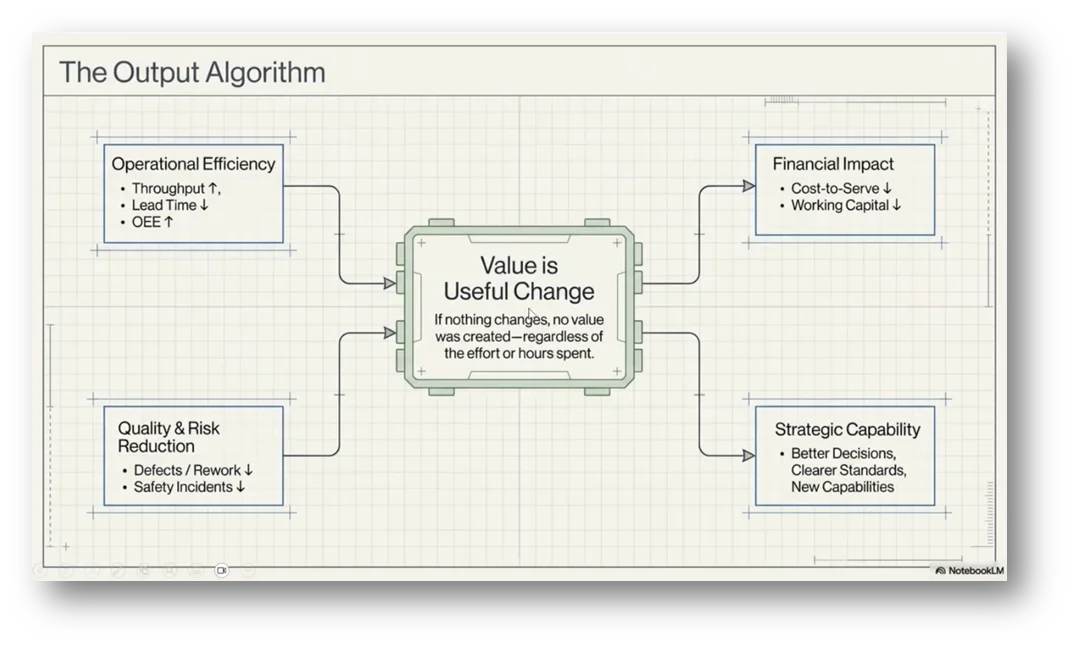
Figure 38 The Output Algorithm

Figure 39 Writing the Cognitive Engine

Figure 40 Identifying Potential Weaknesses

Figure 41 The Value-Add Translation Matrix

Figure 42 The Effort Vs. Value Audit
How can AI Enhance Thought Leadership Effectiveness?
During the conclusion of the session, artificial intelligence was framed not as a professional threat but as a crucial productivity enhancer for thought leaders. Implementing technologies such as Large Language Models and Retrieval-Augmented Generation (RAG) databases significantly streamlines complex document analysis, positioning the user as highly capable and efficient. Nevertheless, navigating the trajectory of thought leadership remains precarious due to intricate organisational politics.
Proposing a technological direction that contradicts prevailing stakeholder sentiment risks substantial professional marginalisation. Consequently, pre-emptive lobbying and consensus-building in one-on-one environments prior to formal group meetings are essential strategies. The essence of effective thought leadership lies in the ability to empirically demonstrate a core proposition: delivering measurable, useful change through specific actions that yield quantifiable metrics. Without delivering change deemed useful by the broader organisation, maintaining influence is exceptionally difficult.

Figure 43 The Career Control Room
- Key Takeaways
- Is your Career Strategy Driving Impactful Change?
- How are Data Personas Evaluated by Different Metrics?
- How can Data Professionals Bridge the Last Mile Gap?
- What Defines a Thought Leader's Influence in Organisations?
- How do Thought Leaders Assess their Influence Effectively?
- How can we Measure Strategic Initiative Impact Effectively?
- What is the Value Per Hour Metric?
- What Defines a Thought Leader's Influence Strategies?
- How can AI Enhance Thought Leadership Effectiveness?


