
Key Takeaways
- The Foundation of Data Architecture: An AI-ready enterprise needs robust data architecture to align business strategies with technology and governance.
- The Context Gap in AI: Most generative AI failures stem from lost context, not just technical or semantic errors.
- Persistent Knowledge Extraction Hurdles: Extracting tacit knowledge from SMEs is a crucial operational bottleneck in automation processes.
- Integrated System Governance: Organisations should use “human-in-the-loop” feedback for integrating knowledge into observability and governance.
- The Misalignment of Theoretical Frameworks: Traditional data management frameworks misalign with executives in pre-existing “brownfield” technology environments.
- The Critical Communication Deficit: The decline of business systems analysts has created a gap between executives and technologists.
- The Upstream Shift of Semantics: Semantic modelling needs to align with business discourse; architects must bridge AI and strategy gaps.
- Mandatory Foundational Prerequisites: Successful AI deployment requires solid data management, including glossaries, competency frameworks, and data-information separation.
- Agile Maturity and Standardisation: AI implementation failures stem from contextual gaps, not just technical or semantic issues.
Webinar Details
Title: Is your Semantic Model truly AI Ready for Data Professionals
Date: 2026-03-26
Presenter: Howard Diesel
Meetup Group: African Data Management Community
Write-up Author: Howard Diesel
How does a Robust Data Architecture Framework Contribute to an AI-Ready Enterprise Architecture?
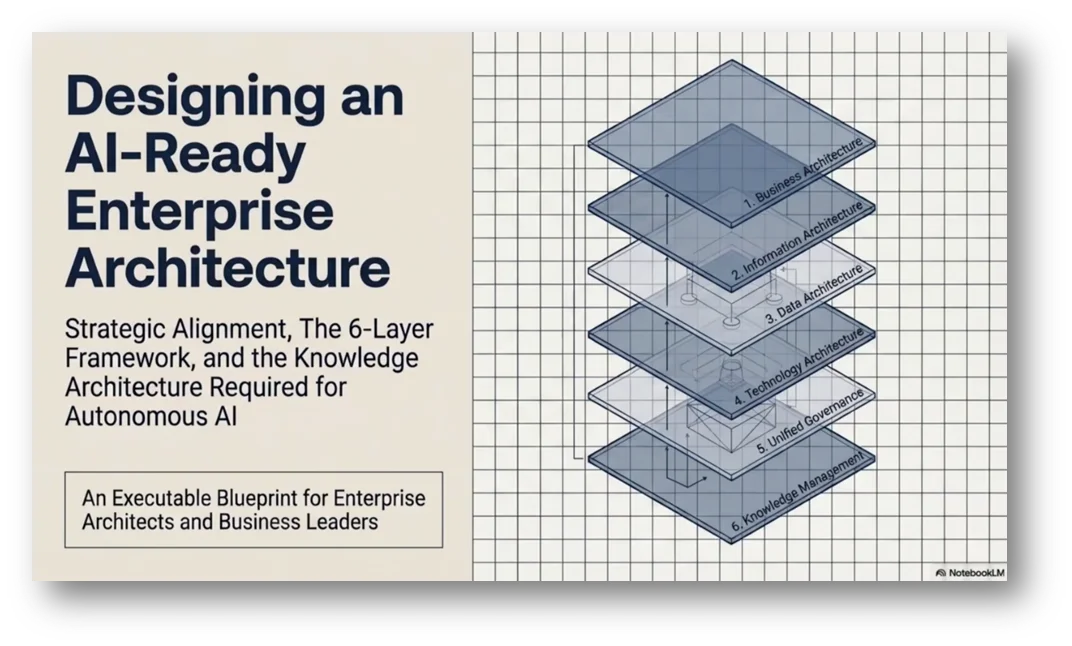
The establishment of an artificial intelligence (AI)-ready enterprise architecture inherently depends upon a robust data architecture framework. Data architecture occupies a central position, dictating the strategic direction for both the overarching business levels and the underlying technological infrastructure. To be effective, data architects must possess a comprehensive understanding of business and information architectures to accurately capture the semantic meaning of organisational operations.
Once this semantic foundation is established, these requirements must be systematically translated to technology architecture, governance structures, and knowledge management divisions. Ultimately, bridging this operational gap is a critical prerequisite for equipping an enterprise to meet the demands of modern generative AI implementations.
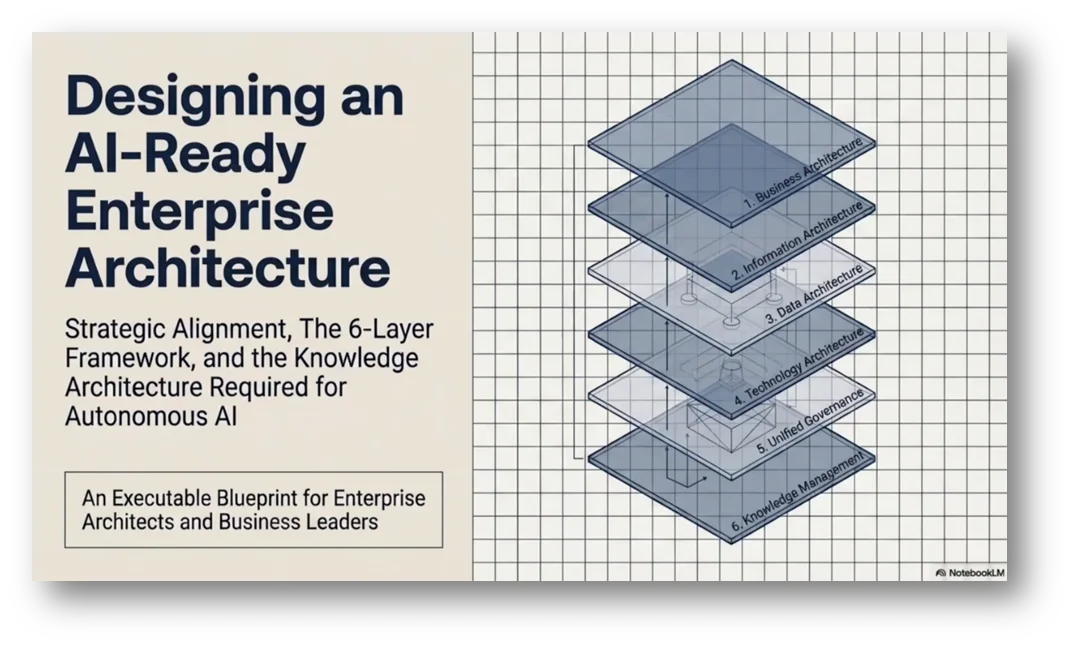
Figure 1 Designing an AI-Ready Enterprise Architecture
What Recent Analyses Reveal about the Reasons Behind AI Implementation Failures?
Recent analyses indicate a paradigm shift in how AI implementation failures are understood, attributing them primarily to contextual rather than technical or semantic deficiencies. Previously, enterprise semantic layers were positioned as the primary solution; however, these initiatives largely failed to provide the necessary operational backing.
The core issue arises when human experts rely on tacit knowledge to make or override decisions; this nuanced context is often discarded when data is simply stored in relational tables. To effectively train AI agents, organisations must implement structured human-in-the-loop processes. It is imperative to systematically capture the underlying context, drivers, and tacit reasoning behind human decisions to facilitate accurate future decision-making by AI agents.

Figure 2 AI Failure is Rarely Technical; It is an Alignment Failure
What Historical Challenges did Early Expert Systems Face in Knowledge Extraction from SMEs?
The historical trajectory of early expert systems and Robotic Process Automation (RPA) provides vital precedents for current AI challenges. Historically, constructing expert systems required extensive consultation with Subject Matter Experts (SMEs) to model their decision-making frameworks using complex conditional logic. This process was frequently impeded by the limited availability of these experts, who naturally viewed such knowledge extraction as an operational overhead.
Similarly, RPA implementations often devolved into the tedious programmatic coding of extensive “if-then-else” statements, mirroring the limitations of early expert systems. Consequently, the consistent extraction and formal recording of tacit knowledge from human experts remains a significant operational hurdle, creating persistent bottlenecks in deploying advanced AI technologies.
What is Identified as the Primary Reason for the High Failure Rate of Generative AI Pilot Programmes?
Industry analysts, such as Gartner, project that 95% of generative AI pilot programmes will fail, identifying the “context gap” as the primary catalyst. Addressing this deficiency requires organisations to transition tribal knowledge, structural rules, and business policies directly into system governance and observability platforms. When an AI agent escalates a complex decision to a human operator, the system must subsequently record the human’s underlying assumptions, the actors involved, and the strategic drivers.
Feeding this explicit reasoning back into the system is essential for subsequent agentic learning. However, successfully operationalising this knowledge management framework fundamentally requires strict strategic alignment between explicit business requirements and the capabilities delivered by information systems.

Figure 3 The Enterprise Context Layer: Closing the Gap Between AI Pilots and Production
In What Ways do Existing Frameworks Fail to Illustrate Procedural Flow Effectively?
Foundational data management frameworks, such as those detailed in the DMBOK, frequently present significant comprehension challenges for corporate leadership. Theoretical models, including Aiken’s Pyramid and the Amsterdam Information Model, often generate confusion due to their static visual nature, which fails to adequately illustrate procedural flow or contextual application. Furthermore, these frameworks often assume a theoretical starting point, whereas most organisations operate within “brownfield” environments.
In these practical scenarios, entities frequently procure technical platforms and initiate data modelling or storage procedures well before executing proper strategic planning. Consequently, the presentation of these formal frameworks typically underscores the existing misalignment between theoretical data management methodologies and practical organisational realities.

Figure 4 The Strategic Alignment Model

Figure 5 Purchased or Built Database Capability

Figure 6 The DAMA-DMBOK2 Data Management Framework (the DAMA Wheel)

Figure 7 DAMA Data Management Function Framework
How does Strategic Alignment Influence Successful AI Integration in Organisations?
Successful AI integration necessitates rigorous strategic alignment across multiple organisational dimensions, ensuring a cohesive fit between external business strategies and internal operational capabilities. Historically, the business systems analyst functioned as the critical intermediary, capable of translating between user requirements and technical programming specifications. However, the prevalence of this role has significantly diminished, particularly with the advent of specific Business Intelligence tools.
This decline has exacerbated a structural communication deficit, characterised by executives who refuse to acquire technical literacy and technologists who lack business acumen. Without analysts to articulate contextual meaning in the business’s native language, sophisticated technological solutions and initial semantic layers often fail to achieve operational resonance.

Figure 8 The Strategic Alignment Model: Synchronising Business Strategy and Technology

Figure 9 Structural Misalignment Destroys Technology ROI

Figure 10 Four Pathways to Achieve Alignment

Figure 11 The Six Dimensions of the Alignment Engine
How should Semantic Modelling be Positioned in Relation to Business Intelligence Applications?
Given the historical failure of semantic layers strictly attached to Business Intelligence applications, industry consensus dictates that semantic modelling must be positioned significantly further upstream, aligning directly with the origin of business discourse. As the traditional systems analyst role has eroded, the responsibility for securing strategic alignment has largely transitioned to Business and Enterprise Architects.
These architectural professionals must increasingly operate as change agents within the enterprise. Their mandate encompasses interpreting complex technological capabilities, such as AI, for business stakeholders while concurrently translating strategic objectives into implementable system requirements. This ensures that vocabulary, context, and operational logic remain consistent from overarching business strategy down to functional technological execution.

Figure 12 The Maturity Heatmap: From Ad Hoc to Optimised

Figure 13 The 6-Layer Enterprise Architecture Blueprint

Figure 14 Layers 1 & 2: Anchoring Strategy and Semantics

Figure 15 Layer 3 & 4: Translating Meaning into Structural Realisation

Figure 16 Layers 5 & 6: the AI Control Plane

Figure 17 Building the Context Mesh
What Fundamental Data Management Capabilities are Necessary for True AI Readiness?
Establishing true AI readiness demands the prior implementation of fundamental data management capabilities. Foundational exercises, such as defining comprehensive competency frameworks and developing formalised business glossaries, remain non-negotiable prerequisites. A critical component of this foundational architecture is the distinct conceptual separation of “information” and “data,” ensuring each domain receives appropriate analytical focus.
Neglecting these foundational architectural layers invariably compromises downstream AI deployments, as the necessary structural integrity is absent. Although contemporary AI tools can significantly accelerate the drafting of definitions and the construction of these preparatory components, human oversight is required, and the core preparatory work itself remains an absolute operational necessity.
What Limitations do Isolated Semantic Layers Present in Data Management?
To rectify the limitations of isolated, proprietary semantic layers, the industry is increasingly adopting interoperability standards, notably the Open Semantic Interface (OSI) and the Model Context Protocol (MCP). These protocols function as universal connectors—analogous to a USB cable—enabling disparate systems and AI agents to exchange contextual data seamlessly.
However, technological standardisation alone is insufficient; consistent, formalised human language remains the foundational prerequisite for effective data management architecture. Rather than delaying deployment pending absolute enterprise-wide standardisation, organisations are advised to implement an agile maturity methodology. This entails iteratively constructing modular semantic models and progressively integrating them to cultivate comprehensive, enterprise-level AI readiness.
- Key Takeaways
- How does a Robust Data Architecture Framework Contribute to an AI-Ready Enterprise Architecture?
- What Recent Analyses Reveal about the Reasons Behind AI Implementation Failures?
- What Historical Challenges did Early Expert Systems Face in Knowledge Extraction from SMEs?
- What is Identified as the Primary Reason for the High Failure Rate of Generative AI Pilot Programmes?
- In What Ways do Existing Frameworks Fail to Illustrate Procedural Flow Effectively?
- How does Strategic Alignment Influence Successful AI Integration in Organisations?
- How should Semantic Modelling be Positioned in Relation to Business Intelligence Applications?
- What Fundamental Data Management Capabilities are Necessary for True AI Readiness?
- What Limitations do Isolated Semantic Layers Present in Data Management?


