
Key Takeaways
- Value is defined as “useful change for somebody else”: Hard work alone isn’t enough. What counts is delivering results your key stakeholders can actually measure.
- Career progression requires a strategic destination, not just a pursuit of job titles: Use the SFIA framework and 90-day plans to shape your career instead of waiting for it to happen to you.
- Manage your visibility and autonomy: Document the value you deliver and confirm it with stakeholders. That record is your best defence against return-to-office mandates.
- Avoid getting stuck in “the grind”: Spend too much time on non-value tasks and your career stalls. Worse, you become invisible.
- Conduct regular work audits: Sort your weekly tasks into value-add and non-value-add, then automate or drop what you can.
- Align your daily work with top-level business strategy: Tie your initiatives to organisational strategy and set up monthly feedback so performance reviews stop being a surprise.
- Write a clear professional value proposition: “For [beneficiary], I provide [change] by executing [action], achieving [measurable metric].”
- Aim for the “win-win” zone: That means lining up your own growth with the organisation’s need for revenue and efficiency.
Webinar Details
Title: Data Talent Strategy for Data Professionals
Date: 2026-07-16
Presenter: Howard Diesel
Meetup Group: African Data Management Community
Write-up Author: Howard Diesel
What Defines Value in the Professional Workplace?
In the professional workplace, value comes down to one thing: generating useful change for somebody else.
Hard work, task counts, and hours logged don’t automatically earn recognition. Someone has to actually notice the outcome.
To avoid drifting into work that goes nowhere strategically, set a clear value statement before you start a focused session.
Key Takeaways
- Value equals useful change for a specific beneficiary.
- Time spent does not guarantee workplace recognition.
- Value statements should guide all deep work sessions.
FAQ
- How is workplace value measured? It comes down to the useful change you deliver to a stakeholder, not the hours you clocked or the tasks you ticked off.
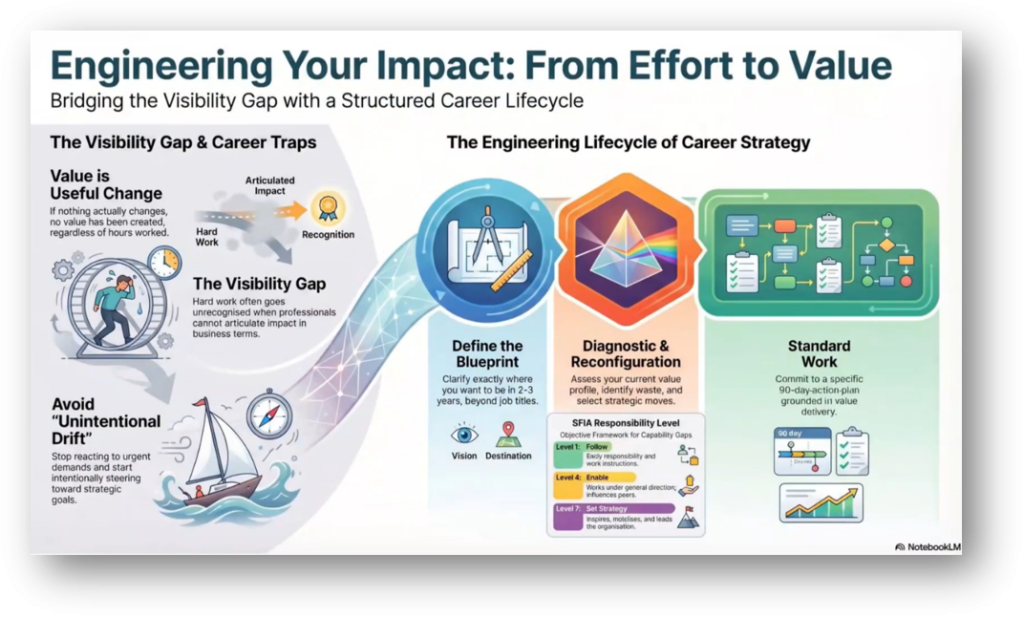
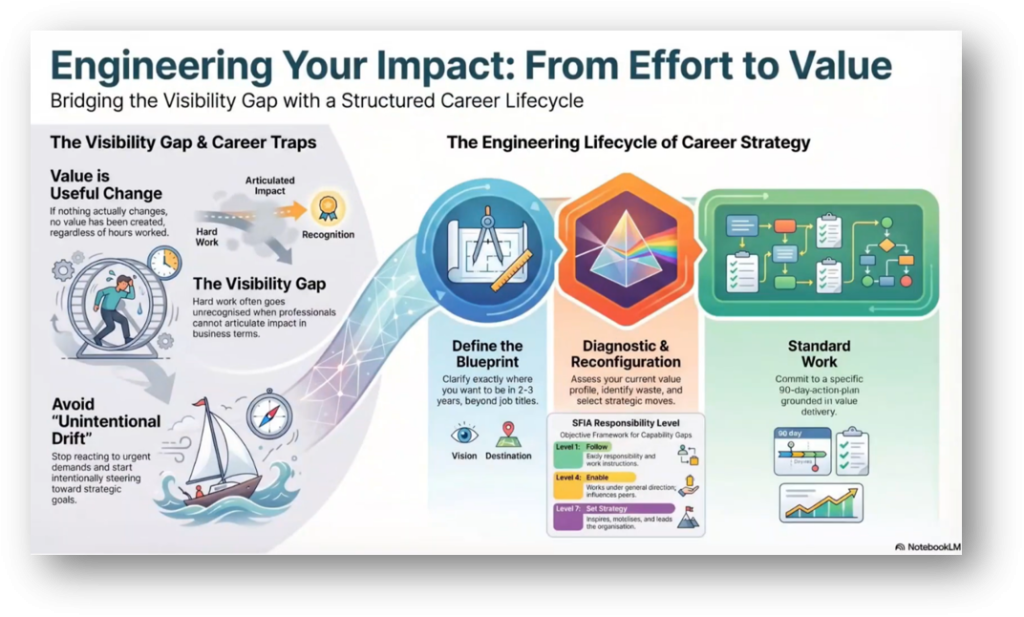
Figure 1 Engineering Your Impact: from Effort to Value
How do You Define a Proactive Career Lifecycle?
Building a proactive career means picking a destination that’s bigger than your next job title.
Frameworks like SFIA (Skills Framework for the Information Age) help here, mapping progression from following instructions at Level 1 to setting strategy at Level 7.
A 90-day action plan built around value delivery keeps you out of “the grind”, the endless cycle of non-value work like fixing technical debt that never quite ends.
Key Takeaways
- Career planning must focus on broader destinations, like thought leadership, rather than just sequential job titles.
- The SFIA framework helps categorise professional responsibility levels.
- 90-day action plans keep professionals focused on high-value delivery.
FAQ
- What is “the grind” in a career lifecycle? It’s the non-value-adding work, repetitive technical fixes and the like, that causes career drift and keeps you from delivering anything measurable.

Figure 2 The Visibility Gap
How can Professionals Achieve Career Visibility Effectively?
You build career visibility by identifying who benefits from your work and agreeing with them on the value you deliver.
Take these value definitions to your manager, who should be acting as a “growth architect”, so you get continuous feedback and stay aligned with stakeholders.
Autonomy has to be earned by showing you can manage your own work. Strict return-to-office policies are often a company’s response to teams that haven’t shown they can.
Key Takeaways
- Visibility requires defining beneficiaries and validating value with them.
- Managers should act as growth architects, backing professional development.
- Autonomy is earned by mastering self-management and business skills.
FAQ
- How can employees increase their visibility at work? Run weekly work audits, sort tasks by the value they add, and share the results with leadership.

Figure 3 Leadership & Thought Leadership

Figure 4 SFIA: the Global Skills Framework

Figure 5 How can I Develop these in my Career?
Are Return-to-office Mandates Driven by Mistrust?
Return-to-office mandates are often less about productivity data and more about leadership mistrust.
Remote work has real, measurable benefits: commute time that used to be stressful becomes time for personal activities or extra work.
A lot of these mandates come down to money: companies stuck with expensive, half-empty office leases. If you want to make the case for remote flexibility, a work audit is how you prove the value you’re delivering.
Key Takeaways
- Return-to-office mandates are often driven by a lack of managerial trust.
- Remote work cuts out the commute, which helps employee well-being.
- Work audits provide the empirical data needed to justify remote work.
FAQ
- Why do companies push for return-to-office mandates? Beyond mistrust, companies are often just trying to justify the office space they’re already paying for.

Figure 6 The Engineering Lifecycle of Career Strategy
How can I Align my Career with Company Strategy?
A structured career workbook lets you assess where you stand, define where you’re headed, and line that up with organisational strategy in a way that works for both sides.
Look at your personal work portfolio, and you can cut redundant tasks and build a “career menu” of high-value initiatives on purpose, not by accident.
Whatever career path you choose, it needs to line up with the company’s digital and data strategy, or you risk sinking time into skills that go obsolete.
Key Takeaways
- Career workbooks help diagnose current value and plot future destinations.
- Professionals should design a “career menu” of preferred, high-value work.
- Skill development should keep pace with organisational data strategy.
FAQ
- How does a career workbook help professionals? It helps you catalogue your work, link daily effort to project scoring, and build a two-to-three-year plan aimed at somewhere specific.

Figure 7 Helper Tool

Figure 8 Your Journey – the 14 Steps of the KYV Workbook
What is Your Professional Value Proposition Strategy?
A strong professional value proposition spells out the change delivered, who benefits, and the metric that proves it worked.
Doing fewer tasks can actually generate more business value, as long as you stay focused on strategic, measurable change.
When you’re pinning down the financial or operational impact, start with a broad estimate and narrow it as you go, through delivery and feedback.
Key Takeaways
- Value propositions define the action, the capability improved, and the metric impacted.
- Working fewer hours can yield more value if aligned correctly.
- Value metrics can be iterative, starting broad and narrowing over time.
FAQ
- What is the formula for articulating professional value? The formula reads: “For [beneficiary], I provide [change] by executing [action], achieving [measurable metric].”

Figure 9 The Value Position: Measuring and Articulating Your Impact

Figure 10 Importance of Measuring
How do Personal and Career Values Influence Success?
Personal value shapes your habits and long-term goals outside work, while career value shapes your professional identity and expertise.
Work creates tangible value in a few recognisable ways: new value creation, risk protection, capability enablement, system optimisation, and evidence-based learning.
To measure success accurately, track operational indicators such as lead times, defect rates, and cost-to-serve.
Key Takeaways
- Personal value is separate from job titles and organisational roles.
- Work taxonomy categorises value into creation, protection, enablement, and optimisation.
- Value is proven through hard operational efficiency and risk reduction metrics.
FAQ
- What is the difference between shareholder value and stakeholder value? Shareholder value leans on financial metrics like cash flow and cost-to-income ratios. Stakeholder value covers more ground: customer satisfaction, employee turnover, and similar impacts.

Figure 11 What do I Value?

Figure 12 Redefining Value as Useful Change

Figure 13 Value Taxonomy: Shareholder Value and Stakeholder Value

Figure 14 Position Types of Value: Six Ways Work Creates Value
How do Individual Tasks Align with Business Strategies?
Strategic alignment means connecting your daily tasks directly to the bigger business, digital, and data strategies.
Instead of dreading the annual review, proactive employees set up monthly feedback loops with the people who benefit from their work, so value gets validated as it happens.
Whether your knowledge is deep and “T-shaped” or broad and “comb-shaped”, you need to be able to say exactly how your skill set solves a specific business problem.
Key Takeaways
- Individual initiatives must map directly to top-level business strategies.
- Monthly feedback takes the dread out of the annual review.
- Professionals must customise their value statements for different areas of expertise.
FAQ
- How should employees handle year-end performance appraisals? Document the value you deliver continuously, and get monthly validation from stakeholders, so appraisal time holds no surprises.

Figure 15 Strategy – Line of Sight: Strategic Alignment

Figure 16 What am I Value for?

Figure 17 A Simple Value Statement Formula

Figure 18 The Win-win Zone

Figure 19 What Does Your Company Value?

Figure 20 The Structural Tension
Is Personal Growth Aligned with Organisational Efficiency?
The win-win zone is where your own desire for growth overlaps with the organisation’s need for revenue and efficiency.
Getting there means cutting non-value-adding activities and automating the mandatory compliance work, before it burns you out.
Real business leadership is about delivering measurable outcomes for clients, not maximising billed hours for a short-term win.
Key Takeaways
- The win-win zone combines high personal growth with high organisational value.
- Plan to reduce, automate, or stop non-value-adding work.
- Client outcomes must take precedence over raw billable hours.
FAQ
- What happens if an employee does too much non-value-adding work? Get stuck doing too much non-value work and your career stalls. Do too little value-adding work and you disappear from leadership’s radar, which puts your job at risk.
- Key Takeaways
- What Defines Value in the Professional Workplace?
- How do You Define a Proactive Career Lifecycle?
- How can Professionals Achieve Career Visibility Effectively?
- Are Return-to-office Mandates Driven by Mistrust?
- How can I Align my Career with Company Strategy?
- What is Your Professional Value Proposition Strategy?
- How do Personal and Career Values Influence Success?
- How do Individual Tasks Align with Business Strategies?
- Is Personal Growth Aligned with Organisational Efficiency?


