Key Takeaways
- Articulate and measure value clearly: Utilise a “Value Statement Formula” for stakeholder feedback on impact, skills, and measurable outcomes.
- Prioritise and protect “Deep Work”: Prioritise uninterrupted deep thinking by designating spaces, disabling distractions, and scheduling focus time in advance.
- Audit and classify daily capacity: Utilise a “Productivity Hub” to colour-code tasks, ensuring time spent adds tangible value.
- Minimise the cognitive cost of context switching: Interruptions create “attention residue,” lingering focus on prior tasks, disrupting flow for 20-30 minutes.
- Establish a daily operating rhythm: Establish a daily routine: morning prep, lunchtime review, and evening closure to reduce stress.
- Use AI strategically but maintain human context: AI tools like Claude excel at summarising tasks, but avoid fully automating your responses.
- Prepare for unexpected offline time: In interruptions like power outages, use paper flowcharts or walks to maintain productivity and problem-solve.
Webinar Details
Title: Data Talent Strategy for Data Citizens
Date: 2026-07-09
Presenter: Howard Diesel
Meetup Group: African Data Management Community
Write-up Author: Howard Diesel
How can a Productivity Hub Enhance Employee Value?
Understanding the true value employees contribute to an organisation requires structured auditing tools like a “Productivity Hub”. This section explains how data citizens can track their daily work rhythms to maximise business value.
The Productivity Hub is a critical asset that helps workers audit their tasks, identify peak energy times, and prepare effectively for their day. By tracking when they feel drained or when they are burdened by meetings, employees can align their schedules for optimal output. Before diving into reactive platforms like email, Teams, or WhatsApp, professionals should intentionally structure their morning routines to prevent digital distraction. This structured approach enables a “growth architect” to define data initiatives and ensure employees spend their time delivering strategic value.
Key Takeaways
- Use a Productivity Hub to audit daily work and energy levels.
- Limit exposure to distracting platforms at the start of the workday.
- Align daily tasks with strategic business initiatives.
FAQ
- What is a Productivity Hub? A Productivity Hub is an audit tool used to track daily tasks, manage energy rhythms, and align individual work with broader business strategies.
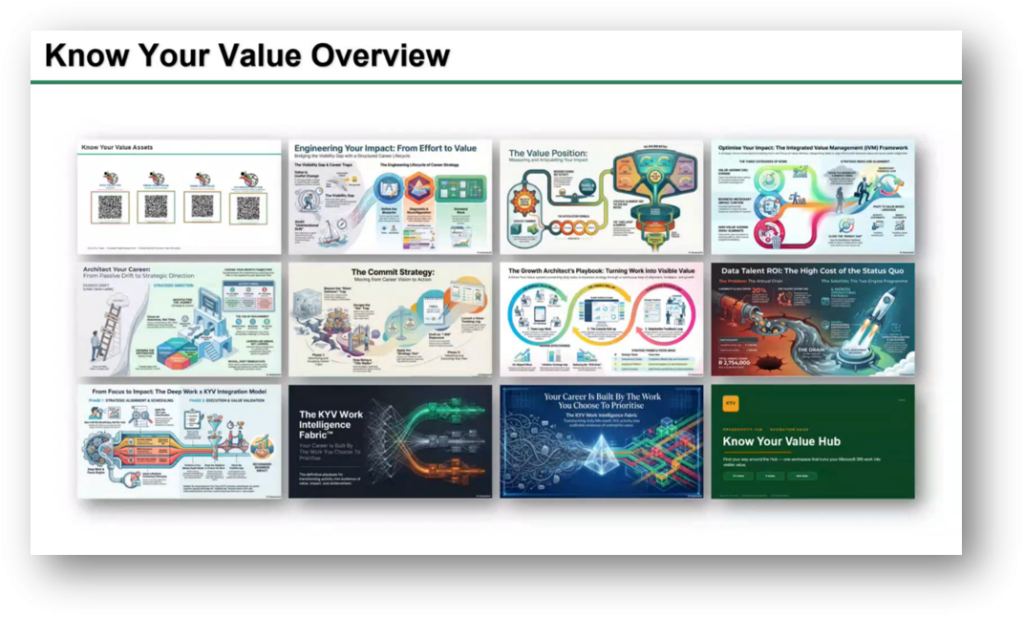
Figure 1 Know Your Value Slide Deck

Figure 2 Know Your Value Assets

Figure 3 Modelware Asset Navigator
What is the Value Statement Formula’s Purpose?
A Value Statement Formula is a structured method for professionals to clearly articulate the impact of their work. To ensure daily tasks align with business strategy, employees must shift from counting hours worked to measuring tangible outcomes.
The core formula requires identifying four elements: the beneficiary, the useful change delivered, the capabilities used, and the resulting metrics. For example, an industrial engineer might state: “For the assembly line, I deliver a 12% throughput increase by redesigning changeovers, resulting in +8 OEE points”. If professionals cannot define who benefits from their work and what changes occur, they risk operating without purpose. Ultimately, connecting individual goals to broader strategic themes keeps employees in a productive “win-win zone”.
Key Takeaways
- Stop measuring productivity by hours spent in meetings.
- Clearly identify the beneficiary and measurable impact of every task.
- Connect individual goals to high-level strategic objectives.
FAQ
- How do you write a value statement? A value statement defines the beneficiary, the useful change provided, the specific actions taken, and the measurable evidence or metrics of success.

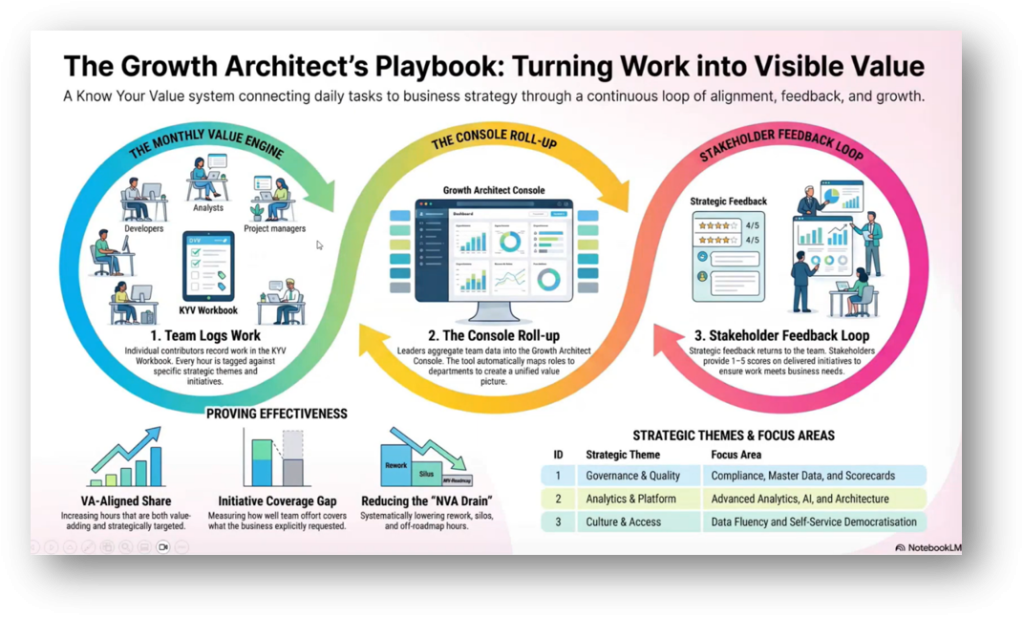
Figure 4 The Growth Architect’s Playbook: Turning Work into Visible Value

Figure 5 The Articulation Formula

Figure 6 The Value Position: Measuring and Articulating Your Impact
How can we Optimise Environments for Deep Work?
To combat the distractions of modern technology and AI, professionals must cultivate physical and digital environments optimised for “deep work”. MIT professor Cal Newport’s research highlights the danger of constantly engaging with machines at the expense of our own deep thinking.
Creating a dedicated deep work environment often requires strict physical and digital boundaries. One effective strategy involves using two separate desks: a “digital desk” for computer work and a “non-digital desk” for focused, distraction-free thinking. When engaging in deep work, professionals should actively disconnect by turning off communication applications like WhatsApp, Microsoft Teams, and email. Blocking out specific focus times in a calendar further safeguards your capacity to concentrate.
Key Takeaways
- Over-reliance on AI can diminish independent, deep thinking.
- Separate digital and non-digital workspaces to improve focus.
- Actively switch off communication tools during deep work sessions.
FAQ
- What is a two-desk system for productivity? It is a workspace setup featuring one desk for digital tasks (like email and coding) and a separate, screen-free desk dedicated entirely to focused thinking and problem-solving.

Figure 7 ‘Deep Work: Rules for Focused Success in a Distracted World’ by Cal Newport
How can we Maximise Productivity through Task Classification?
To maximise productivity, professionals must audit their daily capacity by actively classifying tasks and enforcing strict personal boundaries. Categorising work provides a clear visual representation of where time is spent versus where value is generated.
A highly effective classification method involves colour-coding calendar events: green for “value-add” tasks, red for “non-value-add” distractions, and orange for necessary “business non-value-add” administrative work. By extracting these colour-coded entries into a work audit, individuals can precisely track their valuable output. Furthermore, sustaining long-term productivity requires strict personal boundaries. For example, completely shutting down digital devices by 5:30 PM protects family time, while shifting deep work to early morning hours (e.g., 3:00 to 5:00 AM) can provide distraction-free focus.
Key Takeaways
- Colour-code calendar tasks to audit daily value generation.
- Identify and minimise “non-value-add” (red) activities.
- Establish firm daily cutoff times to protect personal well-being.
FAQ
- What is “business non-value-add” work? It refers to necessary administrative tasks, categorised as orange in a calendar audit, that keep the business running but do not directly generate strategic value.

Figure 8 The Value Engine: Integration Blueprint
How can we Accurately Measure Professional Value?
Accurately measuring professional value requires a “reverse assessment” process that relies on direct stakeholder feedback rather than self-evaluation. This ensures that deliverables meet actual business needs and expectations.
Once a data initiative is complete, the professional assesses their own work, but true validation comes from the project stakeholder. This feedback loop prevents individuals from either underrating or overrating their contributions. To evaluate both hard deliverables and critical soft skills, organisations can utilise the SFIA (Skills Framework for the Information Age). The SFIA framework allows professionals to rank their business acumen, autonomy, and ability to manage complex work when engaging with business stakeholders.
Key Takeaways
- Do not rely solely on self-assessment to measure work value.
- Seek “reverse assessments” directly from project stakeholders.
- Use the SFIA framework to evaluate essential soft skills and business acumen.
FAQ
- What is the SFIA framework? The Skills Framework for the Information Age (SFIA) is a global competency standard used to assess a professional’s technical abilities, soft skills, autonomy, and business acumen.

Figure 9 Stakeholder Feedback
How can Professionals Ensure Recognition for Deep Work?
Without clearly articulated value statements, deep work remains invisible to management, creating a “visibility gap” where intense effort goes unrecognised. Professionals must proactively protect their time and document their outcomes to ensure proper recognition.
Protecting focus requires blocking out calendar time weeks in advance. However, simply reserving time is insufficient if that time is wasted on non-value-add distractions. Scheduled focus time must be converted into measurable outcomes. When professionals fail to communicate the results of their intense, 14-hour days, they risk drifting away from the “win-win zone”—a state that balances personal growth with clear business value. Evaluating progress along the seven levels of the SFIA framework helps map continuous capability growth.
Key Takeaways
- Block out deep work sessions on your calendar weeks in advance.
- Document measurable outcomes to ensure deep work becomes visible to leadership.
- Strive for the “win-win zone” to balance business value with personal growth.
FAQ
- What is the visibility gap in deep work? The visibility gap occurs when an employee performs intense, focused work but fails to articulate the resulting value, leaving their efforts unnoticed by stakeholders.

Figure 10 Engineering Your Impact: from Effort to Value

Figure 11 Know Your Value: System Optimisation for Your Career
How does an Operating Rhythm Reduce Work Anxiety?
Establishing a consistent “operating rhythm” is essential for maintaining daily focus and preventing work-related anxiety from disrupting sleep. A structured daily routine provides predictable check-ins that keep projects aligned with strategic goals.
An effective operating rhythm consists of morning preparation, a lunchtime review of ongoing deep work, and an evening close-out to assess the value delivered. Without a closing routine, professionals often suffer from “chasing the wind”—lying awake at night trying to mentally resolve unfinished work issues. To combat this nighttime stress, individuals can keep a pen and paper beside their bed to quickly jot down distracting thoughts, allowing them to return to sleep and address the problem in the morning.
Key Takeaways
- Implement a daily rhythm: morning prep, lunchtime review, and evening close-out.
- End the workday with a clear assessment of what value was achieved.
- Use bedside notes to capture late-night work anxieties and protect sleep.
FAQ
- What does “chasing the wind” mean in a work context? “Chasing the wind” refers to the futile and exhausting practice of lying awake at night trying to mentally solve work problems instead of sleeping.

Figure 12 From Focus to Impact: The Deep Work x KYV Integration Model

Figure 13 Daily Rhythm
How does Context Switching Affect Productivity and Focus?
Context switching between tasks creates “attention residue,” a cognitive drag that severely diminishes productivity and focus. Managing both internal and external interruptions is crucial for maintaining a state of flow.
When a professional pauses a complex task to answer a quick message, they carry lingering thoughts of the first task into the second. Returning to complex work, such as coding or deep analysis, can take 20 to 30 minutes just to regain initial focus. For unavoidable external interruptions—like power outages—professionals should prepare non-digital backup methods. Transitioning to pen-and-paper flowcharting or taking a walk to problem-solve ensures that progress continues even when digital tools are unavailable.
Key Takeaways
- Avoid context switching to prevent the cognitive drag of “attention residue”.
- Recognise that regaining deep focus after an interruption can take up to 30 minutes.
- Prepare non-digital work methods, like paper planning, for unexpected technological failures.
FAQ
- What is attention residue? Attention residue is the lingering cognitive focus left on a previous task after you have been interrupted or switched to a new task, making it difficult to fully concentrate.

Figure 14 The Value Engine: An Operating Discipline for the Modern Corporate Professional

Figure 15 Focus is the Bridge from Effort to Measurable Change

Figure 16 Meeting Compressor

Figure 17 Attention is Not a Free Resource

Figure 18 The Corporate Constraint: Systemic Overload

Figure 19 Deep does not always Mean Valuable; Shallow does not always Mean Waste

Figure 20 Selecting a Corporate Focus Architecture
How can we Maximise Focus with Rituals?
Maximising focus requires intentional entry rituals and careful implementation of AI automation tools to prevent loss of human context. Structuring the start of tasks guarantees clear deliverables and defined boundaries.
Professionals should utilise a “5-minute entry ritual” before starting deep work to explicitly define the task’s beneficiary, the expected deliverable, and the exit condition. While AI tools like Claude can expertly summarise daily emails to reduce inbox fatigue, professionals must be wary of fully automating their outbound communications. Relying on instant, mechanical AI agents to reply to emails often strips away essential human context and can severely damage stakeholder relationships. True productivity blends strategic automation with intentional, human-driven deep work.
Key Takeaways
- Use a 5-minute entry ritual to define a task’s goals and boundaries before starting.
- Leverage AI to summarise communications and identify priority emails.
- Avoid fully automating interpersonal responses, which can seem mechanical and alienate stakeholders.
FAQ
- What is a 5-minute entry ritual? It is a brief planning session immediately before starting a task to define who benefits from the work, what the final deliverable is, and what signals the task’s completion.

Figure 21 Step One & Two: Target and Classify Capacity

Figure 22 Step Three & Four: Protect the Menu and Trigger the State

Figure 23 Step Five & Six: Contain Friction and Measure Momentum

Figure 24 Step Seven: Articulate and Validate

Figure 25 The Illusion of Productivity Hides True Strategic Impact

Figure 26 The Daily Rhythm Translates Intent into Execution
- Key Takeaways
- How can a Productivity Hub Enhance Employee Value?
- What is the Value Statement Formula's Purpose?
- How can we Optimise Environments for Deep Work?
- How can we Maximise Productivity through Task Classification?
- How can we Accurately Measure Professional Value?
- How can Professionals Ensure Recognition for Deep Work?
- How does an Operating Rhythm Reduce Work Anxiety?
- How does Context Switching Affect Productivity and Focus?
- How can we Maximise Focus with Rituals?


