
Key Takeaways
- Transitioning from Firefighting to Reliability: Organizations need to prioritise stable data pipelines to reduce financial losses and engineer burnout.
- The Six-Phase Data Lifecycle Framework: Creating a sustainable data architecture involves six phases: Plan, Engineer, Ingest, Observe, Test, and Cultivate.
- Designing for Longevity and Automation: Platforms must be designed to function autonomously without relying on daily manual interventions or individual “heroes”.
- Strict Environment Isolation: Maintain identical Development, Testing, and Production environments using tools like Docker or Kubernetes for reliability.
- Smart Recovery and CI/CD: Implement “smart recovery” in pipelines for automatic backfilling and utilise CI/CD for continuous updates.
- Cultivating an Engineering Culture: Reliability hinges on team culture, prioritising empathy, progress, and clear, dynamic documentation of purpose.
- Scalability and Cost Reduction: Small teams can efficiently manage extensive workloads, minimising pipeline failures and significantly reducing processing costs.
- Rigorous Data Privacy Management: To meet GDPR, sensitive data and PII must be securely isolated and inaccessible for analytics.
Webinar Details
Title: The Reliable Data Platform Framework: Engineering Data Platforms That Last with Attia Elsayed
Date: 2026-06-29
Presenter: Attia Elsayed
Meetup Group: Book Launch with Technics Pub x MWS
Write-up Author: Howard Diesel
Is a Reliable Data Platform Crucial for Success?
A reliable data platform framework eliminates continuous firefighting and stabilises the entire data lifecycle.
Companies struggling with fragile data pipelines suffer from severe financial losses, eroded executive trust, and widespread engineer burnout. Transitioning to a reliable, six-phase framework prevents these daily failures. It allows data engineers to focus their time on innovation and business value rather than constantly writing temporary scripts to fix broken data feeds.
Key Takeaways
- Reliability is the foundation of any truly data-driven organisation.
- Constant “firefighting” causes costly engineering burnout and destroys leadership trust.
FAQ
- What is a reliable data platform framework? It is a systematic, six-phase approach designed to process data dependably across its lifecycle without requiring constant manual intervention.
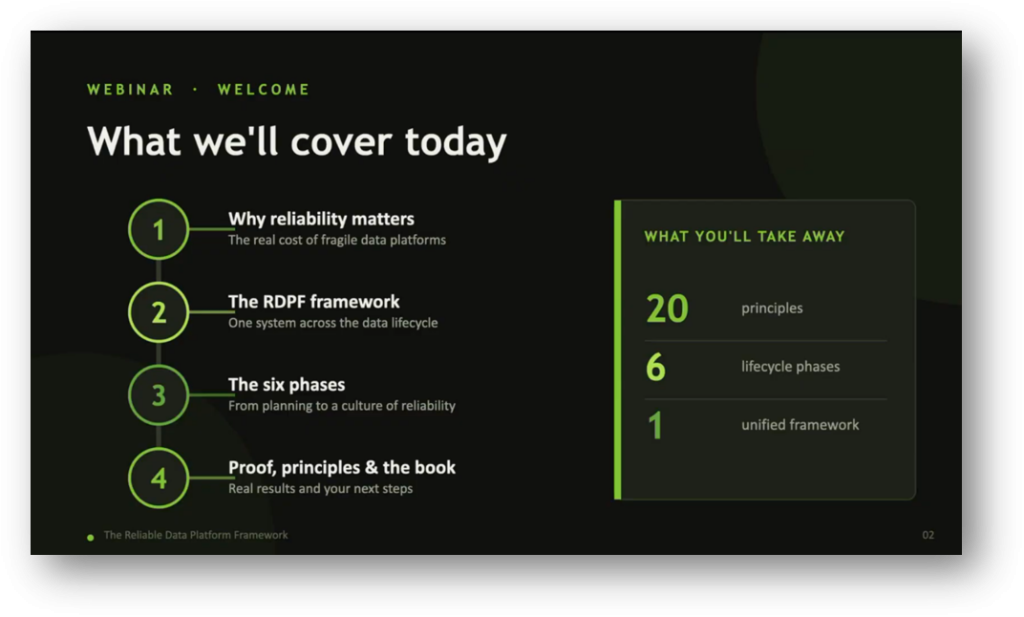
Figure 1 What we’ll Cover Today

Figure 2 Why this Framework Exists: Born under Pressure – not in Theory

Figure 3 The Stakes: The Hidden Cost of Unreliable Data

Figure 4 The Shift from Firefighter to Architect
How can Data Teams Build Trust Effectively?
Building trust in a data team requires demonstrating platform reliability through targeted pilot projects and eliminating wasted effort.
Unreliable data pipelines cost organisations dearly, with industry estimates suggesting up to 60% of data engineering time is wasted on rebuilding broken systems. To combat this frustration and restore executive confidence, data leaders must deliver targeted solutions that align clearly with business strategy. Understanding the specific nature of the data needed—whether real-time or batch processing—enables teams to build custom solutions that fulfil exact business objectives.
Key Takeaways
- Rebuilding broken pipelines consumes massive amounts of engineering resources.
- Executive trust is restored by clarifying business requirements and executing highly reliable pilot projects.
FAQ
- How do you build executive trust in data platforms? By deeply understanding the overarching business strategy, confirming exact requirements, and consistently delivering accurate insights on time.
What Ensures Longevity in a Data Platform Design?
The foundation of a lasting data platform requires designing for longevity and isolating code through strict staging environments.
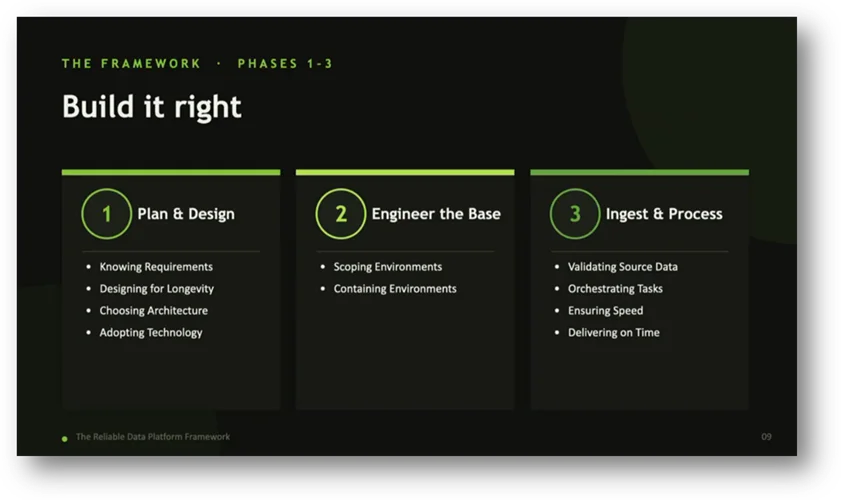
The data lifecycle framework begins with meticulous planning (Phase 1) and robust engineering (Phase 2). Designing for longevity means eliminating manual dependencies, so systems survive employee absences and holidays seamlessly. Organisations must select tools and architectures based strictly on their unique use cases. Crucially, the engineering phase demands three isolated environments—development, testing, and production—to ensure unstable code never touches live data.
Key Takeaways
- Design systems that operate autonomously without daily manual intervention from staff.
- Use strictly separated environments to test code and prevent catastrophic production failures.
FAQ
- Why is environment isolation important in data engineering? Separating development, testing, and production ensures that unreliable scripts or untested features are caught before they can corrupt live business data.

Figure 5 The Framework at a Glance: One Framework Across the Full Data Lifecycle

Figure 6 The Framework Phase 1-3: Build it Right
How does Phase 3 Validate Source Data Efficiently?
Phase 3 focuses on validating source data prior to ingestion and utilising containerization to manage platform dependencies.
Before moving data, automated pipelines must validate the source data’s type, structure, and size to catch schema drafts early. Efficiently orchestrating these tasks ensures data is processed at the proper speed, resolving external issues like API bottlenecks that delay crucial insights. Utilising containerization tools, such as Docker or Kubernetes, allows teams to create truly identical deployment environments and effortlessly scale system dependencies.
Key Takeaways
- Validate source data structures automatically prior to ingestion to prevent pipeline breaks.
- Containerization ensures identical dependency management across scaling server environments.
FAQ
- How does containerization help data platforms? It ensures that deployment environments are completely identical regarding operating systems and dependencies, significantly increasing system reliability.
How do Robust Platforms Manage Data Recovery Effectively?
Robust platforms utilise automated smart recovery and strict CI/CD pipelines to manage continuous updates and data failures safely.
During the Observe and Operate phase, pipelines must recover smartly from external source failures. Instead of relying on manual scripts to fetch missed data after a vendor outage, systems should automatically detect historical gaps and backfill the data. The Test and Release phase manages the inevitable evolution of data structures through automated Continuous Integration and Continuous Deployment (CI/CD). All deployments should be strategically timed to avoid disrupting active business operations.
Key Takeaways
- Implement smart recovery to automatically backfill missing data after source outages.
- Use CI/CD practices to automate testing and safely deploy continuous platform features.
FAQ
- What is smart recovery in data pipelines? It is the automated ability of a pipeline to detect missing historical data and retrieve it sequentially without any manual engineering interference.

Figure 7 The Framework Phases 4-6: Run it Reliably
How does culture impact data platform reliability?
A highly reliable data platform relies on dynamic documentation, communication in code, and a team culture of empathy and progress.
Technical excellence must be paired with a strong engineering culture. “Communication in the code” means comments should explain the purpose behind a script, not just its basic mechanics. Furthermore, documentation should be dynamic, automatically tracking the lifecycle and evolution of pipelines rather than relying on forgotten static text files. Teams should adopt guiding mindsets like “systems over heroes” (removing dependency on a single expert) and prioritise “empathy over blame” when errors occur.
Key Takeaways
- Code comments should clearly explain the business purpose behind data transformations.
- Prioritise automated, dynamic data tracking over static, manually written documentation.
- Build resilient systems that operate independently of any single “hero” engineer.
FAQ
- What does “communication in the code” mean, and why is it important for a reliable data platform? Communication in code emphasises comments explaining intent, enhancing collaboration, troubleshooting, and overall project success.

Figure 8 The Mindset that Lasts: to Continue Great Work
How do Small Teams Manage Massive Data Pipelines?
The reliability framework is completely technology-agnostic, allowing exceptionally small teams to manage massive data pipelines effectively.
Whether a company uses Kimball, Data Vault, or operates strictly on-premise for high-security constraints, the core reliability principles remain exactly the same. By strictly adhering to these operational standards, lean teams can achieve massive output. For example, a three-person engineering team can reliably manage over 300 daily pipelines across 11 diverse global markets. Additionally, generating strict metadata records ensures executives can easily verify data integrity and regulatory compliance.
Key Takeaways
- Core reliability principles apply regardless of chosen data architectures or proprietary tools.
- Automated frameworks empower very small engineering teams to scale their operations massively.
FAQ
- Does the framework require a specific data architecture? No, the conceptual phases can be applied across various methodologies and deployment types, including highly secure, offline on-premise setups.
How can we Secure Executive Support for Data?
Sustaining executive support for data initiatives requires delivering measurable, long-term stability and significant cost reductions.
Executives frequently lose patience with lengthy data modelling projects if they do not see immediate or consistent results. Data teams can secure ongoing leadership support by achieving massive reliability milestones—such as running automated pipelines for over 1,000 to 4,000 consecutive days without manual intervention. Furthermore, fixing root causes rather than continuously applying temporary patches optimises pipeline performance and can reduce platform processing costs by up to 90%.
Key Takeaways
- Demonstrating zero-failure operational milestones builds long-term executive confidence.
- Optimising pipelines to resolve root causes drastically reduces cloud computing and processing costs.
FAQ
- How do you maintain executive patience for lengthy data projects? By providing uninterrupted, high-quality insights and demonstrating measurable reductions in platform operating costs.

Figure 9 Proof the Framework Works: Reliability you can Measure
How should Data Governance be Maintained Consistently?
Strict data governance and privacy regulations must be maintained identically across all development, testing, and production environments.
While most deployments should utilise automated CI/CD pipelines, manual tests must serve as a backup for incompatible visual tools to prevent production harm. When addressing data privacy, adhering to regulations like GDPR requires isolating Personally Identifiable Information (PII) at the earliest raw data layer. This highly sensitive data must remain locked and excluded from analytics across all environments (staging, development, and production) unless explicitly authorised by a Data Protection Officer.
Key Takeaways
- Always have a manual rollback plan if automated CI/CD deployments face tool-specific obstacles.
- PII must be completely isolated from analytical workflows across all environments.
FAQ
- How should sensitive data be handled in staging environments? PII should be entirely locked down or stripped uniformly across development, staging, and production to guarantee legal compliance.

Figure 10 Thank you: Questions
- Key Takeaways
- Is a Reliable Data Platform Crucial for Success?
- How can Data Teams Build Trust Effectively?
- What Ensures Longevity in a Data Platform Design?
- How does Phase 3 Validate Source Data Efficiently?
- How do Robust Platforms Manage Data Recovery Effectively?
- How does culture impact data platform reliability?
- How do Small Teams Manage Massive Data Pipelines?
- How can we Secure Executive Support for Data?
- How should Data Governance be Maintained Consistently?


