Key Takeaways
- AI Value Starts at Selection: Strategic value needs to be defined right at the start of use case selection, not assessed after the fact.
- Shifting from Narrative to Evidence: Organisations often get stuck in “POC Purgatory,” and structured, evidence-based evaluation is what breaks the decision paralysis behind it.
- The Value and Readiness Framework: A structured 12-step approach puts business value first, then assesses readiness to support genuinely innovative ideas.
- Bridging the IT-Business Divide via “Evals”: Use cases tend to fail when solutions aren’t aligned with business workflows and metrics, which is exactly what collaboration fixes.
- Managing Granularity and Portfolio Governance: Business units should unify AI projects for effective governance, evaluating their combined strategic impact rather than looking at each in isolation.
- End-to-End Business Architecture Alignment (The Spine): High-trust AI projects need a cohesive framework that links use cases to stakeholders, capabilities, and KPIs.
- Standardised Controls and Rapid Drafts: Established frameworks let organisations draft business architecture and AI use cases in as little as seven days.
Webinar Details
Title: AI Value Starts at Selection with Mario Cantin Part One
Date: 2026-08-20
Presenter: Howard Diesel & Mario Cantin
Meetup Group: African Data Management Community
Write-up Author: Howard Diesel
How does Canada’s AI Strategy Enhance Adoption?
The Canadian National AI Strategy aims to accelerate state-level AI adoption by training leaders, from executives down to data specialists, with the core objective of raising organisational AI integration from 12% to 60%. Public and private sectors alike keep failing to deploy models, though, mainly because they can’t identify or select viable use cases in the first place. Strategic value must be established at the selection phase, not after development is already underway.
National AI Strategy: A government framework designed to scale AI capabilities, standards, and adoption across public and private sectors.
Key Takeaways
- Canada’s national policy targets a rise in AI adoption from 12% to 60%.
- Organisations struggle with the initial identification and selection of AI use cases.
- AI value begins at selection, requiring disciplined executive decision-making.
FAQ
- What is the main objective of Canada’s National AI Strategy? The strategy aims to increase national AI adoption from 12% to 60% by helping organisations effectively select and deploy AI use cases.
- Where does AI project value originate? Value starts at the selection phase, where leaders must qualify use cases before committing resources.
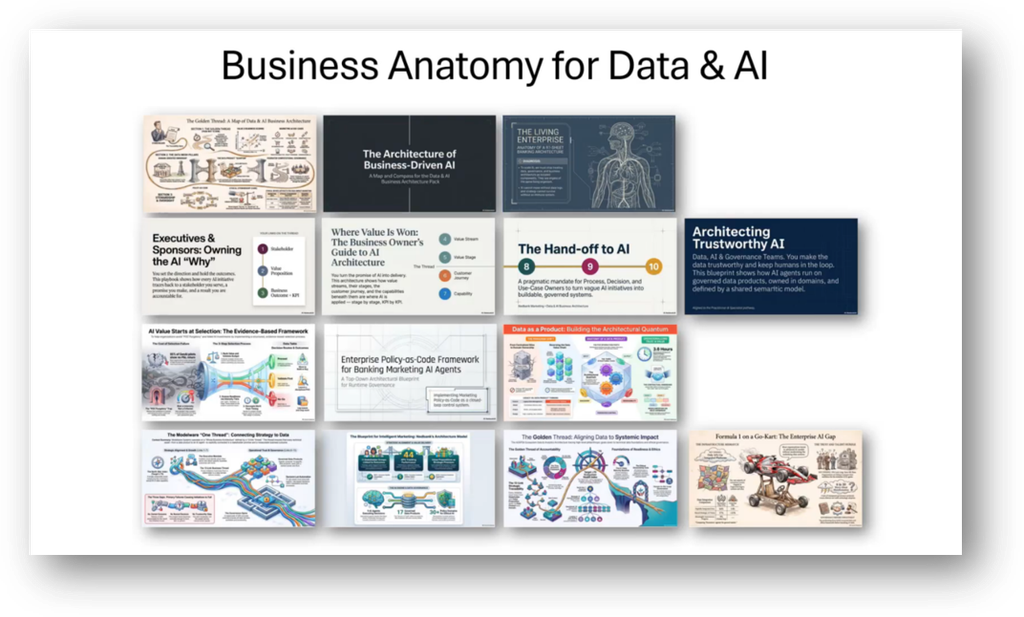
Figure 1 Business Anatomy for Data & AI

Figure 2 AI Value Starts at Selection: The Evidence-based Framework
What Causes Decision Paralysis in AI Implementation?
Decision paralysis is what keeps organisations from implementing AI, trapping projects in “POC Purgatory.” Decision-makers get stuck fearing mistakes, given the complex risks, compliance requirements, and lack of structured evidence involved. Breaking that cycle means moving from narrative-based, qualitative pitches toward objective, evidence-based selection.
POC Purgatory: A state where an organisation runs numerous experimental Proof of Concept (POC) projects but fails to transition any of them into production.
Decision Paralysis: Inaction caused by the fear of regulatory, technical, or financial failure.
Key Takeaways
- Fear of failure and risk compliance lead to decision paralysis.
- Over-reliance on qualitative, 200-page narrative-based documents stalls deployment.
- Unmitigated data breaches can freeze an entire organisation’s AI pipeline.
FAQ
- What causes “POC Purgatory” in corporate AI? POC Purgatory occurs when organisations cannot make deployment decisions due to a lack of objective evaluation evidence.
- How do leaders resolve AI decision paralysis? Leaders must shift from subjective narratives to structured, evidence-based decision frameworks.
How can Organisations Select the Right AI Use Cases?
Selecting the right AI use cases takes a structured Value and Readiness Framework. Prioritising risk first tends to kill innovation, so leaders should anchor decisions in business value instead. Once value is established, the organisation can evaluate readiness through a tiered assessment model, light, standard, or deep, calibrated to the project’s potential impact.
Value and Readiness Framework: A 12-step decision-making model that prioritises business value first, followed by tiered organisational readiness assessments.
Tiered Assessment: A non-dogmatic approach where low-risk projects receive light reviews and high-impact projects undergo deep compliance testing.
Key Takeaways
- Always evaluate business value as the primary anchor before evaluating risk.
- Calibrate readiness reviews (light, standard, deep) to prevent compliance bottlenecks.
- Dogmatic, one-size-fits-all compliance reviews kill viable business cases.
FAQ
- Why shouldn’t organisations select AI use cases based on risk first? Selecting based on risk first freezes innovation; evaluating value first defines what is worth de-risking.
- What is the most important element of the readiness framework? The tiered “light, standard, and deep” approach, which adapts assessment intensity to project risk.

Figure 3 Business Architecture for Data & AI

Figure 4 AI Value isn’t Lost in Delivery. It’s Lost at Selection.

Figure 5 AI Use Case Selection Framework
How does Portfolio Governance Ensure Strategic Alignment?
Preventing business units from bypassing governance means portfolios need to stay strictly aligned with strategic outcomes. Department heads often split complex, high-risk AI projects into small, low-impact tasks specifically to dodge deep compliance checks, which is why portfolio governance evaluates split components by their combined end-state impact and strategic alignment, not each piece in isolation.
Project Granularity: The scale at which a project is defined, from micro-tasks to enterprise-wide initiatives.
Portfolio Governance: The centralised management of AI projects to ensure they collectively deliver business value and respect safety standards.
Key Takeaways
- Splitting large AI projects is useful for execution but risky for governance.
- Assess organisational readiness based on the combined end-state impact of all sub-projects.
- Discard micro-projects that fail to map clearly to strategic business outcomes.
FAQ
- How do business units bypass AI governance? Business units bypass governance by breaking complex projects into small, low-impact parts that look low-risk.
- How do you govern split AI projects? Evaluate the combined readiness and cumulative impact of all integrated parts, rather than assessing each micro-project in isolation.
How does the IT-Business Divide Affect AI Projects?
AI use cases often fail because of the IT-Business divide, where IT ends up promoting technology in search of a problem to solve. When technologists drive selection, projects tend to lack business metrics and end up with unconvincing financial cases. Closing that divide means businesses establishing clear, non-technical evaluations (evals) that measure decision-making and operational quality directly.
IT-Business Divide: The misalignment between technical teams pushing tools and business teams requiring functional, value-driven solutions.
Evals (Evaluations): Systematic metrics used to check if an AI model achieves intended business quality and operational outcomes.
Key Takeaways
- Never select AI use cases solely on risk; evaluate readiness against risk.
- Technologist-led AI projects often lack clear, quantifiable business metrics.
- Evals must measure business decision quality, not just technical data quality.
FAQ
- What is the primary flaw in IT-led AI use case selection? IT-led selection focuses on technological capabilities rather than mapping to defined business processes and metrics.
- What are AI “evals” in a business context? Evals are business-focused performance indicators that verify whether an AI system (like a chatbot) improves operational decision quality.

Figure 6 The Reality and the Three Visible Symptoms

Figure 7 Visible Symptoms and the Four Fatal Flaws of Selection
How to Evaluate AI Beyond Technical Accuracy?
Bridging the gap between data science and business operations takes collaborative frameworks that define practical evals before deployment even begins. A marketing chatbot built to generate innovative ideas, for instance, can’t really be judged on technical accuracy alone. Teams need clear communication to translate abstract concepts like “innovation” into measurable business evaluations.
Practical Evals: Business-driven performance metrics co-created by technical and operational teams before building an AI model.
Key Takeaways
- Embed data scientists directly within business units to improve project outcomes.
- Define non-technical, domain-specific evaluation dimensions (e.g., “innovativeness”) early.
- Frame AI initiatives as products rather than isolated technical projects to foster collaboration.
FAQ
- How does embedding data scientists in business units help? It bridges the communication gap, aligning technical development with actual business workflows and process improvements.
- Why do technical “evals” fail business users? Technical metrics (like response truthfulness) do not measure qualitative business needs, such as the originality of generated marketing ideas.

Figure 8 AI Value Chain
How does the Prodigal Tool Measure Value Confidence?
The Prodigal tool dashboard puts evidence-based decision-making into practice, visually mapping AI use cases across value and readiness dimensions. It helps leaders manage the AI value chain end to end, from initial top-down identification through to purchasing and deployment, calculating value confidence scores based on whether the underlying claims come from structured internal analysis or a vendor pitch.
Prodigal Tool Dashboard: A software interface designed by Prodago to track, evaluate, and prioritise enterprise AI use cases.
Value Confidence Score: A metric that ranks the trustworthiness of an AI project’s estimated financial and strategic benefits.
Key Takeaways
- The Prodigal tool manages the entire AI value chain on a single dashboard.
- The dashboard plots use cases on value, readiness, and confidence coordinates.
- Sizing use case markers by uncertainty reveals high-value, high-risk bets.
FAQ
- What is the purpose of the Prodigal dashboard? It supports evidence-based selection by standardising how organisations document, assess, and prioritise AI initiatives.
- How is a value confidence score determined? It is based on the source of the value estimate, ranking structured internal analyses higher than unverified vendor claims.

Figure 9 Use Case List

Figure 10 Use Case Center: Build and Manage Use Case

Figure 11″ Value”

Figure 12 Business Critically of Targeted Process

Figure 13 “Impact”

Figure 14 Assessment Intensity
How do we Validate High-trust AI Use Cases?
Selecting high-trust AI use cases means validating where the evidence actually came from and aligning assessments with international standards. Establishing that veracity means looking at who made the claims, what bias they might carry, and whether there’s executive sponsorship behind them. Readiness controls should also draw on recognised frameworks like the NIST AI RMF, ISO standards, and the EU AI Act.
NIST AI RMF: The National Institute of Standards and Technology AI Risk Management Framework, providing guidelines to manage AI-related risks.
EU AI Act: A European regulatory framework that sets compliance requirements based on AI risk levels.
Key Takeaways
- Validate evidence origin and sponsorship to confirm use case credibility.
- Ingest global frameworks (NIST, ISO) to standardise readiness controls.
- Classify use cases into portfolio buckets: proceed, validate first, or no-go.
FAQ
- How do you validate evidence for an AI use case? Assess who produced the data, identify their biases, check for executive sponsorship, and evaluate if claims have support.
- Where do the compliance controls in the Prodigal tool come from? They are aggregated from international standards including NIST, ISO, DAMA, D-CAM, and the EU AI Act.

Figure 15 Merit (Value + Readiness)
How does Lineage Explorer Enhance Enterprise AI Deployment?
Successful enterprise AI deployment depends on tracing use cases all the way from high-level strategic KPIs down to physical data products. Using a Lineage Explorer, organisations can map an AI model to its exact stakeholder, business capability, process decision, and policy control. That structured lineage is what rules out “unbreakable threads” and lets teams deliver a functional architecture draft in as little as seven days.
Lineage Explorer: A visual tool showing the end-to-end connections between stakeholders, business capabilities, processes, AI models, and data assets.
Spine: The core structural thread of business architecture linking KPIs, capabilities, decisions, and data.
Key Takeaways
- Trace use cases up to strategic KPIs and down to data products.
- Map AI decisions directly to business capabilities to secure executive buy-in.
- Leverage pre-configured templates to build an architecture draft in seven days.
FAQ
- What is a Lineage Explorer in AI architecture? A tool that visualises how an AI use case connects to stakeholders, capabilities, process decisions, policies, and data assets.
- How quickly can an organisation draft its AI architecture? Organisations can build a first draft of their business and data architecture in seven days using templated frameworks.

Figure 16 The SPINE (the Golden Thread)

Figure 17 The Diagnostic Axis

Figure 18 Business Architecture Lineage Explorer

Figure 19 The Head & Heart (Strategic Alignment)

Figure 20 The Immune System (Controls & Defence)

Figure 21 Build the Living Enterprise

Figure 22 Formula 1 on a Go-kart: the Enterprise AI Gap
- Key Takeaways
- How does Canada’s AI Strategy Enhance Adoption?
- What Causes Decision Paralysis in AI Implementation?
- How can Organisations Select the Right AI Use Cases?
- How does Portfolio Governance Ensure Strategic Alignment?
- How does the IT-Business Divide Affect AI Projects?
- How to Evaluate AI Beyond Technical Accuracy?
- How does the Prodigal Tool Measure Value Confidence?
- How do we Validate High-trust AI Use Cases?
- How does Lineage Explorer Enhance Enterprise AI Deployment?


