Key Takeaways
- A Shift from Bureaucracy to Enablement: Traditional governance in Latin America is evolving to support ethical AI and enhance operational flexibility.
- A Multi-Disciplinary approach: AI governance relies on data governance, integrating data, risk, and processes to enhance collaboration.
- The Consumption vs. Investment Gap: Latin America’s AI adoption is rapid, yet structural investment lags significantly behind global standards.
- Turning Constraints into Innovation: Latin American enterprises turn constraints into opportunities, acting as innovation labs for creativity and speed.
- Mining (Reactive to Predictive): AIoT improves equipment reliability and resource efficiency, boosting mineral recovery while conserving vital water resources.
- Healthcare (Continuous Prevention): Over 30% of healthcare costs stem from administrative inefficiencies; AI enhances triage and promotes wellness.
- Education (Institutional Gaps & Personalisation): Over 80% of students use AI, highlighting a gap in static formal curricula and personalised tutoring.
- Banking (Real-Time Intelligence): Financial institutions are embracing real-time interactions, boosting efficiency and cutting costs across Latin America.
Webinar Details
Title: Leading Data & AI Transformation in LATAM Emerging Markets with Marita Huamán and Eliana Barrantes
Date: 2026-08-18
Presenter: Marita Huamán and Eliana Barrantes
Meetup Group: DAMA SA User Group Meeting
Write-up Author: Howard Diesel
How can Organisations Shift AI Governance for Trust?
Building trustworthy AI systems means shifting the governance mindset: away from a traditional, restrictive compliance gatekeeper role and toward a strategic enabler of trust. AI is simply too active and dynamic for the old restrictive methods to manage well.
Traditional data governance is built around restricting access to static database assets, to prevent security and compliance issues. AI governance works differently, designed to enable and manage active entities that move, learn, and act on their own.
Getting this right takes professionals who genuinely understand AI’s actual value, and leadership brave enough to embrace early, structured experimentation.
Key Takeaways
- Trust over Restriction: Pivot governance toward enabling trusted and ethical AI rather than simply locking down static data.
- Active Entity Management: Design AI governance to manage active, self-learning models instead of static data repositories.
- Brave Leadership: Foster an exploratory environment where teams can learn from early experimental failures.
FAQ
- How does AI governance differ from traditional data governance? Traditional data governance restricts access to static data to avoid risk. AI governance takes a more active role, enabling trust and accountability for models that continuously learn and decide on their own.
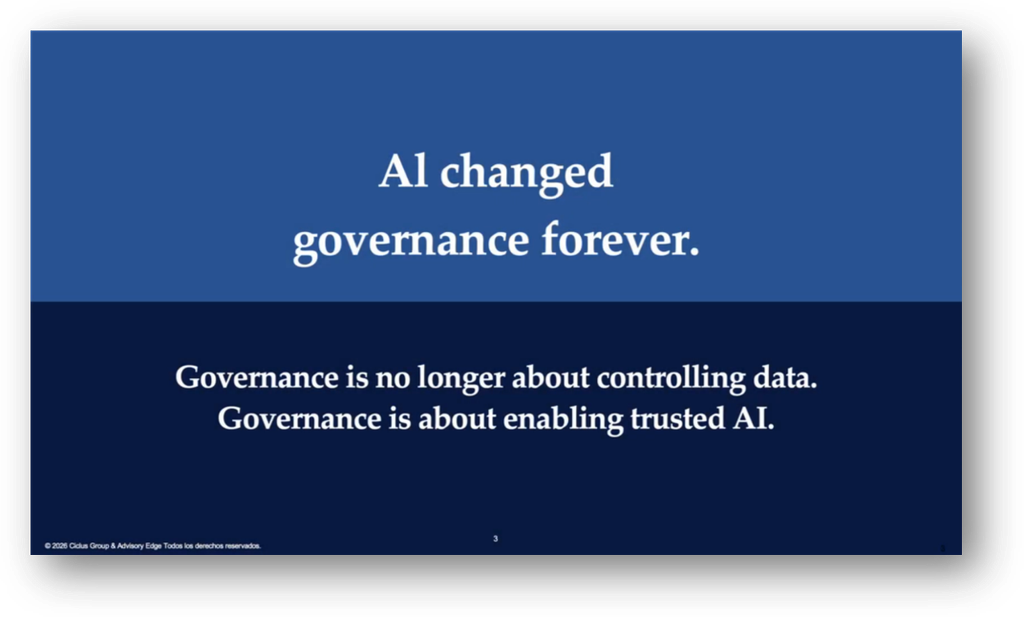
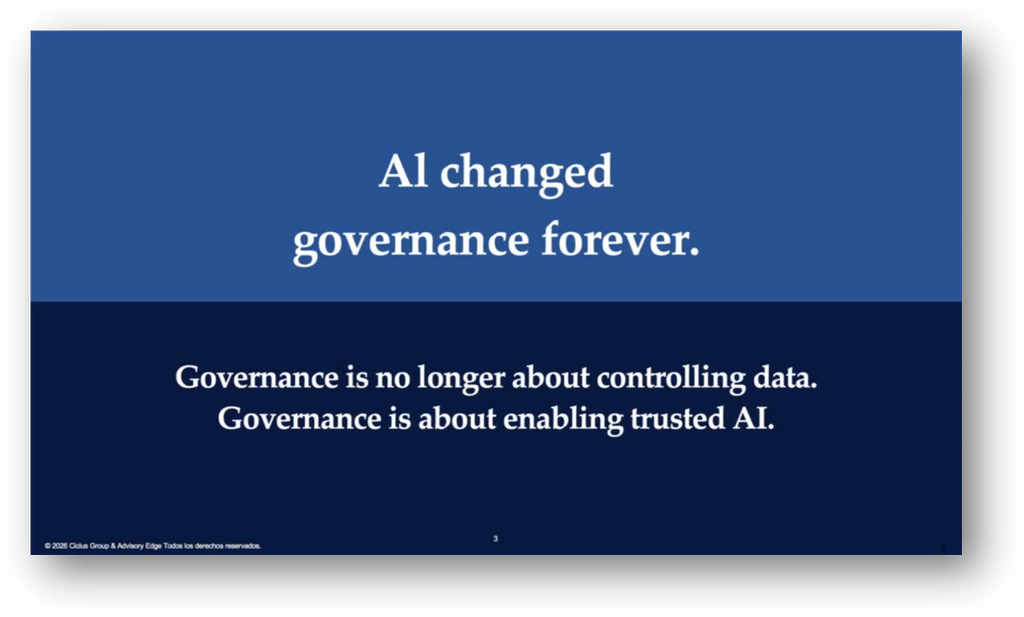
Figure 1 AI Changed Governance Forever

Figure 2 Act 1: the New Reality

Figure 3 The Governance Gap in Artificial Intelligence

Figure 4 The Paradigm Shift

Figure 5 The Foundational Basis of Trust
What is the LATAM AI Paradox’s Impact?
Latin America faces what’s being called the LATAM AI Paradox: rapid, consumer-level adoption of web-based AI tools is outpacing structural corporate investment and local development.
The region represents 10% of the global population and drives 15% of web-based AI usage, yet its structural AI investment accounts for a mere 1% globally. And while 88% of businesses use AI, only 23% actually capture business value from it, and just 24% manage to scale models into production. Real gaps persist in regional infrastructure, data readiness, and specialised talent.
Unlocking the estimated $1.7 billion in annual economic value on the table means moving past basic tool consumption and toward building local capabilities.
Key Takeaways
- Close the Capital Gap: Shift focus from consuming generic APIs to investing in local infrastructure and talent.
- Scale beyond Ad-Hoc: Establish formal management to lift the fraction of models successfully reaching production above 24%.
- Balance Value Creation: Channel AI into critical commercial sectors (mining, banking) and social impact sectors (healthcare, education).
FAQ
- What is the primary bottleneck for AI adoption in Latin America? The core bottleneck is a structural gap in local infrastructure, data readiness, and specialised development talent, even with enthusiastic consumer-level tool adoption.

Figure 6 Act 2: Emerging Markets as Innovation Labs

Figure 7 The Adoption of AI in Latin America Could Increase Productivity by Between 1.9% and 2.3% Annually

Figure 8 The Region is Overrepresented in Terms of Consumption but Pales in Comparison Regarding Structural Investment

Figure 9 The Gap Between Enthusiasm and Real Economic Value

Figure 10 LATAM is not just Adopting Innovation. It is Testing it Under Real-world Constraints.
How does AIoT Improve Mining Operations’ Safety?
In heavy, asset-intensive industries like mining, predictive AI combined with IoT sensors turns costly reactive operations into efficient, safer ones.
Traditional mining suffers from expensive unplanned downtime, energy inefficiencies, and real safety hazards. Integrating AI with Internet of Things (IoT) sensors, a combination known as AIoT, lets operations continuously capture equipment conditions, predict failures, and automate real-time decisions.
That predictive model boosts both competitiveness and resource recovery, and it takes human workers out of hazardous environments in the process.
Key Takeaways
- Implement AIoT Systems: Connect continuous physical sensors with predictive AI to anticipate equipment failures before they halt operations.
- Maximise Resource Recovery: Deploy real-time machine learning models to optimise mineral flotation and grinding plants.
- Evolve the Operating Model: Move systematically from reactive maintenance to protective organisation and autonomous operations.
FAQ
- What measurable results has AI delivered to Latin American mining? Anglo American in Chile improved mineral recovery by 15% using digital twins, BHP saved 3 gigalitres of water, and Gold Fields in Peru boosted gold and silver recovery by 1.5% in real time.

Figure 11 LATAM Mining Loses Hundreds of Millions Annually Due to Unplanned Downtime and Reactive Maintenance

Figure 12 Operational Evolution: from Forensic Repair to Predictive Orchestration Driven by AIoT
How does AI Improve Healthcare Efficiency and Outcomes?
Bringing AI into healthcare lets medical networks shift from episodic, reactive treatment toward continuous prevention, even under tight resource constraints.
Healthcare systems carry a lot of operational waste, with up to 30% of clinical spending absorbed by administrative inefficiencies. AI models ease that burden by optimising triage, automating paperwork, and predicting patient risk profiles early, without replacing essential clinical staff.
That predictive shift lets hospitals and wellness providers expand care capacity and improve patient outcomes.
Key Takeaways
- Eliminate Administrative Waste: Deploy AI to automate administrative workflows, targeting the 30% overhead loss in healthcare spending.
- Enact Continuous Prevention: Use predictive data analytics to identify patient health risks early, rather than treating acute illness reactively.
- Scale Access Safely: Bring in digital tools, emotional support platforms and risk-tracking analytics among them, to expand services under constrained budgets.
FAQ
- Does AI in healthcare aim to replace human doctors? No. AI is designed to support clinical staff, handling triage, automating administrative burdens, and identifying health risks earlier, which expands care capacity rather than replacing the people providing it.

Figure 13 Health Systems are Collapsing Under a Highly Fragmented and Reactive “Sick-care” Model

Figure 14 Care Redesign: from Episodic Transactional Claim to Continuous Prevention Ecosystem
How can institutions effectively leverage AI in education?
Closing the educational gap means academic institutions moving past standardised curricula, toward predictive early-warning analytics alongside conversational tutoring platforms.
There’s a real paradox here: over 80% of students already use AI for their studies, but formal institutional adoption remains minimal, which leaves usage shallow and unguided. Rather than banning these tools, which doesn’t really work anyway, educators need to adapt evaluation models and guide students toward responsible, analytical collaboration with AI.
Implementing personalised learning at scale helps institutions retain students and preserve academic integrity.
Key Takeaways
- Mitigate Shallow AI: Bridge the gap between student tool adoption and institutional reluctance by integrating AI literacy into curricula.
- Deploy Early Warnings: Use predictive modelling to identify students at risk of dropping out and intervene with proactive support.
- Scale Tutoring: Utilise conversational generative platforms to provide immediate, scale-free tutoring and explanation of mistakes.
FAQ
- How should universities handle student AI usage? Universities need to move from restrictive bans toward integrating AI into curricula, updating evaluation techniques, and training students in responsible, ethical AI collaboration.

Figure 15 The Personalisation Crisis: the ‘One Size Fits All’ Educational Model Curbs the Development of Critical Skills

Figure 16 Securing the Student Journey: from Linear Curriculum to Hyper-personalised Tutoring

Figure 17 Transactional Friction and Reactive Fraud Erode Operating Margins in Latin American Banking
How is AI Transforming Banking Services Today?
AI is shifting corporate and retail banking away from static, retrospective transactions and toward intelligent, real-time, personalised financial services.
In corporate banking, Natural Language Processing (NLP) automates document ingestion, cutting “Know Your Customer” onboarding from 20 days down to minutes. On the retail side, lightweight digital wallets use transactional and context data to deliver highly predictive financial products at scale.
Emerging markets offer real flexibility for rapid deployment, but organisations still need to navigate tightening local laws responsibly.
Key Takeaways
- Automate Back-Office Bottlenecks: Implement NLP to streamline compliance and slash corporate onboarding cycle times from weeks to minutes.
- Leverage Digital Wallets: Use mobile wallet transactional and environmental data to scale predictive financial products across massive user bases.
- Balance Speed with Governance: Capitalise on operational agility while building compliant, high-quality models that respect local regulations.
FAQ
- How does NLP improve corporate banking efficiency? NLP automates corporate file ingestion, compressing the client onboarding timeline from 20 days to minutes, with over 20% higher accuracy too.

Figure 18 Transactional Evolution: from Retrospective Evaluation to Continuous Hyperservice

Figure 19 What we have Seen Across these Industries is not Simply Technology Adoption. LATAM’s Constraints are Forcing Companies to Redesign how Value is Created

Figure 20 The True Power of AI in Latin America Lies not in its Adoption
How does AI Governance Unify Corporate Frameworks Effectively?
Modern AI governance requires dismantling corporate silos to unify data management, business processes, security, and human intuition into an integrated corporate framework.
Unlike previous digital transformations where departments operated in isolation, AI is completely cross-functional. Effective AI governance does not replace data governance; rather, it incorporates it alongside business process lifecycle management. Human leadership must partner with AI, contributing emotional intuition and strategic oversight instead of delegating final decisions.
Key Takeaways
- Break Down Departmental Silos: Integrate data management, business processes, and risk parameters into a single governance framework.
- Practice AI Partnering: View AI as a strategic partner requiring human oversight and clear rules, rather than delegating final choices.
- Focus on AI Management: Train professionals in strategic AI management, query craft, and ethical boundary-setting, not just basic tool usage.
FAQ
- Can organisations rely solely on AI models to make critical decisions? No. Humans need to stay in the loop, providing the emotional intuition and critical oversight that keeps models operating within ethical and operational boundaries.

Figure 21 Act 3: the Future of Governance

Figure 22 Governance as an Accelerator

Figure 23 the Purpose of the Governance is Changing

Figure 24 Govern what Organisations HAVE

Figure 25 Enabling Trusted Intelligence to Decide and Act
Are AI Regulations Shifting to Strict Legal Compliance?
Global and regional AI regulations are moving fast, from voluntary ethical principles toward strict, risk-based legal compliance mandates.
Modelled on frameworks like the EU AI Act, countries like Peru have passed risk-based laws requiring organisations to classify models by threat level, low, medium, or strong. High-risk applications, medical triage or credit scoring, for instance, require strict explainability and human-in-the-loop oversight to prevent algorithmic bias.
Organisations must build compliance and accountability into their development pipelines from day one.
Key Takeaways
- Classify Algorithmic Risks: Map corporate AI models into risk tiers to align with evolving national laws and ISO-based standards.
- Mandate Model Explainability: Build transparent systems and explanatory dashboards to translate complex black-box model outputs for auditors.
- Embed Compliance Early: Integrate compliance and risk mitigation directly into the AI development lifecycle.
FAQ
- What is the significance of “explainability” in AI compliance? Explainability is what prevents “black box” decisions. Under risk-based laws, high-risk models have to explain their decision-making logic to auditors and affected users, which is what ensures fairness.

Figure 26 AI Regulatory Context: a Dynamic and Asymmetric International Landscape

Figure 27 The Inflexion Point: AI Governance
How can Organisations Sustain AI Value Effectively?
Sustaining AI value means moving from ad-hoc technology adoption toward a balanced formula: integrated leadership, AI literacy, and autonomous governance working together.
Sustainable value creation depends on organisations building solid data foundations, targeting real business problems, and redesigning customer journeys around them. The final phase in that evolution is autonomous, agentic AI governance, where humans set strict boundaries for self-acting AI agents while still holding ultimate legal accountability.
By aligning leadership, data, and risk, organisations can convert AI into a trusted, scalable competitive advantage.
Key Takeaways
- Apply the Success Formula: Combine deep AI literacy with brave, collaborative leadership to eliminate corporate operational silos.
- Solve Measurable Problems: Direct capital toward high-impact use cases with high-quality data foundations rather than generic projects.
- Prepare for Agentic AI: Establish autonomous governance rules to safely monitor and manage future self-acting AI agents.
FAQ
- Who is legally responsible for an autonomous AI agent’s errors? Ultimate responsibility and legal accountability always rest with human leaders and operators, who need to supervise AI agents the way a parent guides a child.

Figure 28 Govern what Intelligence DOES

Figure 29 The 6 New Governance Objects

Figure 30 How to Reverse this Situation?

Figure 31 Reversing the Numbers: the Diagnosis is Human

Figure 32 The Success Formula: the Human System

Figure 33 Act 4: Our Belief

Figure 34 From AI Adoption to Value Creation: what Leaders Must do Next

Figure 35 We are Living through a Transformative Technological Era

Figure 36 Closing Slide
- Key Takeaways
- How can Organisations Shift AI Governance for Trust?
- What is the LATAM AI Paradox's Impact?
- How does AIoT Improve Mining Operations' Safety?
- How does AI Improve Healthcare Efficiency and Outcomes?
- How can institutions effectively leverage AI in education?
- How is AI Transforming Banking Services Today?
- How does AI Governance Unify Corporate Frameworks Effectively?
- Are AI Regulations Shifting to Strict Legal Compliance?
- How can Organisations Sustain AI Value Effectively?