
Key Takeaways
- The Social Nature of Data Governance: Data initiatives often falter due to human factors, highlighting the importance of trust and communication.
- Trust vs Confidence: Trust is passive; confidence drives decisions. Data governance bridges trusting data and acting confidently on it.
- The Trap of “Governance Theatre”: Organizations often rely on impressive frameworks that employees ignore during daily operations or pressure.
- The Invisible Cost of Deferred Decisions: Poor data governance leads to deferred decisions, as leaders debate dashboards instead of strategy.
- Addressing Root Causes Over Symptoms: Leadership frequently addresses symptoms rather than exploring root causes like data quality issues or flawed processes.
- AI Amplifies Existing Data Flaws: AI highlights existing data governance issues, creating an urgent need for rigorous validation of outputs.
- Governance is an Endurance Discipline: Data governance, like marathon training, demands a solid foundation for long-term organisational resilience under pressure.
- Invisible Success: Mature data governance integrates smoothly into daily tasks, enhancing decision-making while preventing potential crises.
Webinar Details
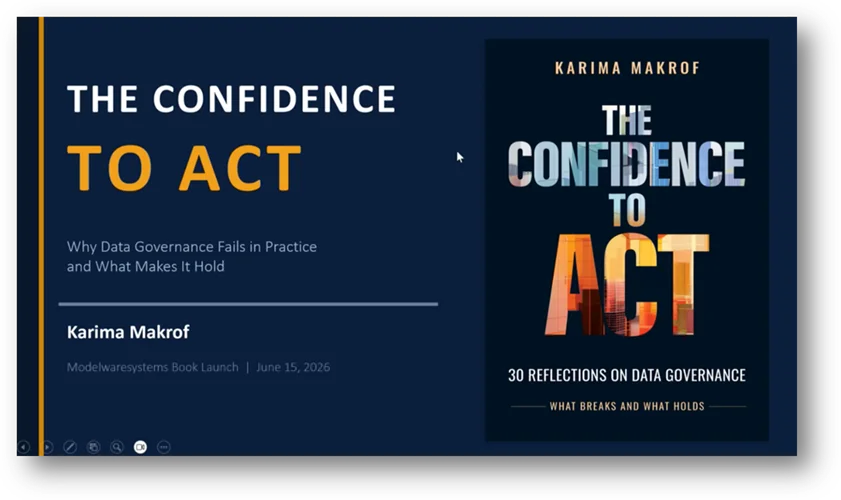
Title: The Confidence to Act: Why DG Fails in Practice & What Makes It Hold with Karima Makrof
Date: 2026-06-15
Presenter: Karima Makrof
Meetup Group: Book Launch with Technics Pub x MWS
Write-up Author: Howard Diesel
Why do Data Governance Frameworks often Fail?
Data governance frameworks often fail due to underlying social and behavioural realities rather than technical system flaws.
In ‘The Confidence to Act’, author Karima Makrof explores the recurring governance patterns that plague modern organisations. While companies utilise vastly different technical environments and organisational structures, the underlying behavioural tensions remain remarkably similar across all industries. Leaders frequently focus on building complex dashboards while ignoring the social friction that prevents users from adopting them.
Ultimately, successful data management requires acknowledging that human behaviour drives data adoption.
Key Takeaways
- Social and behavioural realities drive data governance success more than technical tools.
- Data dysfunction patterns repeat consistently across diverse industries.
FAQ
- Why do data dashboards fail in practice? Dashboards typically fail because organisations focus entirely on the technical build while ignoring the social and behavioural realities of the end-users.
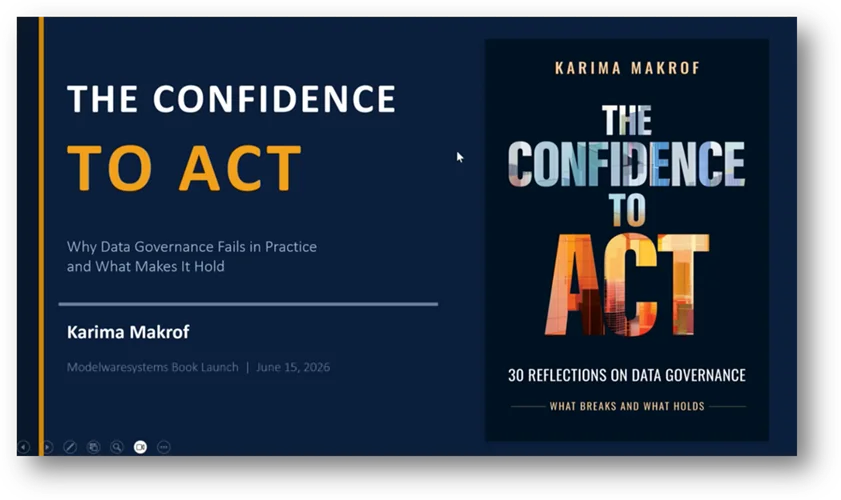
Figure 1 The Confidence to Act
Is Data Governance like an Endurance Sport?
Data governance is like an endurance sport: both require structural foundations that maintain their integrity under extreme pressure.
Long-term success in data management relies on steady consistency rather than short bursts of intense effort. Much like training for a marathon, a governance framework will quickly expose its fundamental weaknesses when stressed by organisational challenges. Effective governance is not achieved through massive revelations, but rather through small, intentional moments of continuous operational alignment.
There is no “finish line” in governance; it is a continuous discipline.
Key Takeaways
- Consistency is more valuable than temporary intensity.
- Frameworks reveal their structural weaknesses under pressure.
FAQ
- What is the ultimate goal of a data governance program? The goal is not to reach a static point of perfection, but to build operational resilience that adapts to changing business environments.

Figure 2 About the Speaker

Figure 3 How this Started
Can we Trust our Data Enough to Act?
Trust is a passive belief in data accuracy, while confidence is the active willingness to make business decisions based on that data.
Organisations today do not lack information; instead, they suffer from operational hesitation. The core question defining data maturity is: “Can we trust our data enough to act on it?”. When distrust occurs, decision-making slows down, escalations multiply, and employees quietly build parallel spreadsheets to verify numbers.
Data governance exists to close the operational gap between passive trust and active confidence.
Key Takeaways
- Hesitation, not data scarcity, is the primary barrier to data-driven action.
- Trust operates silently in the background, but confidence drives forward movement.
FAQ
- What prevents organisations from becoming truly data-driven? Organisations fail to become data-driven because employees lack the active confidence required to make swift decisions using the available data.

Figure 4 “Can we Trust our Data Enough to Act on It?”
How does Poor Data Governance Affect Decisions?
The most expensive hidden cost of poor data governance is the deferred business decision.
“Governance theatre” occurs when impressive data policies and ownership matrices exist formally on paper but are completely bypassed during daily operations. A prime example is when senior leadership teams spend entire strategic meetings arguing over the validity of a single customer metric rather than discussing actual business strategy. Adding more bureaucratic structure rarely fixes this behavioural disconnect.
Good governance must fundamentally change how daily decisions are made.
Key Takeaways
- Formal ownership is useless without operational reality.
- Deferred decisions generate massive invisible costs for businesses.
FAQ
- What is governance theatre? Governance theatre is a phenomenon where organisations create beautiful data frameworks and policies that employees immediately bypass when under pressure.

Figure 5 Why Governance Actually Fails

Figure 6 The Decision Never Happened
Can Automating Flawed Processes Improve Data Governance?
Automating a flawed data governance process will only scale and accelerate organisational mistakes.
To resolve conflicting data, leaders must dig into root causes rather than debating superficial symptoms. While AI agents offer exciting possibilities, you cannot simply automate bad behaviours and expect improved governance. Effective automation requires first establishing a highly functional process.
Furthermore, robust metadata acts as a foundational requirement to successfully drive automated data quality operations.
Key Takeaways
- Automating bad processes simply accelerates failure.
- Leadership must prioritise root-cause analysis over treating symptoms.
FAQ
- Can artificial intelligence automate data governance? AI can assist, but attempting to automate governance before fixing underlying procedural flaws will result in scaled errors.

Figure 7 What Breaks
How does Data Governance become Invisible in Organisations?
Silent workarounds and missing data represent invisible governance failures that severely distort strategic decision-making.
Data trust is highly fragile; it cannot be manufactured by simply rolling out a new dashboard or publishing a policy. Trust accumulates slowly through repeated, reliable experiences with accurate data. When data governance truly matures, it becomes seamlessly “embedded” into daily workflows.
In highly mature organisations, governance becomes invisible because it works flawlessly without friction.
Key Takeaways
- Invisible data problems alter decisions without leaders realising it.
- Trust is earned slowly through reliable, repeated data experiences.
FAQ
- How do organisations build trust in their data? Organisations build trust by consistently providing accurate data exactly when it is needed, allowing confidence to accumulate naturally over time.

Figure 8 What Holds
Does AI Amplify Existing Data Governance Problems?
Artificial intelligence does not remove data governance problems; it dramatically amplifies and scales them.
AI systems operate with incredible speed and conversational fluency, creating a dangerous illusion of certainty for end-users. If an organisation currently suffers from weak data quality or unclear ownership, AI will rapidly scale the consequences of those weaknesses. Fluency is not the same as trustworthiness.
Consequently, strict governance acts as a critical “decision architecture” to validate AI outputs.
Key Takeaways
- AI amplifies existing data flaws rather than curing them.
- The fluency of AI creates a dangerous illusion of factual certainty.
FAQ
- Does adopting AI solve poor data governance? No, adopting AI actually makes governance more urgent, as automation scales existing bad data and unclear accountability.

Figure 9 Why AI Makes This More Important
What is the Goal of Enterprise Data Governance?
The ultimate goal of an enterprise data governance program is to build organisational resilience, not perfection.
Successful governance practices are highly cumulative; doing the right things consistently compounds into long-term clarity and trust. Organisations often demand immediate maturity, but sustainable governance requires step-by-step foundation building. Furthermore, governance is a profoundly human endeavour rooted in behaviour, communication, and responsibility.
When organisational pressure rises, the true quality of your governance foundation is exposed.
Key Takeaways
- Good governance compounds over time, building deep resilience.
- Data governance is fundamentally a human behavioural discipline.
FAQ
- When is a data governance implementation finished? Data governance has no finish line; it is a continuous practice that must evolve alongside changing organisational scales and pressures.

Figure 10 The Long-distance Discipline
How does Data Governance Impact Business Decision-making?
The true return on investment (ROI) for data governance is measured by the speed and quality of business decisions.
Before establishing formal data ownership, organisations must aggressively ask “why” the business requires it. For example, a factory halting production due to an upstream data entry error highlights the urgent operational need for end-to-end data accountability. The greatest successes in data governance are often invisible “non-events,” where accurate data seamlessly prevents crises.
Effective governance ensures cross-departmental alignment so decision-makers can act quickly.
Key Takeaways
- Governance ROI is demonstrated through faster, confident decision-making.
- Identify the exact business problem before assigning formal data owners.
FAQ
- How do you prove the value of data governance? The value is proven by tracking the reduction in deferred decisions and the elimination of operational bottlenecks caused by bad data.

Figure 11 “Governance is not about Controlling Data. It is about Enabling Confidence.”

Figure 12 Closing Slide
- Key Takeaways
- Why do Data Governance Frameworks often Fail?
- Is Data Governance like an Endurance Sport?
- Can we Trust our Data Enough to Act?
- How does Poor Data Governance Affect Decisions?
- Can Automating Flawed Processes Improve Data Governance?
- How does Data Governance become Invisible in Organisations?
- Does AI Amplify Existing Data Governance Problems?
- What is the Goal of Enterprise Data Governance?
- How does Data Governance Impact Business Decision-making?


