
Key Takeaways
- The necessity of nuanced AI education: ‘Robbie Just Wants to Help’ offers a balanced view of AI, avoiding extremes of fear and wonder.
- Simplifying core AI mechanics: The story clarifies AI concepts such as pattern recognition, data labelling, and essential safety guardrails.
- Universal applicability of foundational concepts: The book’s lessons reveal corporate missteps, like overusing complex AI for simple automation tasks.
- The environmental cost of AI: AI queries use more electricity than standard lookups, highlighting the need for mindful usage.
- AI lacks independent agency: Concerns about AI domination are mostly misplaced, as it requires human guidance and lacks agency.
- Human skills remain irreplaceable: Empathy, intuition, and creativity are uniquely human traits that make us essential guides for AI.
- Developing “consequence capital”: The future workforce needs professionals skilled in AI, ethics, and real-world decision impacts.
- The importance of safe digital boundaries: Children should explore AI using safe, educational tools that lack addictive social media features.
- AI’s dual potential in the real world: AI holds great promise for medicine but also risks; digital literacy is crucial to safeguard vulnerable populations.
- Promoting screen-free learning: The author published the book as a hard copy to promote screen-free, engaged learning.
Webinar Details
Title: A Live Reading with Tiankai Feng: Robby Just Wants to Help
Date: 2026-06-24
Presenter: Tiankai Feng
Meetup Group: Book Launch with Technics Pub x MWS
Write-up Author: Howard Diesel
What is ‘Robbie Just Wants to Help’ about?
Understanding AI Through a Human-Centric Lens
The webinar introduces “Robbie Just Wants to Help”, a children’s book designed to guide the next generation through an increasingly AI-driven world. The book seeks to provide a nuanced educational approach, rejecting polarising views that frame AI as either terrifying or purely magical.
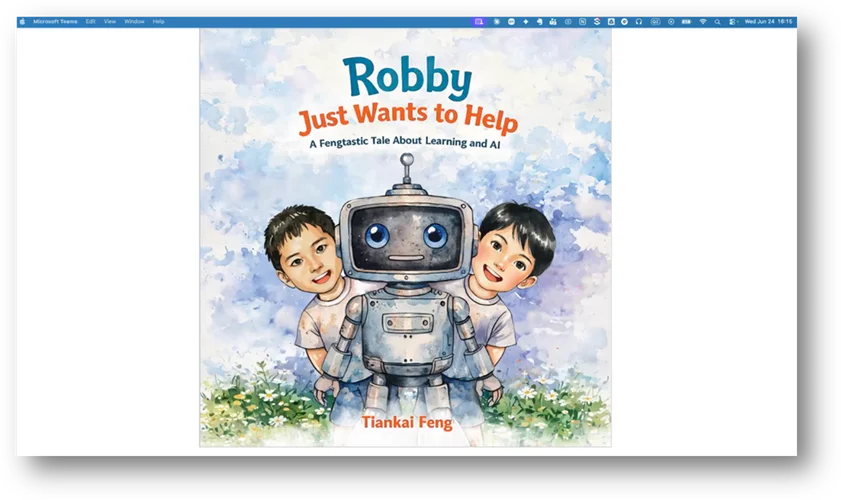
Tiankai Feng drew heavily on his personal life, making his own sons, Sky and Cloud, the main characters after they began asking questions about smart assistants. Additionally, the book honours the author’s Chinese-German heritage through its unique illustration style, adopting a 1970s Asian aesthetic of ink outlines and watercolours.
Key Takeaways
- Nuanced AI education prepares children for an automated future.
- Relatable narratives help demystify smart technology.
- Cultural representation enriches educational materials.
FAQ
- What is the goal of “Robbie Just Wants to Help”? The book aims to guide children into an AI-driven world by offering a balanced, nuanced perspective on how artificial intelligence works.
Figure 1Live Reading of ‘Robby Just Wants to Help’ by Tiankai Feng
What are Core AI Concepts for Beginners?
Core AI Concepts Explained for Beginners
The story follows brothers Sky and Cloud as they learn to interact with Robbie, a metallic household robot. The foundational lesson is that AI learns through “pattern recognition”, requiring hundreds of examples to identify common traits.
The brothers quickly discover the necessity of “guardrails”—strict operational limits placed on the AI to prevent it from executing unwanted actions, like dismantling furniture to clean a room. They also learn the importance of correct data “labelling”; without it, an AI cannot distinguish between correct answers and mistakes.
Crucially, the book explains “hallucinations”—when an AI confidently invents false information because it lacks the correct data. Ultimately, the boys realise that human intuition, emotional intelligence, and creativity are irreplaceable, cementing the role of humans as essential guides for AI.
Key Takeaways
- AI relies on pattern recognition and human-guided data labelling.
- Guardrails are essential to keep AI operations within safe boundaries.
- AI systems can hallucinate and require human fact-checking.
FAQ
- What are AI guardrails? Guardrails are specific boundaries and limits placed on an AI system to prevent it from taking incorrect, unhelpful, or dangerous actions.
How can Children’s AI Lessons Benefit Professionals?
Applying Children’s AI Lessons to the Corporate World
The simple, foundational lessons taught in ‘Robbie Just Wants to Help’ translate directly into best practices for adult professionals using AI. Following the reading, webinar participants noted that the book’s core concepts should be required reading for corporate teams.
By understanding basic principles—like setting clear boundaries, verifying outputs, and maintaining human oversight—professionals can seamlessly extrapolate these lessons into their work environments. The book proves that mastering AI requires a return to foundational logic, regardless of the user’s age.
Key Takeaways
- Foundational AI concepts are universally applicable.
- Corporate teams benefit from simplified explanations of AI boundaries.
- Human oversight remains critical in workplace automation.
FAQ
- Can professionals learn from children’s AI books? Yes, foundational principles like data verification and AI guardrails apply directly to managing complex AI agents in corporate environments.
How can we Educate about AI’s Environmental Impact?
Adapting the AI Conversation and Highlighting Environmental Costs
Explaining AI effectively requires adapting technical language to the audience’s baseline understanding. Because most individuals already hold preconceived notions about AI, educators must focus on correcting misconceptions and managing human comfort levels regarding automation.
A human-centric approach is vital when integrating AI into daily life. Beyond technical limits, the environmental impact of AI must be addressed; for instance, a single AI query consumes significantly more electricity than a traditional search, contributing to massive city-level energy consumption. Teaching these realities empowers users to adopt critical thinking and use AI tools responsibly.
Key Takeaways
- Adapt AI explanations to address existing misconceptions.
- Consider human comfort levels before fully automating tasks.
- AI queries consume massive amounts of electricity, requiring mindful usage.
FAQ
- Why is it important to teach the environmental cost of AI? AI queries use up to ten times more energy than standard searches; teaching this promotes mindful, eco-friendly digital habits.
Is AI Dependency Leading to Context Fatigue Risks?
Understanding AI Agency and the Risk of Context Fatigue
Artificial intelligence lacks independent agency and cannot take over the world without explicit human direction. Despite mainstream fears surrounding Artificial General Intelligence (AGI), AI remains a tool that requires human instructions to execute tasks.
For highly regulated professions, such as aviation, AI will act as an assistant to human pilots rather than a total replacement, as human judgment is non-negotiable. Furthermore, over-relying on AI introduces a serious risk of “context fatigue.” If humans delegate all critical thinking and problem-solving to AI, they risk losing their foundational skills entirely.
Key Takeaways
- AI does not possess independent agency or motives.
- Human oversight and judgment remain essential in critical fields.
- Outsourcing too much thought to AI degrades human problem-solving skills.
FAQ
- Will AI replace human pilots? No, AI will assist in the cockpit, but human responsibility and situational judgment will always be required to fly safely.
Are Organisations Mismanaging AI Adoption and Finances?
Navigating Enterprise AI Missteps and Financial Governance
Many organisations fail at AI adoption because they misunderstand technical requirements and ignore financial constraints. A common enterprise mistake is deploying complex generative AI models for basic tasks that only require simple workflow automation.
Successful AI integration requires cultural readiness and a solid data foundation, rather than expecting AI to fix existing structural problems. Financially, unchecked experimentation burns through expensive compute “tokens,” leading finance departments to implement strict governance checks to ensure AI usage is actually cost-effective.
Key Takeaways
- Avoid using advanced AI for tasks that only require basic automation.
- AI cannot fix broken data foundations or resistant company cultures.
- Unchecked AI experimentation causes severe financial strain via token costs.
FAQ
- What is a common mistake companies make with AI? Organisations frequently overcomplicate processes by using expensive generative AI agents for tasks that only need basic workflow automation.
What is Consequence Capital in the Future Workforce?
Developing Consequence Capital for the Future
The future workforce will demand professionals who combine strong domain expertise with advanced AI orchestration skills. To stand out in a market saturated with automation, the next generation must develop “consequence capital”—the uniquely human ability to foresee the ethical and real-world outcomes of business decisions.
The ideal future worker is an “AI-augmented” professional. Just as engineers use advanced calculators to perform complex math, future experts will use AI to scale their specific subject matter expertise while retaining ultimate creative and ethical control.
Key Takeaways
- Future jobs require a blend of domain expertise and AI orchestration.
- “Consequence capital” is the human ability to foresee ethical outcomes.
- Workers must view AI as an augmenting tool, not a replacement for knowledge.
FAQ
- What is an AI-augmented professional? A worker who possesses deep subject matter expertise and uses AI tools to amplify their productivity and problem-solving capabilities.
How can Parents Safely Introduce AI to Children?
Setting Safe Digital Guardrails for Youth AI Access
Parents and educators should introduce AI to children transparently, using age-appropriate tools while enforcing healthy digital boundaries. Practical AI education involves hands-on experimentation, such as using code-generation tools or AI music generators, while explicitly explaining that the outputs rely on training data, not magic.
Unlike social media, which is inherently designed to be addictive, AI tools can be safely introduced through tailored, educational applications. By providing these “guardrail views,” parents allow children to benefit from AI education without exposing them to digital addiction or unfiltered large language models.
Key Takeaways
- Demystify AI for children by explaining the role of training data.
- AI applications can be educational without being addictive.
- Children should use restricted, kid-friendly AI tools rather than open models.
FAQ
- Should children be allowed to use AI? Yes, provided they use safe, educational applications with strict guardrails that are designed to be helpful rather than addictive.
How might AI Protect Vulnerable Populations Effectively?
Leveraging AI for Global Good and Protecting the Vulnerable
AI possesses immense potential for positive global impact, particularly in healthcare. Because AI is highly effective at identifying data patterns, it is already being utilised to predict disease spread, advance cancer research, and analyse bloodwork.
However, as AI becomes more capable, vulnerable populations like the elderly require greater digital literacy to protect themselves from highly realistic, AI-driven voice scams. To encourage grounded learning and protect users from constant screen time, the author explicitly chose to publish “Robbie Just Wants to Help” exclusively as a physical hard copy book.
Key Takeaways
- AI excels at medical pattern recognition and predicting disease outbreaks.
- Digital literacy is urgently needed to protect the elderly from AI scams.
- Physical books provide a vital, screen-free method for learning digital concepts.
FAQ
- How is AI being used in healthcare? AI assists in medical research by identifying complex patterns, predicting future disease outbreaks, and analysing data for cancer and flu research.
- Key Takeaways
- What is ‘Robbie Just Wants to Help’ about?
- What are Core AI Concepts for Beginners?
- How can Children's AI Lessons Benefit Professionals?
- How can we Educate about AI's Environmental Impact?
- Is AI Dependency Leading to Context Fatigue Risks?
- Are Organisations Mismanaging AI Adoption and Finances?
- What is Consequence Capital in the Future Workforce?
- How can Parents Safely Introduce AI to Children?
- How might AI Protect Vulnerable Populations Effectively?


