
Key Takeaways
- Executive 7-Minute Review Drill: The governance framework simplifies data ethics assessments into a quick 7-minute review for executives.
- The BALANCE Framework: Governance evaluations use the BALANCE framework: Benefits, Affected stakeholders, Limits, Accountability, Negative consequences, Controls, and Evidence.
- Performance vs Conformance Equilibrium: The drill encourages honest discussions to reveal internal tensions and conflicting priorities rather than rigid checklists.
- Conversational Review over Checklists: The drill encourages open dialogue to uncover organisational tensions and conflicting priorities instead of rigid checklists.
- Named Executive Accountability: Every AI deployment must have one accountable executive to manage risks and halt operations as needed.
- Mandatory Human Adjudication: Decisions with adverse, ambiguous, or contested outcomes require mandatory human review, not just automation.
- Prohibition of Silent Denials: Automated systems must provide clear reasoning and notification for any silent claim denials.
- Right to Human Remedy: Organisations should ensure claimants can directly access authorised human decision-makers, avoiding automated chatbot issues.
- Defensible Decision Records: The governance review creates a binding record detailing decisions, dissent, and approval conditions.
- Context-Specific Governance: AI ethics must adapt to diverse contexts like insurance, philanthropy, and community research.
- Hybrid Operations and Human Intuition: Successful AI integration requires a hybrid approach, balancing human intuition with AI automation for safety.
Webinar Details
Title: The Art of Defensible Data and AI Governance for Data Executives
Date: 2026-10-01
Presenter: Howard Diesel
Meetup Group: African Data Management Community
Write-up Author: Howard Diesel
How can we Simplify Executive AI Governance Training?
Executive AI governance requires simplified training frameworks and interactive tools to build defensible corporate alignment.
Executives must simplify complex data governance concepts to ensure active strategic engagement across leadership teams. Grounded in South Africa’s KING V corporate regulation, this executive approach translates multi-day ethical assessment reviews into a concise, actionable drill.
Interactive engagement tools, such as Menti quizzes, flashcards, and mind maps, help assess knowledge and build self-directed learning paths for corporate leaders.
Key Takeaways
- KING V compliance requires tailored executive training frameworks.
- Interactive tools replace rigid lectures with active participation.
- Self-study mind maps and flashcards reinforce foundational AI ethics concepts.
Frequently Asked Questions
- Why target executives with short governance frameworks? Executive oversight requires rapid, actionable engagement rather than dense, multi-day technical training.

Figure 1 Ethical Assessment Review Instrument

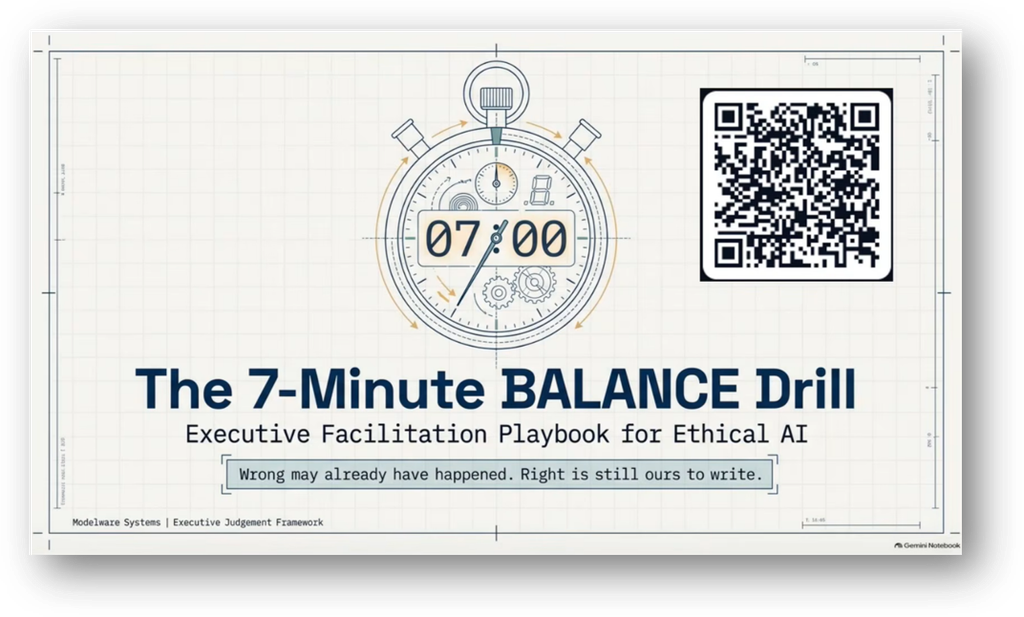
Figure 2 The 7-Minute BALANCE Drill

Figure 3 Datasherpa – Workbench Player
How does BALANCE Framework Ensure Ethical Business Performance?
The BALANCE framework provides a 7-minute conversational drill to reconcile business performance with ethical conformance.
The BALANCE acronym stands for Benefit, Affected stakeholders, Limits, Accountability, Negative consequences, Controls, and Evidence. It establishes a structured 7-minute executive dialogue rather than a passive, mechanical checklist review.
Organisations must balance financial performance (speed, scale, reduced costs) against ethical conformance (dignity, rights, and harm prevention). Maintaining this equilibrium ensures strict prohibition of silent claim denials and guarantees mandatory human adjudication for affected individuals.
Key Takeaways
- BALANCE evaluates key ethical dimensions in a 7-minute drill.
- Conformance protects human dignity without stalling business performance.
- Every AI deployment requires named executive accountability and human fallback mechanisms.
Frequently Asked Questions
- Is the BALANCE framework a scoring tool? No, it is a disciplined executive conversation designed to surface tensions and establish accountable oversight.

Figure 4 The BALANCE Framework: 7 Questions for Ethical AI Leadership

Figure 5 The BALANCE Model: Navigating AI in Insurance

Figure 6 The Executive Mandate Requires Balancing Opposing Forces
What are the Rules for AI in Insurance?
Automated insurance claim systems require explicit human intervention rules, named accountability, and prohibition of silent denials.
An interactive quiz scenario evaluates executive readiness when deploying AI in insurance claim processing. Results show that named executives, not software developers or CTOs, hold sole answerability for operational AI harm.
Automated systems must escalate adverse, ambiguous, or contested outcomes to mandatory human adjudication. Silent denials are also strictly prohibited, ensuring claimants retain direct rights to human remedy.
Key Takeaways
- Named executives carry legal and operational accountability for AI decisions.
- Contested or adverse outcomes require mandatory human review.
- Claimants must be protected from silent automated rejections.
Frequently Asked Questions
- Can AI algorithms trigger mandatory human review? Human review should be triggered by adverse or ambiguous outcomes, not solely by fraud detection scores.
How do Use-case Owners Drive C-suite Alignment?
Board-appointed use-case owners drive C-suite alignment and assume full responsibility for mitigating AI-induced harm.
Effective AI governance requires engaging the entire C-suite to build collective understanding across diverse corporate functions. Presenting multi-dimensional scenarios prevents isolated decision-making between technical and business leaders.
Board-level appointment of accountable use-case owners ensures clear ownership over operational outcomes. These owners must possess the authority and education required to halt high-risk AI deployments when necessary.
Key Takeaways
- Cross-functional C-suite engagement aligns technical and operational leaders.
- Boards must formally designate named owners for specific AI use cases.
- Accountable owners need authority to stop non-compliant AI models.
Frequently Asked Questions
- Who designates the accountable owner for an AI model? The executive board formally appoints the owner during the governance review process.
What is the Purpose of the 7-minute Review?
The 7-minute review drill surfaces conflicting business objectives to produce a binding Defensible Decision Record.
The governance process frames the core human decision influenced by AI without focusing on underlying technology stacks. Facilitators force leadership teams to articulate explicit tensions between competing objectives, such as speed versus fairness.
Rather than relying on arbitrary compliance scores, the drill generates a Defensible Decision Record documenting executive rationale, conditions, and dissent. This record establishes clear governance verdicts: deployment approval, conditional pilot, redesign, or rejection.
Key Takeaways
- Reviews focus strictly on human decision parameters, omitting tech stack debates.
- Decision records document dissenting views, conditions, and formal review triggers.
- Governance outcomes yield clear verdicts: approve, pilot, redesign, or reject.
Frequently Asked Questions
- How does the 7-minute drill handle unresolved debate? Facilitators record dissent or flag unresolved questions as gaps requiring further analysis.

Figure 7 The Architecture of the 7-minute Drill

Figure 8 The BALANCE Diagnostic Wheel

Figure 9 [00:00 – 01:00] (Move 01) Frame the Human Decision

Figure 10 [01:00 – 02:00] (Move 02) Surface the Tension

Figure 11 [02:00 – 05:00] (Move 03) Apply the Core BALANCE Sprint

Figure 12 [05:00 – 06:30] (Move 04) Set the Governance Response

Figure 13 [06:30 – 07:00] the Defensible Decision Record
Do Automated Support Systems Erode Customer Trust?
Unchecked AI customer support loops erode trust and show the need for human escalation and aligned KPIs.
Poorly governed automated support systems create operational friction, as seen when customers encounter endless AI bot loops without resolution. Excessive automation without human fallback frustrates users and damages corporate credibility.
Automated service failures stem from misaligned key performance indicators (KPIs) and support agents lacking decision-making authority. Ethical support structures must offer accessible human escalation to protect customer dignity.
Key Takeaways
- AI customer agents without human oversight damage operational trust.
- Misaligned support KPIs prevent fast issue resolution.
- Organisations must guarantee accessible human escalation channels.
Frequently Asked Questions
- Why do AI customer support bots frequently fail? Failure occurs when systems lack human fallback pathways and enforce rigid automated closure rules.

Figure 14 AI Support Challenge

Figure 15 [07:00 -08:00] Scenario Application: Insurance Claims Automation
How should AI Governance Adapt Across Industries?
Contextual AI governance must adapt across diverse industries, from insurance triage to philanthropic funding and community research.
AI governance principles must be tailored to specific operational contexts rather than applied as a static template. In insurance claims, straight-through processing requires regulatory compliance tracking and fraud screening controls.
In philanthropic grant allocation, governance ensures beneficiary dignity and addresses thin data challenges in high-need groups. For community research, data frameworks like CARE and FAIR enforce shared value delivery before insights are commercialised.
Key Takeaways
- Insurance AI requires regulatory tracking and protection against unfair profiling.
- Philanthropic AI models must respect beneficiary dignity over pure portfolio efficiency.
- Community data collection must deliver reciprocal value under CARE guidelines.
Frequently Asked Questions
- What is the CARE framework in community data governance? CARE focuses on First Nation data usage, collective benefit, and community authority.

Figure 16 [08:00 – 09:00] Scenario Application: Philanthropic Funding (AGGPSA)

Figure 17 [09:00 – 10:00] Scenario Application: Community Analysis (WAKAMOSO)

Figure 18 Cross-case Synthesis Matrix
How can We Overcome Executive Resistance Effectively?
Overcoming executive resistance requires iterative governance workshops to shift focus from budget protection to risk mitigation.
Initial executive governance workshops often encounter friction, such as powerful CIOs resisting oversight or fearing strategy disruption. Conducting multiple workshop iterations helps executives move beyond immediate budget concerns toward human-centred ethics.
Simplification tools like the BALANCE model create an accessible environment to surface hidden operational risks. Documenting specific concerns ensures that potential harms are identified and resolved before deployment.
Key Takeaways
- Expect initial resistance during early C-suite governance reviews.
- Iterative sessions shift focus from budget protection to ethics and risk.
- Accessible frameworks encourage transparent risk identification and logging.
Frequently Asked Questions
- How many workshop rounds are usually needed for C-suite alignment? Successful alignment typically requires two to three iterative sessions.
How does AI Support Human Collaboration Effectively?
Sustainable AI integration relies on hybrid human-AI collaboration, preserving empathy, and embedding ethics into enterprise standards.
AI systems must complement human workers rather than replace them, operating like a hybrid Prius engine that combines automated power with human oversight. Preserving human intuition and hesitation prevents catastrophic decision errors.
Unempathetic algorithms require strict ethical guardrails embedded across enterprise frameworks like DMBOK3. Proactive governance ensures organisations protect human dignity while adapting to industrial shifts.
Key Takeaways
- Hybrid models combine automated efficiency with human judgment.
- Human intuition and hesitation provide a last check before decisions are executed.
- Enterprise data management frameworks must embed ethics into every domain.
Frequently Asked Questions
- Can AI systems replicate human empathy? No, algorithms lack genuine empathy, so human oversight is needed for ethical outcomes
- Key Takeaways
- How can we Simplify Executive AI Governance Training?
- How does BALANCE Framework Ensure Ethical Business Performance?
- What are the Rules for AI in Insurance?
- How do Use-case Owners Drive C-suite Alignment?
- What is the Purpose of the 7-minute Review?
- Do Automated Support Systems Erode Customer Trust?
- How should AI Governance Adapt Across Industries?
- How can We Overcome Executive Resistance Effectively?
- How does AI Support Human Collaboration Effectively?


