
Executive Summary
This webinar covers the key areas of AI and data governance, focusing on where machine learning applications and human oversight meet in sectors like insurance and healthcare. Howard Diesel works through bias and ethical considerations in AI systems, how automation is changing claims management and fraud detection, and why data quality management matters so much. He also covers supervised and unsupervised learning for decision-making and predictive modelling, along with the challenges of AI interaction and monitoring, making the case for solid ethical governance and data governance frameworks that keep algorithm performance strong and AI deployment responsible.
Webinar Details
Title: AI Governance for Data Professionals
Date: 16 October 2025
Presenter: Howard Diesel
Meetup Group: African Data Management Community
Write-up Author: Howard Diesel
AI Governance and Data Governance
Howard Diesel opened the webinar by framing AI governance as something that starts with understanding the basic concepts and terminology behind AI and machine learning. A lot of people feel overwhelmed by how complex these terms sound, which makes it harder for them to ask the right questions or put the right checks in place at their own organisations. This webinar is aimed squarely at people who are new to AI governance, to demystify the basics and make them more approachable.
Machine Learning Types, Applications, and Human Oversight
Machine learning, a subset of AI, is what does the heavy lifting in analysing data and pulling out useful insights. At its core, it covers a range of methodologies, neural networks and deep learning among them, that let systems learn from data. That’s given rise to different types of analytics, descriptive, predictive, and prescriptive, each serving a different purpose in understanding what’s already happened and forecasting what’s coming.
Descriptive analytics looks at historical data to answer what’s already happened, often using tools like the DMBOK and Robert Abate triangle for that. Predictive analytics, by contrast, tries to forecast future events based on historical patterns, using a range of techniques to do it. Understanding that difference is what lets machine learning be used well, to categorise behaviour and anticipate trends rather than just describe the past.
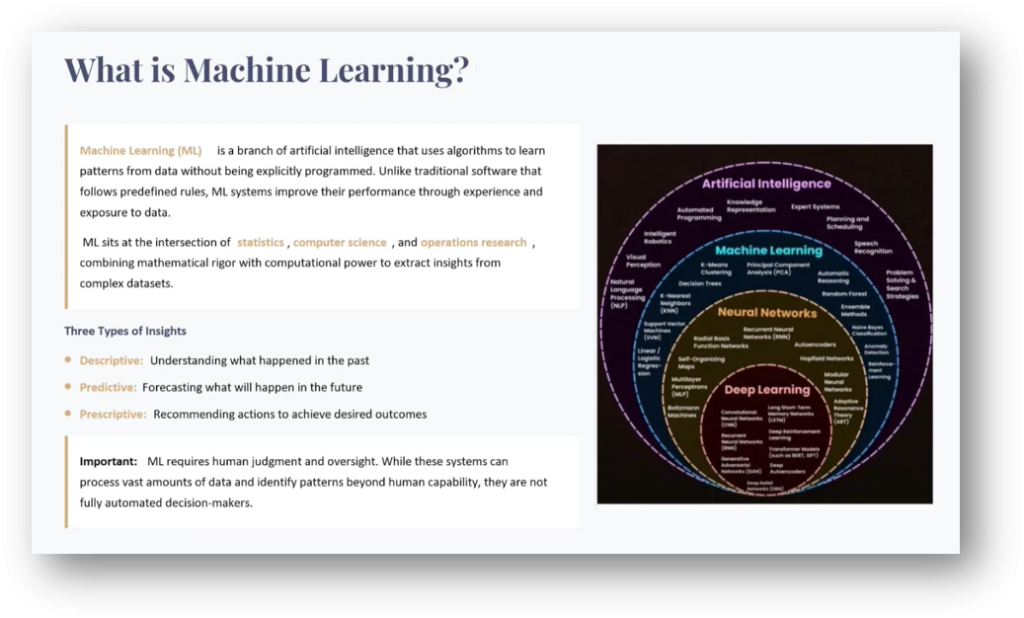
Figure 1 What is Machine Learning?
Data Analysis and Claims Management in Insurance and Healthcare
Bringing different data types together is what makes insurance and healthcare analytics actually effective. That means claims data, policyholder information, and performance data on insured assets like houses and cars, plus geospatial data, the location of those assets and the current weather conditions, and geopolitical context on top. Pull all of that into a data lake or warehouse, and companies get the comprehensive view that nuanced analysis and better decision-making actually need.
Structured data is the foundation of most analytical models, but there’s real potential in unstructured data too, tapped through tools like LLMs and natural language processing, which can analyse a wide range of inputs, text and images among them, and deepen the insights generated. Use both structured and unstructured data well, and organisations end up with more robust models driving better decisions in insurance and healthcare.

Figure 2 ML in Insurance and Healthcare
Automation and Machine Learning in Insurance and Healthcare
Automating claims processing cuts down significantly on the time and resources needed to handle a claim. Traditional methods mean extensive manual review of documents like police reports and medical records, which is slow even with a large team. Machine learning and automation let organisations analyse and process that information much faster, which improves efficiency and speeds up fraud detection and prevention.
Better data analysis is also improving healthcare resource allocation, as ongoing hospital projects show. Initiatives around materials and stock management, for instance, are building toward more comprehensive data models that track resource usage, operating theatres and medical equipment included. Line up resources with actual demand, and healthcare facilities can run more efficiently and meet patient needs better, which is what improves service delivery in the end.

Figure 3 Three Machine Learning Paradigms
Bias and Ethical Considerations in Data Analysis and AI Systems
Unsupervised learning, particularly in customer segmentation and risk groupings, runs into real challenges from bias baked into the data. These methods can identify patterns, sure, but they can also perpetuate discrimination by oversimplifying complex realities, wrongly concluding that everyone from a particular area or demographic group is prone to false claims, for instance, and building unjust assumptions and decisions on that basis.
Addressing that means implementing governance strategies that identify and mitigate bias in the dataset. There are techniques for modifying biased data so training and analysis better reflect reality. Acknowledge and correct those biases, and organisations end up making more equitable, better-informed decisions with the data they have, with less risk of discrimination baked in.
Comparison and Application of Agentic AI Models
How effective an LLM is can vary a lot depending on whether it’s built on publicly scraped data or synthetic data. Building a proprietary LLM for an organisation, with control over the data inputs, tends to give more tailored performance and less bias. Using a public platform like ChatGPT, Claude, or Llama, by contrast, exposes users to whatever bias and error tolerance those systems already carry. Testing across various platforms turned up measurable performance differences, which shows just how much the data source shapes how effective an LLM actually is.
That raises a real question: can best practices even be applied consistently across different LLMs? An agentic AI workflow can help evaluate and improve various models, though adapting practices to each specific platform brings its own challenges. It’s worth exploring further whether standardised methods can realistically work across diverse LLM systems, which would mean better performance and less bias in AI-driven applications generally.
Ethical Implications and Challenges of AI Decision-Making
Data requirements differ quite a bit across supervised, unsupervised, and reinforcement learning. Supervised learning needs labelled examples; unsupervised learning works purely off raw data. Reinforcement learning is different again, working off feedback signals generated from decisions, with the model earning rewards or penalties based on outcomes. In potential fraud cases, for instance, customer feedback is what determines whether a prediction was accurate and adjusts the model’s parameters from there.
The point of all these methodologies is predicting outcomes and finding patterns that yield genuinely useful insights. Understanding the structure of large claims can mean analysing 20, 30, even 40 features, which helps detect anomalies like fraudulent claims, though pinning down which features actually matter for that is often the hard part. Conflict of interest matters here too, being aware of people’s connections and what those relationships might mean for the integrity of the claim being assessed.
Implementing Supervised Learning in Business Applications
In supervised learning, a well-curated training dataset really is the foundation everything else builds on, which is why data governance teams need a thorough grasp of which features should actually be included. Insurance claim processing, for example, can generate a huge array of features, details about individuals, claims, brokers, and so on. Getting faster predictions and less unnecessary training, though, means paring that set down to the features that genuinely matter.
Once the master dataset is in place, the next step is narrowing it down to a manageable set of features that actually align with the outcomes you want. That improves prediction accuracy and heads off training challenges further down the line. Focus on the right features, and supervised learning models end up faster and more accurate, which is what drives better decisions and insight in complex processes like insurance claims.

Figure 4 Supervised Learning: Learning from Labelled Data
Unsupervised Learning and Its Applications in Various Domains
Both supervised and unsupervised learning matter a great deal in data analysis. Supervised techniques like linear regression and logistic regression predict outcomes from labelled data: linear regression for continuous variables like house prices based on features like square footage, logistic regression for categorical outcomes like whether an email is spam. It’s also useful for estimating customer churn, working out the probability a customer leaves based on their lifetime value.
Unsupervised learning works differently, analysing data with no predefined labels or outcomes, aiming to surface hidden patterns and a deeper understanding of the data’s structure. K-means clustering is a common technique here, organising unlabelled data into distinct groups based on similarity. Used well, unsupervised learning can surface insights and trends that supervised methods alone would likely miss.

Figure 5 Supervised Learning

Figure 6 Unsupervised Learning: Discovering Hidden Patterns
Role of AI in Insurance and Fraud Detection
Insurance companies are increasingly using advanced technology for customer segmentation and fraud detection. Identity theft protection products, for instance, are tailored to people who might be vulnerable to fraudsters trying to misuse their personal information for financial gain. Detecting fraud patterns even without labelled data is a big part of this, and high-risk claims get thorough assessment from specialised teams, since a wrong call there can mean real financial losses for the company.
Reinforcement learning is a good example of technology at work here: an agent operates in a data-rich environment, making decisions based on the state of a claim or the circumstances around it, evaluating claims and identifying fraudulent activity by analysing evolving patterns. When an experienced SME confirms a claim is fraudulent, the agent gets that as a reward signal, reinforcing its learning and sharpening future decisions. It improves fraud detection accuracy and streamlines the claims assessment workflow, which benefits both the insurer and the insured.

Figure 7 Reinforcement Learning: Learning through Interaction

Figure 8 End-to-End ML Workflow
Challenges in AI Interaction and Monitoring
Toxicity in language models is worth taking seriously, since responses can degrade over time and lead to genuinely negative interactions. Both online and offline monitoring help here, continuously analysing model output and catching discrepancies or inconsistencies as they happen. Staying proactive that way means harmful tendencies get addressed before they become a real problem.
A call centre team can also help manage the emotional side of user-AI interactions, acting as a bridge that smooths over feelings and sets the right expectations, which makes the overall experience more consistent. When things get difficult, having a human to hand off to means emotional cues get handled properly instead of falling through the cracks, which is what actually improves interaction quality.
Preparation and Data Governance in Data Analysis and Data Modelling
Data preparation eats up a lot of the analytics process, around 60% of the time analysts and data scientists spend on a project, mostly on tasks like defining the business problem and collecting data. Modelling takes about 25%, and deployment accounts for the remaining 15%. Streamline data preparation, and organisations clear the bottleneck and free analysts to spend more time on modelling and deployment.
Tackling that well takes real collaboration between data governance teams and analysts. Getting the right data to the right people at the right time, with quality assured, is what speeds up data preparation, and understanding critical data elements lets governance professionals build a robust feature set that supports successful modelling. Prioritising data quality and governance this way speeds up the analytical process and makes data-driven decisions genuinely more effective.

Figure 9 Data Acquisition and Cleaning: the Foundation of ML
Data Acquisition and Data Quality Management
Turning messy data into clean, standardised datasets is core work for data professionals these days. Most organisations agree data cleaning matters, but plenty still overlook established data quality dimensions, which are what actually help identify specific issues: acceptable ranges for missing values, duplicate records, incompatible data types across sources.
Data scientists working with complex systems like data lakes run into their own challenges too, which is where building a data lakehouse on top of an existing lake helps, giving a structured framework for data management and quality assurance. With organised methodologies in place, data professionals can do a lot more to fix the common data quality issues that come up, which supports more effective analysis and decision-making downstream.
Feature Engineering in Decision Making and Data Analysis
Feature engineering matters a lot for decision-making, since it’s what ensures high-quality data is actually available. Good feature creation, particularly for insurance policies, can surface useful insight like the age of a policy since inception, rather than just its start date, which improves predictive model accuracy and helps flag anomalies like unusually timed claims that might signal fraud.
Focusing on date-related features and understanding what policy age actually implies lets organisations analyse patterns better and normalise data for mathematical operations. A claim filed soon after a policy’s inception, for instance, is a red flag worth noting, since it suggests a higher risk of fraud. Advanced feature engineering techniques like this support better-informed decisions and a more trustworthy data analysis process overall.

Figure 10 Feature Engineering: the Art of ML
Data Transformation and Feature Engineering
Good feature engineering matters a lot for machine learning model performance. Feature transformation, normalisation, and standardisation help adjust the scale of both large and small features for better analysis and understanding. Fit the features within a specific range, 0 to 1, say, and the data’s density and visual representation both get easier to interpret.
Feature selection matters just as much as transformation, keeping only the features that actually add value for model training. If two features are highly correlated, dropping one is often the right call, since it’s not adding much. Features with little relevance or impact are worth removing too, since they don’t help the model understand much. Good feature engineering often has more influence on model performance than the choice of algorithm itself, by making the relationships within the data clear and meaningful.
Data Analysis and Predictive Modelling for Resource Allocation
Limiting the number of features in predictive modelling helps both performance and interpretability. Start with data cleaning: features with low variance, like one with an average of 0.5 and a standard deviation of just 0.001, aren’t adding much meaningful information and can go. Highly correlated features can be dropped too, to avoid redundancy skewing the model with near-duplicate data points. Recursive feature elimination is one way to refine the set, systematically removing the least important features until you land on an optimal selection.
Once the relevant features are identified, evaluating the model’s performance is what matters most, comparing accuracy across different feature sets, five key features against the full set, say, to find which configuration gives the best predictive results. Metrics like accuracy, F1 score, RMSE, and R-squared help assess that comprehensively. Rigorous validation and training on a clean feature set is what confirms the selected features are actually contributing to prediction accuracy, and that’s what drives better outcomes overall.

Figure 11 Feature Engineering: the Art of ML

Figure 12 Feature Engineering

Figure 13 Informs
Understanding the Strategies in Data Analysis and Algorithm Optimisation
One of the biggest challenges with formulas and algorithms is accounting for how much the variables actually vary. It’s easy to default to treating things as constants when they naturally fluctuate. In healthcare, for example, a nurse might spend very different amounts of time with different patients depending on individual need, someone in a critical situation obviously needs more attention. Recognising that variability is what lets you navigate reality more accurately, leaving room for human judgment and adaptability in the decision-making process.
Gathering comprehensive data matters just as much as understanding that variability. Time and activity-based analyses need precise information on procedures, a standard nurse vision exam or dilation time, for example, to set accurate benchmarks. That data helps optimise processes, but it also sheds light on outliers and what might be driving them. Considering both variability and data collection carefully is what improves decision-making in genuinely complex environments.
Data Quality Management and AI
The distinction between column-based and record-based data quality matters more and more these days, especially with machine learning on the rise. Traditional data quality work tends to focus on individual column integrity, around 80% of the time, in fact, while record-based learning cares more about the relationships between multiple features. That’s a real shift in how data professionals need to approach analysis and quality assurance, one that pushes toward a deeper understanding of how everything in a dataset connects.
Embracing AI brings a mindset shift not unlike the excitement business intelligence tools generated back in their day. These new methodologies cut down the tedium of repetitive tasks and open up fresh ways to improve data quality and governance. Exploring AI governance specifically is where a lot of that innovation comes from, strategies that genuinely improve data quality and support better decision-making.
Ethical Governance and AI Implementation
Ethical governance in AI and machine learning matters more as organisations adopt these technologies. Plenty of teams have rolled out AI solutions without thinking through governance protocols first, which creates problems around accountability, data quality, and ownership. That’s why business units need a solid governance framework, clear policies and good data stewardship practices, put in place proactively, which also tends to reduce pushback from teams who don’t yet see why these protocols matter for responsible AI deployment.
Building a strong foundation for ethical AI means addressing fairness, transparency, and accountability head-on in machine learning models. Developing interpretable models and building genuine understanding of these concepts is what strengthens governance structures. As AI implementation discussions move forward, giving teams the resources and knowledge they need is what leads to a more responsible, ethical approach to AI governance, and better outcomes for the business and its stakeholders in the end.

Figure 14 AI Governance and Ethics
Data Governance and Machine Learning Tools
Discovering and categorising rules matters a lot for model performance in data governance. One attendee mentioned a webinar that showcased a third-party tool built specifically for this, letting users organise rules into categories and apply them accordingly, which makes governance noticeably more user-friendly. Before setting any rules, though, it’s worth first identifying and understanding them, since a lot of established guidelines carry historical biases that can skew results.
Developing these rules well means using unsupervised learning to surface the underlying patterns in the data, which helps interpret where those patterns came from and refine what actually counts as a legitimate rule. Layering in reinforcement learning techniques from there strengthens the governance model and pushes toward a more equitable system. Getting rule discovery and implementation right takes a thoughtful, systematic approach, but it’s what protects the integrity of the predictive models downstream.
AI and Data Governance Management
Collaboration matters enormously in AI development. Anyone starting out in AI and machine learning needs a solid foundational understanding to navigate the field’s complexity, and conversations and training sessions are where a lot of that comes from, broadening perspectives and building real insight. Discussions focused on data governance and machine learning terminology, for instance, help demystify the subject and give newcomers the confidence to ask the right questions in a collaborative setting.
The “it takes a village” idea applies just as well to building AI within an organisation. AI implementation doesn’t succeed in isolation; it needs input and feedback from a range of stakeholders to catch issues that wouldn’t be visible from just one viewpoint. An effective AI strategy is a collective effort, making sure decisions in one area don’t create unforeseen problems in another. Foster that kind of collaborative environment, and AI initiatives end up innovative, responsible, and sustainable all at once.

Figure 15 ‘The Center for Ethical AI’
- Executive Summary
- AI Governance and Data Governance
- Machine Learning Types, Applications, and Human Oversight
- Data Analysis and Claims Management in Insurance and Healthcare
- Automation and Machine Learning in Insurance and Healthcare
- Bias and Ethical Considerations in Data Analysis and AI Systems
- Comparison and Application of Agentic AI Models
- Ethical Implications and Challenges of AI Decision-Making
- Implementing Supervised Learning in Business Applications
- Unsupervised Learning and Its Applications in Various Domains
- Role of AI in Insurance and Fraud Detection
- Challenges in AI Interaction and Monitoring
- Preparation and Data Governance in Data Analysis and Data Modelling
- Data Acquisition and Data Quality Management
- Feature Engineering in Decision Making and Data Analysis
- Data Transformation and Feature Engineering
- Data Analysis and Predictive Modelling for Resource Allocation
- Understanding the Strategies in Data Analysis and Algorithm Optimisation
- Data Quality Management and AI
- Ethical Governance and AI Implementation
- Data Governance and Machine Learning Tools
- AI and Data Governance Management


