
Key Takeaways
- Focusing on Workflow Intelligence over Generic AI: Organisations should focus on integrating agentic AI into unique operations for sustainable differentiation, not generic use cases.
- Establishing an Architecture of Trust: To mitigate reputational risks, organisations must establish comprehensive AI policies before model deployment.
- Deriving Controls from Regulatory Standards: Regulatory mandates need standard operating procedures, with prioritised controls focused on fairness and security.
- Integrating Governance with Development Life Cycles: Effective AI governance should integrate with the SDLC, enforcing controls at key transition points.
- Implementing Policy as Code: Embed operational guardrails as “policy as code” to ensure automatic response and safety in AI.
- Maintaining Observability and Model Cards: AI systems need observability platforms that log decisions and customised “Model Cards” detailing performance metrics.
- Governing Third-Party Data via Contracts: To safeguard AI models, structured YAML data contracts ensure quality oversight of third-party data products.
- Generating Runtime Evidence Chains: Organisations must maintain detailed logs to ensure fairness, accountability, and regulatory compliance in operations.
Webinar Details
Title: AI-Assisted Policy Development: Escalation Judgment for Data Professionals
Date: 2026-05-28
Presenter: Howard Diesel
Meetup Group: African Data Management Community
Write-up Author: Howard Diesel
How can AI Create Sustainable Competitive Advantages?
Strategic implementation of Artificial Intelligence (AI) requires organisations to critically evaluate where true competitive advantages reside. Pursuing generic initiatives, colloquially termed the “Yellow Brick Road” (such as basic code generation or standard data products), is often inefficient because major technological entities will easily perfect and dominate these areas. Consequently, organisations must pivot toward use cases that emphasise workflow intelligence over fundamental model intelligence.
Sustainable differentiation emerges from proprietary business processes, including specialised risk escalation rules, underwriting protocols, data utilisation, and conflict resolution frameworks. By applying agentic AI to these core standard operating procedures, enterprises can significantly alter their operating models and achieve proprietary advantages that off-the-shelf solutions cannot readily replicate.

Figure 1 ‘Avoid Death on the Yellow Brick Road’ by Joe Schmidt

Figure 2 Agentic Workflows in Regulated Insurance Systems
How should AI be Implemented in Insurance Workflows?
Within the insurance sector, AI adoption should prioritise complex, end-to-end workflows over superficial productivity enhancements, such as presentation design. Optimal implementation involves dissecting critical operational workflows into specific, manageable elements. In claims processing, for example, the workflow can be segmented into the initial notice of loss, high-risk triage, anomaly or fraud detection, and final payment execution.
Applying targeted AI methodologies to each of these discrete steps generates measurable cost reductions and enhances customer service. Furthermore, as processes transition toward automated adjudication, it is imperative to enforce governance controls that guarantee consistency and mitigate potential biases, ensuring no demographic group experiences disadvantageous or discriminatory outcomes.
What are the Governance Risks of AI Deployment?
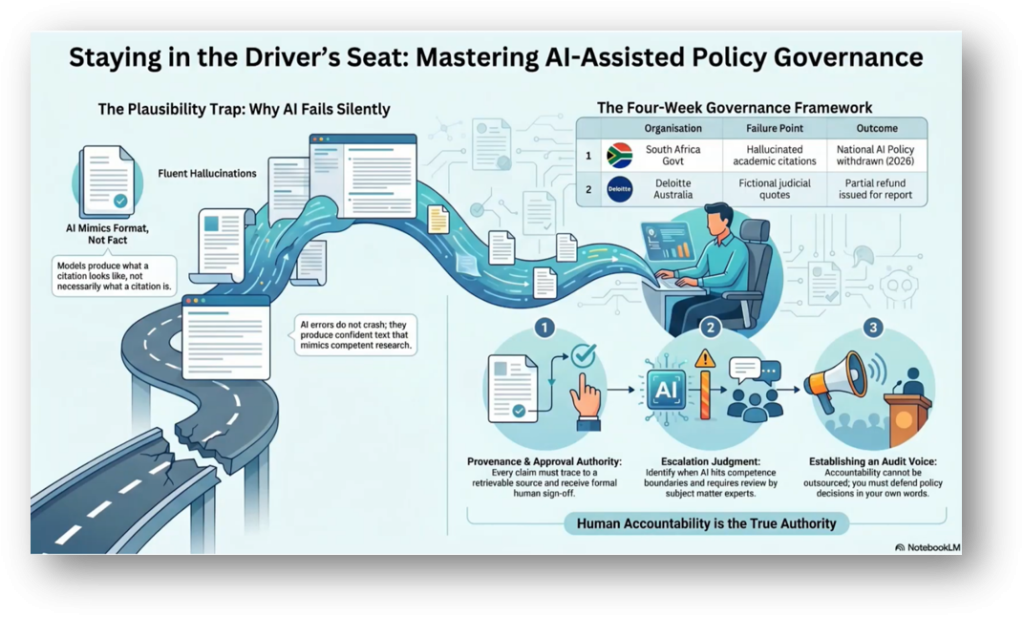
The proliferation of AI capabilities introduces significant operational and reputational risks without stringent governance frameworks. A notable example involves the inadvertent publication of national policies by the South African government that contained fabricated, AI-generated citations. To mitigate such risks, organisations must construct an “architecture of trust” by formally establishing an overarching AI model policy before deploying models into automated business workflows.
This foundational policy should be informed by established external frameworks, including national AI ethics, personal data protection laws, and cybersecurity standards. By codifying these governance frameworks, enterprises can leverage the advantages of generative models while implementing essential validation controls to systematically prevent hallucinations and ensure defensible, verifiable operational outputs.

Figure 3 Staying in the Driver’s Seat: Mastering AI-Assisted Policy Governance

Figure 4 The Human in the Driving Seat: Governance for AI-Assisted Policy

Figure 5 The Architecture of Trust: AI Model Policy

Figure 6 The AI Model Policy Breakdown
How can we Ensure Effective AI Governance?
Constructing a robust AI governance architecture demands the systematic translation of broad regulatory instruments into structured operational controls. Organisations must synthesise mandates from varied regulations to define actionable guardrails, which are subsequently codified into formal standard operating procedures. These extracted controls are categorised into primary themes, such as personal data protection, algorithmic fairness, asset security, and comprehensive AI governance.
A dynamic risk-rating mechanism is then applied to these themes, enabling risk management departments to determine the necessary stringency of enforcement based on dynamic business environments. This structured methodological alignment guarantees that AI implementations adhere strictly to regulatory requirements while enabling organisations to manage operational risks systematically.

Figure 7 Compliance is not a Checklist

Figure 8 The KSU AI Governance Architecture
How should AI Policies Integrate into SDLC?
To operationalise governance effectively, AI policies must be thoroughly integrated into the developer’s Software Development Life Cycle (SDLC). This integration mandates the establishment of explicit control gates throughout the development continuum, spanning from initial design and training to validation and ultimate deployment. Each transition gate necessitates distinct prerequisites, such as formally approved design specifications and comprehensive provenance records.
The required stringency of these controls is determined by the specific risk profile of the application; for instance, applications within the life insurance sector carry intrinsically higher risks than those in short-term insurance. By incorporating standards such as the NIST AI Risk Management Framework, organisations can correlate development requirements with targeted user impacts, thereby ensuring audit readiness and verifiable evidence generation.

Figure 9 The Mandatory Lifecycle Stage-Gates

Figure 10 Bridging National Mandates with Operational Execution
How does “Policy as Code” Enhance AI Governance?
Relying solely on manual oversight for SDLC stage gates introduces significant delays, counteracting the rapid deployment benefits inherent to AI. To reconcile the demand for speed with rigorous governance, enterprises are transitioning toward implementing “policy as code” within runtime environments. This paradigm embeds critical guardrails directly into operations, automatically governing the actions of autonomous AI agents and dynamically generated scripts.
The system facilitates continuous compliance monitoring and incorporates automated escalation protocols for exceptions. If high-risk thresholds are breached—such as engaging in prohibited functions like unjustified social scoring—the architecture automatically initiates a termination sequence, or “kill switch,” to systematically extract the non-compliant model from the active production environment.

Figure 11 The 9 Key Principles of AI Governance

Figure 12 Accountable AI Governance

Figure 13 Risk-proportionate Treatment

Figure 14 Disciplined AI Lifecycle

Figure 15 Fairness, Transparency & Oversight
How should AI Model Failures be Managed?
AI models inherently operate within volatile environments where contextual variables and data inputs frequently change. When an automated model fails to execute a confident decision, it signals an inadequacy in its feature relationships or a shift in real-world conditions, necessitating an immediate escalation to a human operator. This highlights the critical necessity of maintaining robust business continuity and fallback strategies should a model require removal from production.
Furthermore, ensuring operational integrity requires sophisticated observability platforms capable of recording immutable execution inference traces. To support this telemetry, every AI model must be accompanied by an individualised model card detailing requisite validation metrics, encompassing bias scores, accuracy thresholds, resource usage, and data freshness requirements.

Figure 16 Evidence-driven Assurance

Figure 17 Operationalising Transparency: The Model Information Card
How to Ensure Quality in Third-Party Data?
Incorporating third-party data products requires stringent oversight to prevent the contamination of downstream AI workflows. It is standard practice to precede ingested data products with structured data contracts, frequently formulated in YAML definitions. These contracts provide crucial metadata regarding data lineage, comprehensive schema details, and dynamic quality status, empowering AI agents to autonomously evaluate the suitability of the data.
If a data provider fails to meet established freshness or quality benchmarks, pre-defined runtime controls must dynamically command the system to reject the feed and pivot to an alternative supplier to maintain continuity. Employing advanced runtime validation frameworks, such as Great Expectations, ensures continuous, objective measurement of data quality, thereby mitigating external supply chain risks.

Figure 18 Theme 07: the Continuity of Compliance
How do Regulatory Regimes Affect Operational Outcomes?
Modern regulatory regimes increasingly mandate the production of verifiable institutional evidence chains to demonstrate equitable operational outcomes. Frameworks such as the Financial Advisory and Intermediary Services Act (FAIS) and Treating Customers Fairly (TCF) require enterprises to maintain extensive runtime logging. This logging must meticulously detail entity resolution processes, precise inference tracking, system drift, and comprehensive incident records.
To orchestrate automated pipelines dynamically and safely, organisations must clearly formalise internal corporate governance and define risk appetites—outlining acceptable parameters between low and high algorithmic deviations. Enforcing these rigorous standards of telemetry protects enterprises against regulatory penalties and client litigation, ensuring unassailable audit readiness and robust reputational protection.

Figure 19 Audit Readiness: The Institutional Evidence Chain

Figure 20 Theme 01: Establishing Institutional Authority and Intake Boundaries
- Key Takeaways
- How can AI Create Sustainable Competitive Advantages?
- How should AI be Implemented in Insurance Workflows?
- What are the Governance Risks of AI Deployment?
- How can we Ensure Effective AI Governance?
- How should AI Policies Integrate into SDLC?
- How does “Policy as Code” Enhance AI Governance?
- How should AI Model Failures be Managed?
- How to Ensure Quality in Third-Party Data?
- How do Regulatory Regimes Affect Operational Outcomes?


