
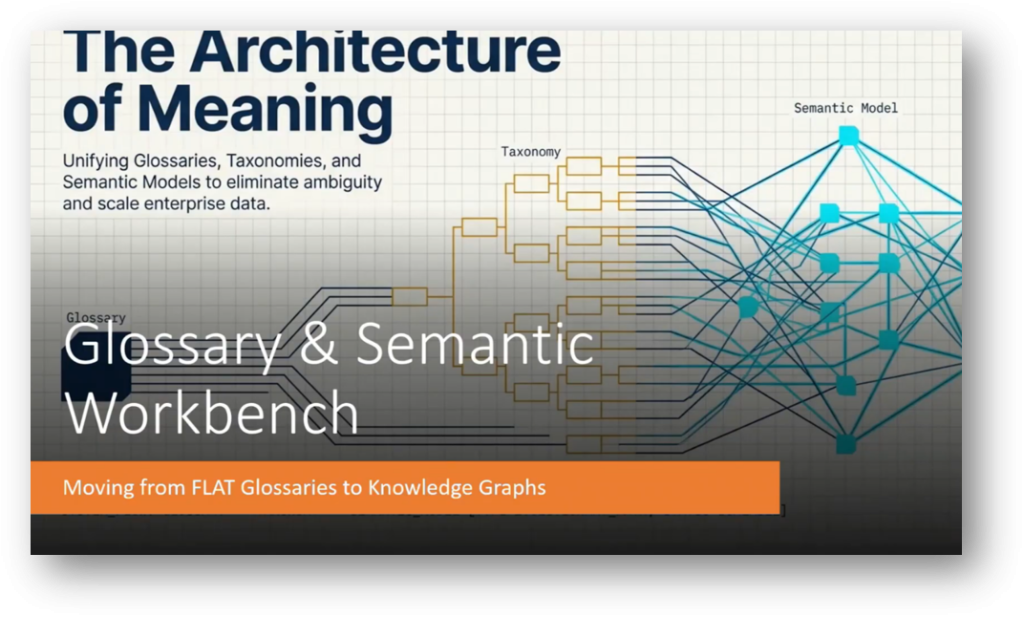
Key Takeaways
- Foundation for AI and Governance: Clear data ownership, defined business terms, and core data products are vital for successful AI initiatives.
- Subject-Predicate-Object (SPO) Framework: Shifting from flat glossaries to an SPO framework enables detailed data models and visual knowledge graphs.
- Strategic Integration of Standards: Aligning internal terminology with international standards fosters reliable data quality assessments and controlled updates.
- Human Curation is Irreplaceable: Human-managed organisational contexts enhance AI performance, while “parking lots” help reconcile terminology effectively.
- Decision Modelling for Automation: Effective business architecture outlines procedural decisions, enabling AI automation while ensuring human oversight for regulations.
- Embedding Controls to Manage Organisational Dynamics: Embed procedural controls in policy to ensure traceability and mitigate “POC fatigue” for agile transitions.
- Rigorous Source Tracking: Applying risk frameworks in Intelligent Document Processing clarifies entities, emphasising the importance of definition sources.
- AI-Assisted Auditing and Version Control: Custom AI skills effectively audit glossaries, ensuring structural integrity before Subject Matter Expert approval.
- Faceted Semantic Architecture: Creating flexible faceted models enhances semantic interoperability between automated agents and various decision processes.
Webinar Details
Title: Glossary & Semantic Workbench for Data Managers
Date: 2026-06-04
Presenter: Howard Diesel
Meetup Group: African Data Management Community
Write-up Author: Howard Diesel
What are the Core Prerequisites for Effective Data Governance?
The development of robust semantic models often begins with resolving complex operational workflows, such as those found in trade finance. By utilising a Claude AI model to process and anonymise organisational documents, practitioners can map out comprehensive enterprise architectures. During this process, significant data management challenges frequently emerge, particularly regarding customer master data.
Ensuring compliance with Anti-Money Laundering (AML) and “Know Your Customer” (KYC) regulations requires stringent data oversight. Ultimately, identifying core data products, defining precise business terms, and establishing clear data ownership are fundamental prerequisites for deploying successful governance and artificial intelligence initiatives.
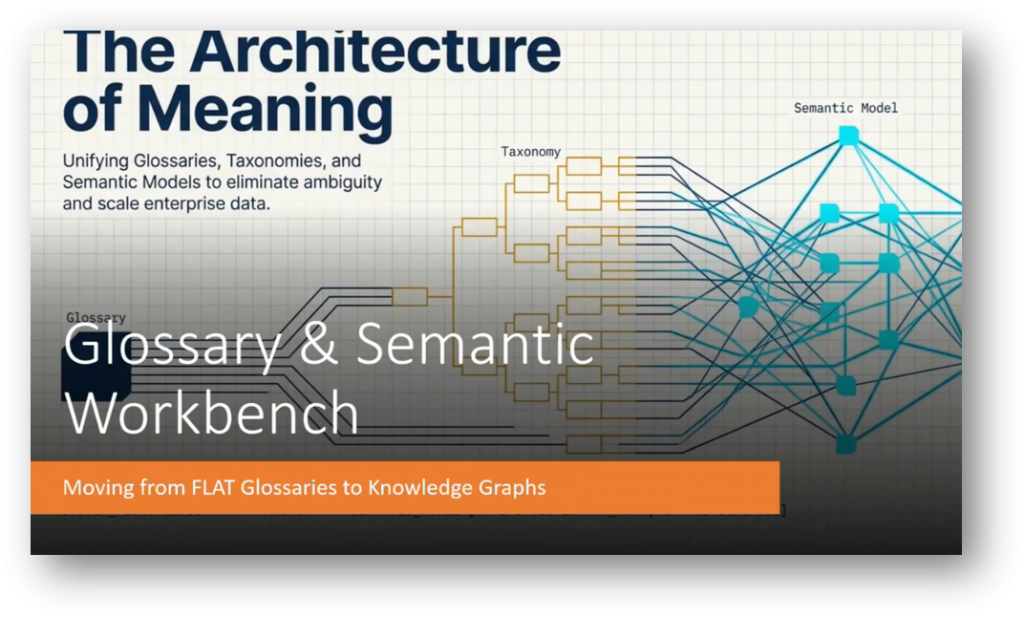
Figure 1 Glossary & Semantic Workbench

Figure 2 Glossary and Semantic Workbench Slide-deck

Figure 3 Trade Finance Pack
What are the Benefits of an SPO Framework?
Managing a traditional, flat business glossary presents substantial structural limitations. To resolve these inefficiencies, organisations can implement a Subject-Predicate-Object (SPO) framework, which enhances term lifecycle management and stewardship. A primary validation metric for any business glossary is its capacity to be translated directly into a functional data model.
For instance, a “letter of credit” can be distinctly defined through SPO statements as a bank’s “promise to pay,” acting as a mechanism that replaces buyer trust with a payment guarantee to the seller. This granular mapping facilitates the construction of visual knowledge graphs, illustrating regulatory compliance, financial conditions, and complex structural relationships.

Figure 4 Reference Data List

Figure 5 Trade Finance, Re-engineered by Agentic AI

Figure 6 Architecture

Figure 7 Business Architecture

Figure 8 Term: “Letter of Credit”

Figure 9 “Letter of Credit” Knowledge Map
How can Data Quality and Standards be Ensured?
Data quality and consistency rely heavily on adherence to international standards. By evaluating internal terminology against frameworks such as ISO 11179, organisations can generate quantifiable quality scorecards for their data elements. Furthermore, mapping internal terms to external benchmarks, like the ISO 3166 country codes, promotes systemic interoperability.
However, establishing direct links between live production systems and external references introduces operational vulnerability, as unverified external modifications can corrupt internal semantic logic. Consequently, organisations must implement structured reference data management systems, utilising controlled development environments and formal role-based approval processes to maintain systemic stability.

Figure 10 ISO/IEC 11179 – Data Element
How does Context Enhance AI Performance Significantly?
The integration of artificial intelligence necessitates a highly curated organisational context. While automated solutions attempt to unilaterally reverse-engineer enterprise knowledge, industry evaluations demonstrate that human-maintained context yields superior AI performance. Developing precise, standardised terminology across disparate domains—including master data, financial crime, and overarching ontologies—demands substantial manual effort.
Reconciling conflicting definitions among independent data stewards is a particularly resource-intensive phase of this process. To mitigate semantic confusion, practitioners utilise “parking lots” to securely document unverified or subjective interpretations, preserving stakeholder input while an official consensus is methodically established.

Figure 11 Semantic Model

Figure 12 Semantic Model Reconciliation Report

Figure 13 Overall Semantic Model
How does Business Architecture Support Operational Targets Effectively?
Effective business architecture directly supports strategic operational targets. Within trade finance, optimising workflows aims to reduce document examination procedures from several days to under ten minutes, facilitating high rates of straight-through processing. This optimisation is achieved via comprehensive decision modelling.
By systematically mapping out procedural decisions—such as evaluating entities against compliance sanction lists to determine whether to block, clear, or escalate a transaction—organisations define strict operational parameters. These well-documented frameworks allow AI agents to execute routine functions securely, ensuring human oversight is mandated only for complex regulatory compliance escalations.

Figure 14 Trade Finance – Value Proposition

Figure 15 Business Objectives & Success Metrics

Figure 16 Documentary-Credit Lifecycle
How can Organisations Improve Decision-making with Controls?
System architecture must proactively manage organisational dynamics and executive overrides. By embedding procedural controls directly into formal policy statements, management can establish definitive decision-making guardrails. This integration ensures that all operational outcomes and procedural deviations remain fully visible and traceable within the system.
Assessing the broader AI value chain reveals that enterprises frequently rely on Proof of Concepts (POCs) to compensate for inadequate use-case analysis. Defining regulatory and internal controls early in the project lifecycle fosters true operational agility, equipping organisations with the structured criteria needed to safely test, fail fast, and transition initiatives into production.

Figure 17 Decision Table

Figure 18 Prodago Demo – Trade Finance

Figure 19 AI Value Chain
What is the AI Value Chain in Governance?
Applying rigorous risk frameworks to specific operational scenarios, such as Intelligent Document Processing, enables organisations to prioritise initiatives efficiently. Evaluating these use cases underscores the analytical value of the SPO framework; dissecting terms into precise subjects, predicates, and objects clarifies the specific entities operating within a knowledge graph far more effectively than flat text descriptions.
Furthermore, preserving the integrity of enterprise definitions requires systematic source tracking. Because a single term, such as “income,” may possess divergent meanings depending on its specific origin document, capturing the foundational source and comprehensive version history is critical for maintaining objective clarity.

Figure 20 Forgery / Tamper Detection

Figure 21 Prioritisation Matrix

Figure 22 Intelligent Document Processing
How can AI Improve Business Glossary Validation Accuracy?
Manual validation of extensive business glossaries is highly susceptible to oversight. To enhance accuracy, custom AI skills can be deployed to systematically audit glossaries for structural anomalies, such as duplicate terms, missing taxonomic parents, or improper role assignments. The AI operates as a preliminary reviewer, flagging discrepancies for Subject Matter Experts to formally accept, amend, or reject. Additionally, modifying active definitions necessitates robust version control to account for historical operations. Preserving knowledge graph snapshots allows enterprises to trace past business decisions back to the exact data definitions enforced at the time of execution.

Figure 23 Document Field

Figure 24 The One Systematic Issue

Figure 25 Running Skills “Anti-sycophancy”

Figure 26 Alias-aware Routing and Hypernym Specialisation

Figure 27 A Curated Reference Data Registry Ready from Day One

Figure 28 Applying Structural Models with Safe Rollback Architecture
What Challenges Arise from Constructing Semantic Models?
Constructing overarching semantic models frequently exposes fundamental structural contradictions. Distinguishing between automated agents and natural persons or accurately modelling the evolutionary taxonomy of a “juristic person,” presents significant integration challenges. To bypass the limitations of rigid, subjective hierarchies, semantic architecture prioritises the use of “facets”.
Maintaining a flat, atomic glossary structure initially allows modellers to assign qualifying facets—such as incorporated or unincorporated status—without forcing premature categorisation. This highly adaptable framework ensures continuous semantic interoperability as data interacts with varying decision engines, external agents, and internal business processes.

Figure 29 Due-Diligence Obligation

Figure 30 Glossary & Semantic Workbench Knowledge Graph

Figure 31 Upper Ontology: Entity, Actor, Party, …

Figure 32 Multiple Facets (Instead of Multiple Inheritance)
- Key Takeaways
- What are the Core Prerequisites for Effective Data Governance?
- What are the Benefits of an SPO Framework?
- How can Data Quality and Standards be Ensured?
- How does Context Enhance AI Performance Significantly?
- How does Business Architecture Support Operational Targets Effectively?
- How can Organisations Improve Decision-making with Controls?
- What is the AI Value Chain in Governance?
- How can AI Improve Business Glossary Validation Accuracy?
- What Challenges Arise from Constructing Semantic Models?


