
Executive Summary
This webinar outlines the critical role of Data Stewardship in enhancing business operations and decision-making. Howard Diesel emphasises the need for a thorough understanding of Data Management, including the importance of metadata and data interpretation within organisational contexts.
The journey of Data Stewardship involves developing a robust capabilities model, particularly in development banking, where the integration of AI technologies like Copilot facilitates efficient industry modelling and communication. Key themes include validating business processes, formulating effective data strategies, and addressing the challenges inherent in Data Stewardship.
The webinar highlights the value proposition of sound data practices in optimising supply chain finance and driving impact management in organisations. Lastly, Howard reinforces the strategic significance of data preparation and application in professional settings.
Webinar Details
Title: Unlock the Power of Data Stewardship for Data Professionals
Date: 19/06/2025
Presenter: Howard Diesel
Meetup Group: African Data Management Community
Write-up Author: Howard Diesel
Data Stewardship and Its Importance in Business
Howard Diesel opens the webinar and shares on the progress made in engaging with Data Stewards to identify their challenges related to Data Management in their departments. The training course he is giving has revealed that Data Stewards are frequently overwhelmed by the complexities they face while trying to fix issues within their own areas.
A notable example comes from a representative of a Development Bank, tasked with assessing non-performing loans and projects. She is currently struggling to consolidate information from approximately 80 to 90 different Word documents and PowerPoint presentations to understand project failures and improve infrastructure initiatives. This situation highlights the widespread difficulties organisations face in managing data effectively and the urgency for better collaboration and support among departments.
Before giving the course, Howard notes that he engaged with Bob Seiner’s content, where Bob expressed scepticism about Data Stewardship, emphasising the need for Data Stewards to grasp the data-related challenges faced by business professionals who often assume these roles. Bob Seiner highlights the complexity of teaching Data Management at an industry or a generic level versus a data-specific level, stressing the growing importance of the latter.
Howard shares that these insights were valuable as he learned that practical tasks such as creating a business glossary or high-level subject area models require careful consideration and time to align with the specific needs of organisations. Additionally, companies such as Woolworths have hired CDMP-certified professionals as Data Stewards who integrate deeply within business units, facilitating a decentralised approach to Data Management that enhances awareness and responsibility for data within those departments.
Effectively managing Data Stewardship within organisations requires understanding both data and business processes. Howard draws a parallel between data and money, highlighting that both are invisible yet essential assets that require careful oversight, much like how departments have dedicated accounting officers to manage budgets. Additionally, he argues that just as accountants need to understand the specific business context to offer sound financial advice, data professionals must also grasp the intricacies of the business and its processes to be effective. This expertise is essential for making informed decisions in Data Management, akin to a mechanic’s requirement to specialise in particular car models.
Figure 1 How-to Steward Data

Figure 2 Learning Objectives

Figure 3 Learning Objectives Pt.2
Understanding Business and Data Stewardship
The best approach to developing Data Stewards within organisations is to identify existing employees who have a natural passion and understanding of data. These individuals often work diligently to ensure data accuracy and have the credibility of their peers. By recognising and nurturing them into a community or club, organisations can organically grow their Data Stewardship, ultimately benefiting from their established trust and expertise within the team.
To effectively transition into a Data Stewardship role, it’s essential to first gain a deep understanding of the business and its industry, particularly since individuals are considering this pathway. The initial task involves comprehensively analysing the department’s history and data origins to identify existing challenges.
This foundational knowledge will enable Data Stewards to leverage their IT skills to create the necessary artefacts to support the organisation. Without this groundwork, new stewards may struggle when facing questions or unexpected issues, highlighting the importance of experience within the specific department.
The Interrogation and Understanding of Data
In last week’s training session, Howard shares that he emphasised the importance of interrogating data before use, encouraging participants to understand its origins, purpose, and any missing elements. He introduced the concept of artefacts that assist in answering key questions about the data, as well as the upcoming RACI matrix that outlines who should be involved in creating these artefacts.
A key focus was on the need to assess Data Management practices, including the creation, updating, and deletion of data, particularly in relation to data privacy and retention cycles. Ultimately, by mastering data interrogation techniques, participants will feel more confident in identifying gaps in data sets and will be better equipped to develop relevant artefacts to address those gaps.

Figure 4 Data Management Artefacts Identification and Purpose

Figure 5 DM Artefact Identification and Purpose
Data Management and the Importance of Metadata
This week, Howard wishes to focus on creating a Data Management artefact playbook, highlighting the prevalence of inadequate metadata in datasets, which often leaves organisations questioning their maturity and positioning among peers. A discussion arose regarding the framework hierarchy between the DMBoK and V-Model, emphasising the importance of mapping artefacts from a technological level (e.g., database tables and keys) up to broader business processes and stakeholder perspectives.
An example shared illustrated the pitfalls of rushing to establish Data Management policies without articulating their value to the organisation. This oversight led to a negative response from senior executives, resulting in a project audit and subsequent cancellation, although the speaker was later involved in the project’s restart.
The need for clarity in communicating benefits to stakeholders highlights the importance of aligning data architecture and modelling with business value. Additionally, an attendee noted that the role of data and process stewards, alongside executive stewards, is to facilitate communication between technical teams and business executives.
These executive stewards help ensure that Data Stewards remain relevant by understanding business challenges and key performance indicators (KPIs). An impact assessment was conducted, demonstrating that Data Stewards could quickly understand the impact of their work on key performance indicators. However, educating them on how to connect their tasks to broader business objectives is essential for improving practices and delivering greater value.

Figure 6 Data Management Artefact Playbook

Figure 7 Framework Hierarchy
The Significance of Data Understanding in Business
Howard discusses the significant progress in elevating the understanding of business among data science students over the past decade. This group, comprising individuals knowledgeable about loan contracts and approvals, has demonstrated a growing appreciation for business concepts compared to previous years. Additionally, an attendee expresses concern about whether business professionals fully grasp the value and importance of these concepts, suggesting that some may still lack a clear understanding of them.
The Journey of Data Stewardship
An attendee shares their journey as a lead data practitioner, emphasising the importance of understanding business needs and fostering relationships with executives to enhance data strategy. Initially acting as a steward, they engaged with business leaders to gauge their perceptions of data, which informed their approach to integrating data into business processes.
Over time, the attendee shares that they developed a community of practice for data practitioners, focusing on balancing technical expertise with soft skills to support business objectives. This collaborative effort includes regular engagements with practitioners and business stakeholders to align data initiatives with strategic goals and ensure compliance, culminating in a five-year journey towards effective data integration and understanding within the organisation.

Figure 8 Complete Vertical Lineage
Understanding Data Stewardship in Business
Another attendee shares that in their experience, while data students can grasp the value and impact of their work on business, this understanding may vary, especially among technical personnel. They note that during a recent experience in the mining sector, these challenges were highlighted, as a client heavily reliant on Excel spreadsheets preferred the ease of access, despite issues such as data duplication and poor management.
The difficulty lay in convincing them of the need for centralised database solutions for better control and reporting, as the prevailing belief in the industry is that if something is not broken, there’s no need to fix it. This led to resistance against addressing the shortcomings of their existing Excel practices.
The importance of enhancing Data Management practices within a business, particularly through improving spreadsheet accuracy and reducing duplication. An attendee highlights that the challenges are caused by copying outdated user information, leading to inflated employee numbers in reports. Additionally, the need for centralised data storage solutions, such as SharePoint or OneDrive, was emphasised to ensure that everyone works from the most current version of spreadsheets. Furthermore, training is also suggested to help employees understand the significance of accurate data reporting and its benefits to the business, particularly in relation to financial objectives.
Fostering a data-driven culture within an organisation is imperative. This is emphasised by the necessity of integrating Data Stewards into the environment to build trust in the data shared. Additionally, by involving all stakeholders in the process, the collective awareness of their interdependent roles and impacts on the value chain is enhanced. This collaborative approach has been shown to create a stronger commitment to Data Stewardship and improve trust in data across the organisation.
The Value Proposition and Value Chains in Development Banking
In a recent discussion with a Development Bank, Howard shares that his aim was to enhance their understanding of their value proposition to key stakeholders, particularly the disadvantaged communities lacking proper infrastructure. During a debate, it became evident that while they struggled to articulate their value in clear terms, they recognised their mission to uplift these communities. He adds that together they explored value chains, capabilities, and models, which helped them grasp the importance of having a data catalogue for better Data Management, including understanding where data was located and the terminology used.
Lastly, Howard shares that instead of starting with definitions, he introduced examples of data products to spark interest, leading to a more engaging dialogue. This culminated in the creation of a dashboard that visually connected all elements of the value chain, showcasing their interconnectedness and enhancing their strategic insights.
Business Architecture in the Development Bank
The current state of a development bank’s solution and application architecture reveals a heavy reliance on Excel and three main systems: CRM, SAP, and a project management tool. Additionally, Howard added that the lead Data Management officer disclosed the absence of a documented business architecture, complicating efforts to assess their operating model.
Despite a lack of a tailored reference model for development banks, insights were drawn from aspects of financial services related to development loans. Identifying stakeholders proved effective, with the team acknowledging that approximately 90-95% of the stakeholders aligned with the documented list. This led to the creation of a RACI matrix by subject area to clarify necessary data for stakeholders to enhance their operations.
Howard shared his experience of creating a value proposition and leveraging Copilot. In a training session, he wished to share this with the attendees. However, he found that, even with support from IT announcing a revised policy to facilitate Copilot usage, many participants shared their hesitation, as they had not previously engaged with the tool.
The primary focus of the development bank was on promoting economic growth and social development, particularly in underserved communities that lacked support from commercial financial institutions. Howard notes that reviewing a value chain that linked strategic planning to key development metrics resulted in positive feedback on the clarity of these concepts.

Figure 9 Working with Copilot to Fill in the Gaps

Figure 10 Building a Generic Business Architecture

Figure 11 “Stakeholders”

Figure 12 “Stakeholder List”

Figure 13 “RACI Matrix”

Figure 14 Value Proposition and Value Chain

Figure 15 Value Proposition and Value Chain Pt.2

Figure 16 “Value Proposition”

Figure 17 “Value Chain”

Figure 18 “Dashboard Requirements”

Figure 19 “Wireframe”

Figure 20 “Suggested Capabilities”
Developing a Capabilities Model in the Development Bank with Copilot
Howard created the capability model utilising Copilot, which facilitated interaction through iterative questions and corrections to refine the output. This model encompasses various stakeholder inputs, detailing the value proposition, delivery venues, efficiency metrics, value chain components, and business processes. Additionally, key elements include a logical data model aligned with strategy, essential data requirements, and system mappings that connect subject areas to operational systems.
The framework also facilitates effective knowledge management, enabling Data Stewards to explore value propositions and understand the mappings between subject areas and systems, while providing insights into business processes such as loan origination. Overall, the model serves as a comprehensive tool for defining development goals and improving integration within the bank’s operations.
The project involved developing a comprehensive understanding of the value proposition across different stakeholder sectors, which led to the creation of KPI-to-value chain mappings that highlighted the impact of various capabilities. Key elements included strategic planning and policy alignment, with an emphasis on understanding the lineage of project proposal information. This concept revealed gaps in knowledge of upstream and downstream usage.
Suggestions were made for specific systems to facilitate project proposals, followed by a proposal for data lineage for consideration. Furthermore, the focus shifted to establishing Data Stewardship within the organisation by defining roles and responsibilities for Data Management, integrating processes as outlined by Limo, and ensuring effective communication and education. Metrics were established, and tools were identified to support these efforts, utilising the Robert Signer framework to address different Data Stewardship needs at various levels.

Figure 21 Suggested Capabilities Pt.2

Figure 22 Capability Model for the Development Bank

Figure 23 Copilot Notebook

Figure 24 Conversation with Copilot

Figure 25 Business Process Example

Figure 26 Development Bank Concept Model

Figure 27 Development Bank Business Goals Infographic

Figure 28 KPI to Value-Chain Mapping

Figure 29 Value-Chain Capability Graph

Figure 30 Data Lineage Documentation

Figure 31 Data Lineage Suggestions

Figure 32 Framework Application

Figure 33 Framework Application Pt.2
Use of Copilot in Building Industry Models and Data Communication
As shown, Howard reiterates that Copilot may be utilised to build an industry model aimed at aiding Data Stewards in understanding their challenges and the significance of their data. He highlights the potential for Copilot to learn from interactions, thereby enhancing its responses for future users while maintaining data privacy.
Despite concerns about how Copilot may evolve over time with accumulated user interactions, Howard expresses confidence that foundational elements of business and data architecture, such as the value proposition, value chain, and various models (capability, subject area, conceptual), will remain constant and not change significantly.

Figure 34 “Enterprise data protection in Microsoft 365 Copilot and Microsoft 365 Copilot Chat”
Supply Chain Finance and the Role of AI in Technology
The Development Banks’ evolving role in supply chain finance had previously faced challenges, resulting in a halt to their involvement. Recently, there has been a reassessment of this area, with an emphasis on new business ideas and case studies from countries like India that utilise geospatial data, IoT, and blockchain to enhance project management among multiple stakeholders.
These technologies have enhanced transparency and facilitated timely communication for development banks, enabling them to stay informed about project progress. Additionally, tools like Copilot can draw attention to relevant documents and provide enhanced insights, offering web references and citations for independent verification of information. This ensures users have access to accurate data and recommendations.
Howard highlights the importance of utilising business architecture and capabilities by providing references for best practices, particularly in different contexts such as South Africa and the US. A significant point raised by Monet emphasises the need for technology to enhance understanding and productivity.
An example was shared involving a woman who was hesitant to engage with AI tools while working on her doctoral thesis due to fears of information leakage. After demonstrating how conversational AI could aid her validation process, she regretted not using such tools earlier, realising they could have improved her efficiency. Ultimately, the key takeaway is to leverage external inputs effectively rather than resorting to simplistic copy-and-paste methods, which can hinder the quality of research and insights.

Figure 35 Suggested Capabilities Pt.3
The Importance of Thought and Data Interpretation in Data Practice
In the context of the community of practice for data practitioners, it’s crucial to nurture and develop your ideas to achieve your goals. Engaging in thoughtful questioning about industry standards and available information will help shape the intellectual insights necessary for organisational success.
While tools like Copilot can provide valuable technical metadata, it’s essential to interpret this information within your specific business context. By translating technical data into relevant insights for your domain, whether it pertains to customers or products, you can drive more impactful outcomes.
Development and Application of a Knowledge Database in AI Systems
Howard discusses the development and implementation of a chatbot integrated with an RAG vector database that houses the organisation’s policies and procedures. This system enables the chatbot to provide accurate responses to inquiries based on internal documents rather than external sources, enhancing knowledge management.
By creating a comprehensive knowledge database, the organisation improves access to essential information, making it easier for employees to find relevant policies and practices. Howard also shares an example of how the chatbot identified missing capabilities from their existing model when compared to an external guide, illustrating the potential of leveraging AI to enhance organisational knowledge and decision-making.
Selective information retrieval suggests that one can restrict access to data only from internal systems rather than the Internet. It emphasises the need to rely on a designated database, or “rag,” stating that if information isn’t available there, external sources should not be consulted. Additionally, Howard emphasises the evolving nature of inquiry, stressing that asking the right questions is crucial for effective understanding and highlighting the value of thorough investigation, which extends beyond merely posing questions.

Figure 36 Copilot’s Ability to be Restricted to Information Uploaded

Figure 37 Sourced Supply Chain Finance Book by Development Banks
The Importance of Preparation in Professional Settings
Howard notes a recent incident that highlighted the importance of thorough preparation and understanding strategies before presenting them to a board. In this case, a team submitted a comprehensive strategy but struggled to answer the board’s questions because they lacked a deep understanding of its contents.
This situation highlights the importance of thorough research and active engagement in the implementation process, as merely copying and pasting or relying on AI tools, such as an inexperienced legal team using ChatGPT for case preparation, can lead to significant errors. Ultimately, successful execution requires constant guidance, conversation, and critical assessment of the materials involved.
Validating the Business Processes
Over the past week, Howard shares that he has been engaging in a steep learning curve regarding business processes and capability models. He adds that he has developed reference tables to validate and ensure consistency across various business elements, including goals, value chains, key performance indicators (KPIs), and stakeholders.
By importing data into Excel and cross-checking it against these tables, Howard was able to identify discrepancies and correct errors effectively. In just three days, he compiled definitions and examples for 725 business terms and gained a foundational understanding of development banks, which I presented confidently. Additionally, this experience highlighted the remarkable productivity that can be achieved through systematic documentation and validation, prompting discussions on the importance of engaging with the business for further validation of definitions.
Howard then emphasised the importance of collaborative learning and the development of relevant definitions within a business context. He shared that he engaged with the participants by providing definitions and encouraging them to evaluate these terms through discussion and debate critically. This process not only allowed participants to refine their understanding but also fostered a sense of ownership and investment in their learning.
A key moment arose when one participant highlighted the need for a practical approach to their discussions, demonstrating their awareness of existing gaps and the necessity for improvement. Howard adds that the conversation underscored the value of interactive dialogue, moving beyond generic templates to create a dynamic learning environment where participants could identify and address challenges collaboratively.
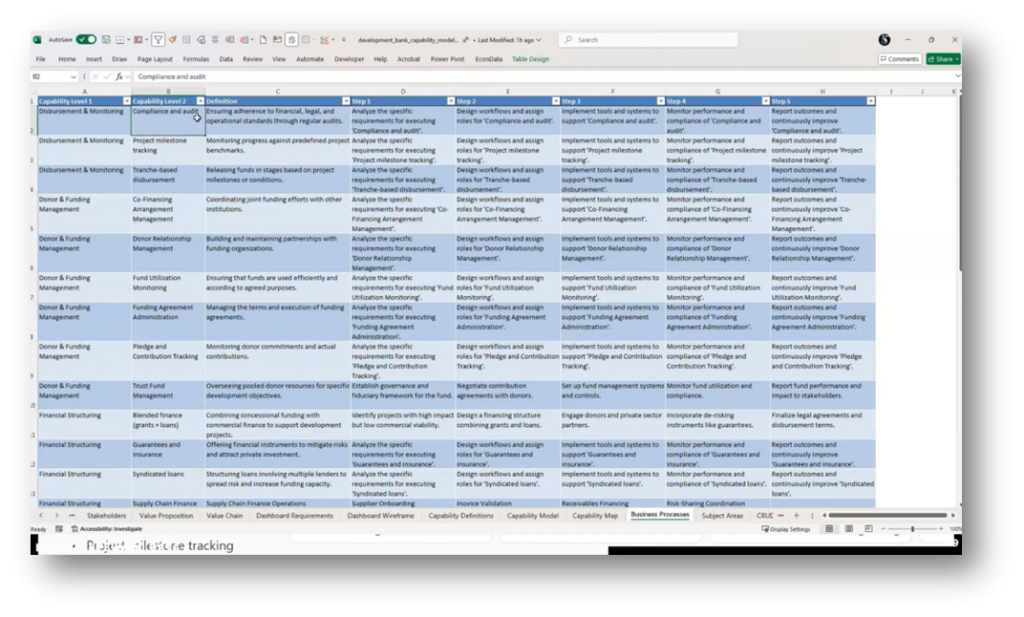
Figure 38 Capability Level

Figure 39 Reference Data

Figure 40 Reference Data Pt.2
Data Strategy and Impact Management in an Organisation
When prioritising departmental change within a data strategy framework, a key question arises: should one tackle the largest department first, potentially delaying ROI for stakeholders, or start with smaller, manageable tasks? The head of Data Management suggests demonstrating an approach to building a data strategy, which begins by creating a use case portfolio that involves engaging various business departments to identify their value chains, key performance indicators (KPIs), challenges, and opportunities. Additionally, emphasising the importance of a global perspective, the speaker notes that while departments often quickly recognise problems—such as issues with master data and reference data—they are slower to identify potential opportunities for improvement.
The process involves identifying global innovation opportunities and assessing their impact on the value chain, feasibility, and organisational capabilities. A use case ideation phase is conducted, followed by the creation of a data strategy that categorises these opportunities by subject area and data type. This includes evaluating use cases for client and stakeholder management, with a particular focus on authoritative sources and identifying potential for uplift.
The rankings of these use cases are determined through a voting system within a steering committee, considering constraints in current resources, which limits the selection to a few cases based on their impact and feasibility. Additionally, a prioritisation matrix is utilised to evaluate high-impact initiatives and their technical feasibility. Ongoing Data Stewardship efforts emphasise building a business glossary to inform priorities and impact assessments.

Figure 41 Use-Case Portfolio

Figure 42 Data Strategy

Figure 43 “Summary of Use-Case Portfolio”
The Implementation of Data Management Strategies
An attendee shared their reflection on the importance of effectively communicating business requirements and engaging with diverse stakeholders across different divisions and countries. They emphasised the necessity of presenting a clear rationale for project initiatives to avoid wasting valuable meeting time on justifying their purpose, as well as the significance of linking deliverables back to business goals.
By addressing key categories of data-related questions, Howard highlighted how answering these inquiries can enhance data discoverability, understanding, and trust. He noted that having a Data Management Officer involved from the beginning fosters collaboration and trust, ensuring that everyone is aligned with the project’s objectives. Ultimately, Howard underscored the value of selecting appropriate artefacts, such as data catalogues and glossaries, to achieve the desired benefits of data rationalisation and harmonisation.

Figure 44 “Business Data Definition Questions”

Figure 45 “Category Explanation”
Challenges and Solutions in Data Stewardship
On the challenges faced in training Data Stewards for effective Data Management, an experience was highlighted where efforts to teach data modelling were met with confusion and resistance, as many participants struggled to grasp the concepts presented. Feedback indicated that the training was not appropriately tailored to the participants’ existing knowledge and skill levels, necessitating a shift to more relevant content.
Howard then touches on the need for Data Stewards and data scientists to possess a deep understanding of business operations, suggesting that true Data Stewards are often found through passion and experience rather than being solely created through formal training. Ultimately, self-service analytics empowers business users to present reports in a way that aligns with their operational needs.
Empowering business users to create their own reports using self-service analytics, rather than relying solely on BI developers, would elevate a key challenge. This is often due to a lack of clarity among business personnel regarding which data systems pertain to their requests, resulting in data lineage issues when process information is combined inappropriately.
Howard emphasises the need for training tailored to different organisational levels, allowing executives to guide technical teams effectively. Additionally, real-life examples from a Development Bank showcase the benefits of collaborative learning and the value of constructive feedback, ultimately promoting better understanding and utilisation of data assets within the organisation.
The Debate on Perfected Collateral in Financial Services
The term “perfected collateral” has caused significant conflict between legal professionals and Development Bank personnel, particularly when a legal expert questioned its usage during a meeting. This disagreement escalated over three weeks, prompting an internal audit to review the definition and application of perfected collateral in their processes.
Essentially, perfected collateral requires the filing of a public notice; without it, another lender can claim the same collateral, jeopardising the rights of the first lender. This situation underscores the crucial importance of adhering to proper legal procedures to prevent unperfected collateral, which can result in losing access to assets when needed.
Data Management and Process in Business
Creating a glossary requires a collaborative approach, where individuals contribute definitions based on their business process perspectives. This is essential because context can shift the interpretation of terms. Engaging various departments allows for a comprehensive comparison of these definitions, ultimately clarifying the importance of the processes involved.
A structured approach not only facilitates understanding but also fosters engagement, especially among Data Stewards, as they take ownership in managing these definitions. The most rewarding aspect of this process is witnessing the moment of realisation when individuals comprehend the significance of their roles and the processes they manage.
An attendee then highlights the pivotal role of Data Stewards in ensuring accurate Data Management, emphasising their passionate and demanding nature. They note that several strong female leaders from various departments effectively drove this initiative. Despite some perceptions that Data Stewards are overly pedantic, their energy and enthusiasm are crucial to success.
Howard recommended that proper support be provided to harness this momentum, as without it, efforts may falter. Additionally, the importance of understanding and adapting to the specific working environment of Data Stewards was underscored. Furthermore, an attendee contributed by reflecting on the insights gained from case studies, particularly the SIP (Capture, Input, Process, Save, Output, Decide, Analyse) model, which aids in organising data functions.
The process of Data Management involves capturing, inputting (either manually or automatically), processing, and saving data, with emphasis on the roles of database management and archival. This is not necessarily linear, as data can be captured from one system while simultaneously outputting to another, necessitating processing in between.
Aligning Data Management efforts with business functions, rather than applications, often yields better results despite potential political complexities. Understanding the value chain of data flow is crucial; collaboration between departments, such as reconciling data needs between Department One and Department Two, can lead to improved data accuracy and requirements. Lastly, considerations regarding data transparency and storage, particularly in light of recent legal rulings on AI Data Management, highlight the importance of vigilance in handling sensitive data.
- Executive Summary
- Data Stewardship and Its Importance in Business
- Understanding Business and Data Stewardship
- The Interrogation and Understanding of Data
- Data Management and the Importance of Metadata
- The Significance of Data Understanding in Business
- The Journey of Data Stewardship
- Understanding Data Stewardship in Business
- The Value Proposition and Value Chains in Development Banking
- Business Architecture in the Development Bank
- Developing a Capabilities Model in the Development Bank with Copilot
- Use of Copilot in Building Industry Models and Data Communication
- Supply Chain Finance and the Role of AI in Technology
- The Importance of Thought and Data Interpretation in Data Practice
- Development and Application of a Knowledge Database in AI Systems
- The Importance of Preparation in Professional Settings
- Validating the Business Processes
- Data Strategy and Impact Management in an Organisation
- The Implementation of Data Management Strategies
- Challenges and Solutions in Data Stewardship
- The Debate on Perfected Collateral in Financial Services
- Data Management and Process in Business


