
Executive Summary
This webinar highlights the essential elements of ethical behaviour in organisations, addresses challenges in detection, and emphasises the importance of fostering a strong ethical culture through feedback. Costa and Christine Ayiotis explore levels of ethical maturity, the complexities of organisational culture, and the issues faced by data-disabled environments.
The webinar emphasises the need for source criticism to build data trust, the principles of duty of care and privacy, and reflects on real-world ethics failures and algorithmic accountability. Lastly, Costa and Christine underscore the importance of Ubuntu principles and community engagement, advocating for proactive ethics and continuous vigilance.
Webinar Details
Title: Data Culture and Data Ethics for Data Citizens with Costa and Christine Ayiotis
Date: 2021-03-10
Presenter: Costa and Christine Ayiotis
Meetup Group: African Data Management Community Forum
Write-up Author: Howard Diesel
Opening and Setting the Context
The webinar opens, and Howard Diesel highlights the importance of fostering awareness around data ethics and culture within organisations. He emphasises a critical transition from merely understanding theoretical concepts—such as the “why” and “what” of ethics—to effectively implementing practical solutions that address the “how.” By prioritising awareness, organisations can cultivate a deeper understanding of ethical principles at all levels, moving beyond simply instructing individuals on what actions to take.
This awareness-first approach is essential for driving meaningful change, as it recognises that ethical transformation cannot occur through mandates alone. Instead, it requires open discussions, continuous engagement, and a shared commitment to integrating ethical considerations into daily data practices. By embedding this understanding within the organisational culture, companies can create a sustainable foundation for ethical behaviour and decision-making.
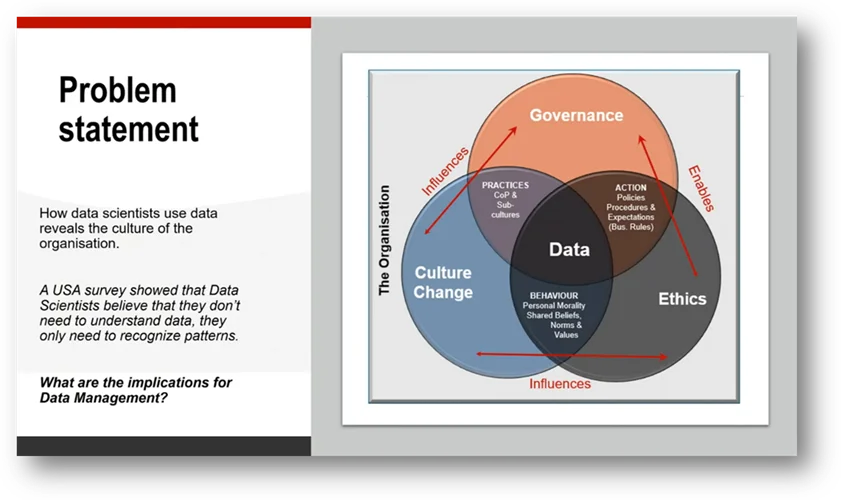
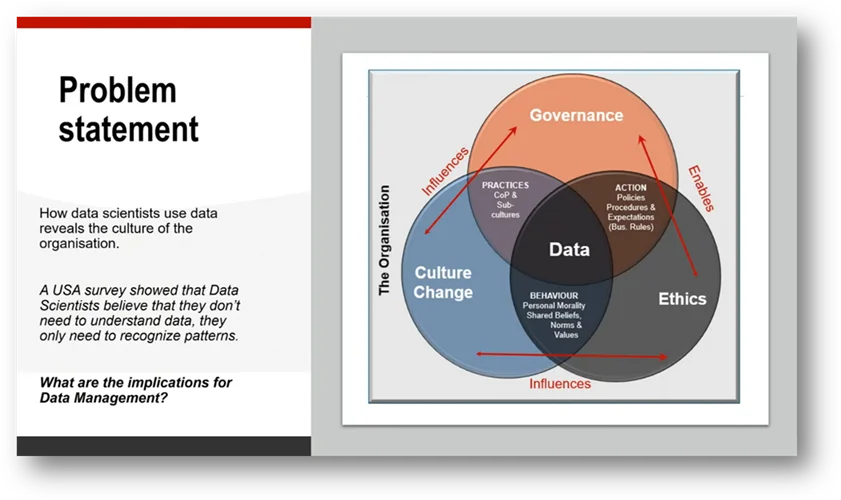
Figure 1 Problem Statement
The Challenge of Detecting Ethical Behaviour
In his role as ethics officer for the DAMA International Board, Howard reflects on his initial struggle to recognise unethical practices during his first board meeting, despite considering himself a moral individual. This experience underscores a fundamental insight: ethics cannot simply be grasped through theoretical understanding of concepts such as maleficence and beneficence. Instead, it necessitates active engagement through conversations, questioning, and open discussions among colleagues.
Data scientists play a crucial role as the first line of defence against unethical behaviour, as they directly engage with data, link diverse datasets, and uncover significant correlations before others identify issues. The key to ethical data handling lies in establishing the “truth of the data,” which involves a thorough understanding of its source, authority, and context. Only with this foundation can meaningful inferences be drawn or conclusions made, ensuring that ethical considerations remain at the forefront of data practices.
The Importance of Feedback and Ethical Culture
The importance of feedback mechanisms in ethical data systems is a central theme in discussions surrounding modern automated systems and machine learning algorithms. Drawing insights from the work of Katherine O’Keefe and Daragh O’Brien, Costa Ayiotis highlights the need for outcomes that align with stakeholder expectations in both societal and organisational contexts.
A critical challenge arises: how can we ensure continuous community feedback to prevent harm before it occurs? The dialogue reveals a tension between digital surveys, which may not provide accurate responses, and face-to-face engagement, often deemed “ground zero truth” by sociologists but typically more resource intensive.
To address these challenges, Costa underscores the need to cultivate an open, safe environment that embraces diversity within teams. This transition from individual moderation to community-based decision-making reflects a broader commitment to the philosophy of Ubuntu, emphasising the importance of actively engaging and including individuals both internally and externally, even when the process becomes complex and demanding. This approach fosters a more ethical framework for data systems, ensuring that the voices of diverse communities are heard and valued in decision-making.

Figure 2 Ethical Data & Information Management (Reference Material)

Figure 3 Ehtical Enterprise Information Management (E2IM)

Figure 4 Ethics of the Individual
Moving Through Ethical Maturity Levels
In contemporary organisations, ethical decision-making often starts at the individual level, with personal moral frameworks guiding choices. This reliance on individual ethics can lead to a dangerously fragmented approach, as employees may hold differing ethical standards and interpretations of situations.
A poignant example from Christine Ayiotis illustrates this risk: project managers’ pressure to meet deadlines led teams to ignore their doubts about the system’s safety, resulting in disastrous outcomes. The relentless pace of modern work environments, characterised by sprints and high expectations, often pressures individuals to overlook or compromise their ethical standards.
To address these challenges, it is essential for organisations to shift from individual ethical moderation to a more structured approach that includes situational and organisational frameworks, ultimately evolving towards community-based moderation. Christine proposes a maturity model consisting of five levels of ethical sophistication, emphasising the importance of progressing through these stages to cultivate an ethical culture. By fostering a shared understanding of ethical standards and promoting collective responsibility, organisations can mitigate risks and enhance decision-making processes, creating a more robust ethical infrastructure.
Figure 5 Ethics of the Individual pt.2

Figure 6 “Structures exist for Resolution of Ethical/Moral Issues”

Figure 7 Problem Statement
Understanding Culture and Its Multidimensional Nature
Christine elaborates on the intricate, multidimensional nature of culture, emphasising that it encompasses shared values, beliefs, norms, and behaviours. She introduces a framework that illustrates how culture operates across various dimensions.
This includes individual characteristics such as age, gender, background, education, and religion, as well as organisational factors such as functional level, department, leadership style, and seniority. Geographic influences also play a significant role in shaping cultural dynamics, underscoring the complexity of ethical behaviour, which is deeply intertwined with these cultural dimensions.
Furthermore, Christine discusses measuring ethical behaviour on a continuum, ranging from distrust and disagreement to trust and agreement. Organisations often find themselves categorised as “data-disabled” when a foundation of trust is lacking; however, they can progress through phases from “data-enabled” to ultimately becoming “knowledge-driven” organisations. This progression illustrates that each stage builds on the last, requiring increasing maturity and trust to foster an ethical organisational culture.

Figure 8 Creating an Ethical, Decision-Data-Driven Culture

Figure 9 Culture = Shared Values + Beliefs + Norms + Behaviours

Figure 10 Culture = Shared Values + Beliefs + Norms + Behaviours pt.2
The Data-Disabled Organisation Challenge
Organisations often struggle to truly appreciate the value of data, as evidenced by their investment in data management practices and in developing data strategies. Many businesses find themselves confined to descriptive analytics, primarily answering “what happened” questions rather than delving deeper into underlying insights.
This lack of trust in their business intelligence (BI) systems leads to a detrimental practice in which employees seek validation from colleagues rather than engaging critically with reports, or, worse, disengaging entirely from analysing data. Furthermore, the tendency to prioritise narrative creation over genuine data understanding exacerbates the issue, as businesses manipulate original sources to fit preferred stories.
An illustrative confession from an actuary highlights this troubling dynamic: “We beat the data until it confesses,” suggesting a mindset in which predetermined conclusions take precedence over authentic data insights. Ultimately, unless organisations confront biases and ensure high data quality, they are unlikely to break free from a data-disabled state, hindering their ability to unlock the full potential of their data assets.

Figure 11 What Indicates Data Culture Change Challenges Exist

Figure 12 Data Disabled to Knowledge Driven Organisations
Source Criticism and Building Data Trust
The importance of historical perspective and source criticism in data analysis is crucial for ensuring data validity. An attendee highlights that historians have grappled with the notion that complete data is rarely available, necessitating a thorough explanation of the usability of existing data.
This principle is equally relevant in advanced analytics and business intelligence environments, where understanding biases—particularly survivor bias—becomes essential. The structured quality assessment process not only enhances data credibility but also fosters trust among users.
Transparency in algorithms is vital to building this trust. Howard advocates making code accessible so users can validate the methods used in data transformations and exclusions.
It is important to clarify that while algorithms themselves are not inherently biased, bias manifests in our perceptions during data creation, usability interpretation, and result analysis. By promoting visible quality processes and possibly establishing public domains for examining code and data quality, we can demonstrate our commitment to ethical data practices and instil confidence in the analytical outputs presented.
Duty of Care, Privacy, and Consent Ethics
Various philosophical frameworks, including deontology, virtue ethics, utilitarianism, and the African philosophy of Ubuntu, influence the overarching theme of duty of care in data ethics. While many companies comply with GDPR and POPIA by focusing on contractual rights and legitimate interests, they often avoid the more challenging task of obtaining explicit consent due to its perceived risk and inconvenience. This approach undermines the ethical obligation, especially when viewed through the lens of Ubuntu, which advocates for a community-consensus model that prioritises collaboration, beneficence, and non-maleficence.
The WhatsApp-Facebook consent controversy highlights the consequences of inadequate consent practices, as illustrated by Apple’s push for transparency in data practices versus WhatsApp’s “take it or leave it” communication method. Additionally, the principle of proportionality is crucial, requiring that data initiatives avoid disproportionate risks relative to their benefits. For example, the proposal to link patient medical records with social media and location data for exercise recommendations raises significant concerns about privacy loss and re-identification risks, illustrating the need for ethical foresight in data usage.

Figure 13 Ethical Theories

Figure 14 The Philosophy of Ubuntu
Real-World Ethics Failures and Algorithmic Accountability
The ethical failures associated with algorithmic systems in education highlight the importance of accountability and the limitations of technology in assessing human potential. A notable example occurred in UK schools during the COVID-19 pandemic, where an untested algorithm was used to predict students’ grades based on prior teacher assessments.
This system not only failed to deliver fair outcomes but also revealed significant systemic biases related to race, gender, and socioeconomic status, resulting in public outcry over issues of fairness and transparency. An illustrative case from Soweto further underscores these limitations, as a student who achieved exceptional academic success—earning nine distinctions with perfect scores in math and physics—defied all algorithmic predictions shaped by environmental factors.
In light of these events, the need for a collaborative approach to data science becomes increasingly clear. The principles of Ubuntu, which emphasise group ownership and shared responsibility, can guide data scientists in navigating their ethical obligations.
It is crucial for professionals in this field to continually reflect on their duty of care and the implications of their work, fostering environments where ethical concerns are openly discussed and vetted. By prioritising accountability and collaboration, the industry can work towards systems that genuinely recognise and nurture individual potential, rather than reducing it to mere data points.

Figure 15 Example for ‘Duty of Care’
Ubuntu Principles and Community Engagement Challenges
The philosophy of Ubuntu, encapsulated in the phrase “I am a person through another person,” emphasises the importance of respect, goodwill, and community cohesion. By valuing external stakeholders and prioritising their welfare, organisations can create a more harmonious social environment that fosters mutual respect and trust.
However, a significant challenge arises when attempting to engage entire communities while managing the complexities of team consensus, which can slow decision-making. Costa highlights the necessity of customer-centricity and emphasises that meaningful engagement with external stakeholders is essential for effective outcomes.
To address these challenges, organisations must integrate team members who can actively engage with communities, ensuring their voices are heard in decision-making. Establishing robust feedback loops is crucial, particularly in the context of recent failures, such as teachers being dismissed without explanation.
As AI continues to shape industries and amplify corporate influence, the public’s right to consultation and transparency becomes increasingly important. Thus, companies must prioritise consent as the default approach, balancing commercial interests with a commitment to ethical responsibility in the face of powerful AI technologies.

Figure 16 The Value of Ubuntu Principles for Data Teams
Proactive Ethics and Continuous Vigilance
The importance of embedding ethical principles within organisations is crucial for navigating complex and often ambiguous situations. Ethics should be integrated at every level of an organisation through ongoing dialogues that promote transparency and continuous questioning.
Engaging in higher-order thinking is essential, as ethical dilemmas often present grey areas that require careful consideration of potential consequences. For instance, a participant shared an example of an oil drilling peer review, highlighting how geologists critically examine motives before committing to data, ensuring that intentions are understood before acting.
To foster a culture of ethical vigilance, organisations must prioritise proactive approaches over reactive responses, which often come too late and lead to reputational damage. This proactive stance should encompass respect for privacy and consent, creating safe spaces for discussions around ethical practices.
An attendee provided a practical illustration of these principles in action through structured questioning and team collaboration, reinforcing that awareness must be constant and that people should always come before data in every step of the process. In conclusion, the ongoing conversation about ethics is vital for the success and integrity of data-driven organisations.

Figure 17 In Summary
- Executive Summary
- Opening and Setting the Context
- The Challenge of Detecting Ethical Behaviour
- The Importance of Feedback and Ethical Culture
- Moving Through Ethical Maturity Levels
- Understanding Culture and Its Multidimensional Nature
- The Data-Disabled Organisation Challenge
- Source Criticism and Building Data Trust
- Duty of Care, Privacy, and Consent Ethics
- Real-World Ethics Failures and Algorithmic Accountability
- Ubuntu Principles and Community Engagement Challenges
- Proactive Ethics and Continuous Vigilance
