
Key Takeaways
- Real-Time Observability: Modern Generative AI needs real-time observability to ensure quality and avoid risks like hallucinations.
- Semantic Architecture Foundation: Organisations must align business architecture with semantic architecture for consistent terminology and concept understanding.
- “Policy as Code”: Business policies should use clear language to convert them into executable code for real-time enforcement.
- Governance as an Accelerator: Effective data governance ensures reliable controls, enabling AI systems to operate confidently at maximum speed.
- Eradicating “Black Holes” via Context Bundles: Document overrides of AI decisions to enable continuous learning and capture expert knowledge.
- Governance Gates and Human-in-the-Loop: Automated systems need governance gates to validate contexts and trigger human escalation in critical situations.
- Differentiating System Drifts: Monitor deployed AI for data drift, model drift, and schema drift due to changes.
- Navigating Environmental Drift: Organizations need dashboards to monitor policy performance and adapt to environmental changes continually.
- Elevating Metadata: Advanced computational power enables organisations to use metadata for tracking errors and preventing data contamination.
- Automated Traceability and Audit Trails: Systemic accountability is achieved by recording inputs, outputs, and state transitions in databases.
Webinar Details
Title: Is your Semantic Model truly AI Ready for Data Citizens
Date: 2026-03-12
Presenter: Howard Diesel
Meetup Group: African Data Management Community
Write-up Author: Howard Diesel
What is Observability in Semantic Architecture?
The implementation of modern Generative AI systems necessitates a paradigm shift toward real-time observability, diverging from traditional data platforms that relied on background Extract, Transform, Load (ETL) processes. Continuous monitoring of behavioural quality is now imperative to mitigate risks such as system hallucinations. Furthermore, establishing a robust data model requires an antecedent focus on semantic architecture.
This process involves aligning business architecture with semantic models to ensure precise comprehension of terminology across the enterprise. Achieving this consistency demands rigorous frameworks to resolve overlapping field definitions and prevent conceptual confusion. By systematically applying definition frameworks, organisations can secure a reliable foundation for enterprise information architecture and subsequent AI deployments.
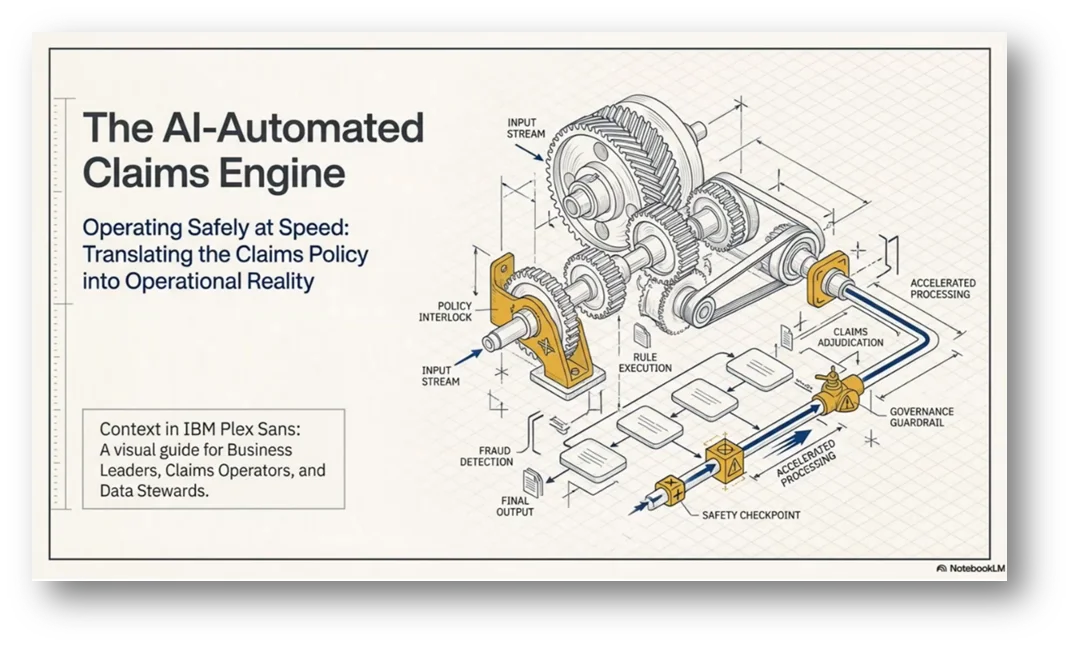
Figure 1 The AI-Automated Claims Engine
How to Write and Implement Business Policies?
Developing comprehensive business policies requires significant dedicated effort, yet the primary challenge lies in their operationalisation. Effective policy documentation must utilise accessible terminology to ensure comprehension among senior stakeholders, such as Chief Financial Officers, whose primary mandate is revenue generation rather than data governance. A robust methodological framework should cascade high-level policies into target operating models, standards, and specific operating procedures.
Standard policy structures typically incorporate terms, scope, key principles, standard operating procedures, roles, and compliance requirements. However, the strategic objective is to transition these frameworks from static documents into “policy as code”. By codifying policies, organisations can effectively operationalise controls within automated systems, accurately dictate risk tolerance, manage procedural overrides, and govern customer communications in real-time environments.

Figure 2 Policy Workbook
What is the Automated Claims Case Study?
In the context of automated insurance claims, organisations strive to accelerate processing speeds while simultaneously minimising fraud exposure. Implementing rigorous data governance in this domain functions analogously to the brakes on a Formula One vehicle; highly reliable braking mechanisms empower the system to operate safely at elevated velocities. Effective governance formalises historically inefficient processes by mandating strict end-to-end traceability and defining the exact semantic meaning of data.
When artificial intelligence agents encounter high-risk scenarios that necessitate human escalation, the system must capture the human expert’s operational rationale to enable continuous machine learning. Furthermore, safeguarding the quality of Critical Data Elements (CDE) during the First Notice of Loss (FNOL) is paramount, as substandard data acquisition significantly impedes downstream automation. By integrating automated triage, bots, and external data validation, organisations can pursue the ultimate objective of achieving near-real-time claim settlement with zero manual intervention.

Figure 3 Why Build Brakes for a High-Speed Engine?

Figure 4 The 7 Core Principles of AI Claims Execution

Figure 5 The AI Governance Stack

Figure 6 The Ideal State: The Automated Claims Pipeline
What is the Playbook for Policy Controls?
Constructing an effective policy framework necessitates a strategic playbook that evaluates the regulatory landscape, business strategy, and targeted operational benefits. This methodology involves defining essential controls, structuring thematic groupings, and establishing accountability models. Each control is mapped meticulously to its core objective and the specific evidence required to demonstrate compliance. Advanced practices now employ artificial intelligence, utilising comprehensive prompts to automatically generate standardised policy statements and operating procedures from these control inputs.
A critical imperative within this playbook is mitigating “black holes”—undocumented, tacit knowledge relied upon by subject-matter experts. If this localised logic is not made explicit, data scientists and automated anomaly detection models operate with incomplete parameters. Consequently, systems must mandate a “context bundle” whenever a human operator overrides an algorithmic recommendation, rigorously documenting the precise signals and rationale utilised to systematically close institutional knowledge gaps.

Figure 7 Policy Guardrails (Controls) & Themes

Figure 8 Why Policy Writing Matters

Figure 9 7-Module Curriculum

Figure 10 Claims Policy: Excel Sheets

Figure 11 Claims Policy: XXX Controls

Figure 12 Claims Policy: Policy Control Statement

Figure 13 Policy Control Model

Figure 14 Policy Control Dashboard

Figure 15 Encoding Tacit Rule TCR_001: the ‘Fleet Expedite’

Figure 16 Diagnosing Critical System Friction

Figure 17 Stratifying the Knowledge Architecture (Artefact A1)

Figure 18 Governance Gate Workflow Diagram: Three-Stage Vertical Flow

Figure 19 Policy-As-Code: Sample Data
What are Governance Gates and Human-in-the-Loop?
In highly automated environments, implementing governance gates is critical for maintaining regulatory control and ensuring satisfactory client outcomes. Comprehensive traceability allows systems to correlate every transactional event with its underlying data dimensions, facilitating complete operational transparency. Furthermore, automation frameworks must incorporate intelligent escalation protocols. For example, during high-stress interactions—such as a claimant utilising a digital interface following a vehicular accident—systems must utilise governance gates to detect user distress and automatically trigger a “human-in-the-loop” escalation to provide necessary manual assistance.
These governance gates also function as essential validation checkpoints for external data integration; if a claim cites a localised weather event, the system can automatically ingest meteorological data to verify the assertion. In scenarios involving manual procedural overrides, governance mechanisms ensure the system immutably records the specific justification for circumventing the algorithmic recommendation, thereby maintaining strict auditability.

Figure 20 Layering the Policy Guardrails into the Pipeline
What is Data Drift Vs. Model Drift?
Deployed artificial intelligence models are inherently susceptible to degradation, necessitating precise differentiation between drift typologies. Data drift occurs when the fundamental quality profile or statistical distribution of an input feature deviates from its baseline during initial model training. In contrast, model drift occurs when the underlying causal relationship between features and the target variable changes; for instance, unprecedented exogenous events such as the COVID-19 pandemic can introduce entirely novel variables that disrupt historical patterns.
Additionally, systems experience schema drift, which can cause pipeline failures when expected data structures are modified before ingestion. To govern these complex architectural dependencies, organisations utilise Directed Acyclic Graphs (DAGs) to map automated decision nodes and designate conflict flows for human-in-the-loop escalation. By maintaining rigorous traceability that links core requirements to specific data quality rules, organisations can continuously monitor these variances.

Figure 21 Guardrail Deep-Dive: The Human-in-the-Loop (HITL) Off-Ramp

Figure 22 Guardrail Deep-Dive: Model Risk, Drift, and Fairness

Figure 23 The Unseen Foundation: Meaning, Data, and Traceability

Figure 24 Operationalising the Rules: The Governance Rhythm
How do we Navigate Policy Updates Effectively?
Beyond statistical model degradation, automated architectures must continuously navigate “environmental drift” concerning corporate policies. This phenomenon occurs externally to the artificial intelligence system when assigned policy owners transition, organisational strategies pivot, or exogenous forces necessitate procedural revisions. Aligning automated systems with these fluid business environments presents a significant challenge; an algorithm may impeccably execute an outdated policy version, rendering the technical output strategically misaligned.
Consequently, systems require operational dashboards to continuously monitor and report on how effectively codified policies are performing against desired outcomes. If a specific automated control demonstrates a high failure rate, it requires prompt analytical review and adjustment rather than waiting for an annual documentation refresh. By directly codifying policies into the execution environment, organisations mitigate institutional memory loss, ensuring that incoming policy owners inherit a transparent, operationalised ruleset.

Figure 25 The Path Forward: Governance Enables Deployment
What are Metadata’s Roles in Automation Processes?
The rigorous frameworks utilised for policy automation are equally applicable to enterprise data quality management. Historically, the objective of achieving fully metadata-driven repositories was abandoned due to profound computational constraints and organisational resistance to codifying decisions. Today, however, advanced computational capacities and the application of knowledge graphs facilitate automated decision-making at unprecedented scales.
To successfully elevate metadata to a primary operational component, automated systems must functionally rely upon it to drive daily processes. This reliance is critical for diagnosing systemic anomalies; without comprehensive metadata lineage, utilising flawed data propagates errors throughout the architecture while the origin of the contaminant remains untraceable. As artificial intelligence increasingly replaces low-level database programming tasks, human oversight will transition toward architecting these sophisticated semantic layers, utilising Large Language Models to tabularize concepts and evaluate organisational risk.
What are System Traceability and Audit Trails?
Establishing ultimate systemic accountability necessitates granular traceability regarding the specific state transitions of every processing node. Advanced architectural designs automatically record the exact inputs, generated outputs, resulting state transitions, and total execution duration for each operational node. By formally encoding state transition diagrams directly into database tables, organisations can achieve comprehensive, automated traceability without the need to author custom code.
This infrastructure allows for rapid algorithmic backtracking to diagnose anomalies and facilitates regression analysis to proactively identify scalability tolerances. Furthermore, for industries subject to stringent regulatory oversight—particularly in high-stakes areas such as loan processing and the prevention of algorithmic bias—these audit trails can be recorded on a blockchain to ensure absolute data immutability. Modern observability platforms complement this by capturing complete execution traces, meticulously logging every prompt, reference, and response generated by Large Language Models.
- Key Takeaways
- What is Observability in Semantic Architecture?
- How to Write and Implement Business Policies?
- What is the Automated Claims Case Study?
- What is the Playbook for Policy Controls?
- What are Governance Gates and Human-in-the-Loop?
- What is Data Drift Vs. Model Drift?
- How do we Navigate Policy Updates Effectively?
- What are Metadata's Roles in Automation Processes?
- What are System Traceability and Audit Trails?


