

Executive Summary
Understanding the importance of data modelling in business is crucial for any organisation. Data modelling helps to identify business needs and resolve communication challenges. It also plays a vital role in database architecture and design, normalisation, and dimensional modelling. Furthermore, it is essential to understand and utilise data effectively, including the benefits of structured definitions and virtualisation. The skills of a data modeller are vital in creating a business model that aligns with data architecture and technology while ensuring the accuracy and safety of the data.
Terry Atkins attributes practicality, negotiation, and active listening as innate to females. Thus, she believes these skills help a data modeller avoid prematurely jumping to conclusions or solely focusing on database design. Additionally, being able to actively listen to the business’s needs and negotiating effectively to align everyone is crucial. From her experience, these skills are essential for a successful career in data modelling.
Webinar Details
Title: Why do Women make better Data Modelers?
Date: 03 August 2022
Presenter: Terry Smith & Mark Atkins
Meetup Group: INs & OUTs of Data Modelling
Write-up Author: Howard Diesel
The Importance of Data Models in Business and the Skills of a Data Modeler
Understanding transaction processing and the use of date of birth in determining discounts has become necessary due to customers giving a different date of birth to get discounts. Data models serve as a communication tool to understand business information and the relationships between data. A good data modeller should possess important skills such as outside-the-box thinking, business understanding, communication, business language, business requirements, and rules.
Importance of Understanding Business for Data Modelers
Data modellers need to understand the business they are working for deeply. Simply drawing entities and relationships is not enough. Important skills for data modellers include listening, being practical, and avoiding jumping to conclusions. Negotiation skills are also essential for aligning people and helping them to communicate effectively. Understanding the language of the business is essential for effective data modelling. Different departments within a business may use their specialised language, leading to misunderstandings and misalignment. To overcome this, creating a non-threatening environment for communication is important.
Resolving Differences and Challenges in Business Communication
To effectively resolve differences and conflicts in business communication, it is important to prioritise listening and establish clarity and common understanding through exploring various definitions of terms. Qualifying words and terms should specify different variations or aspects of a concept, such as in insurance premiums. Governance should be brought into discussions to determine accountability and responsibility for naming and defining concepts. Functional areas with more in-depth knowledge about specific data or information should be given ownership and authority to determine the meaning and name of concepts. Compromise is often necessary to create data models that cannot represent all complex relationships. Additionally, it is important to consider the origin of data and information when determining ownership and authority in organisations. Clive Finkleston, an Australian who contributed significantly to developing notation and third normal form models in data modelling, passed away in September 2021.
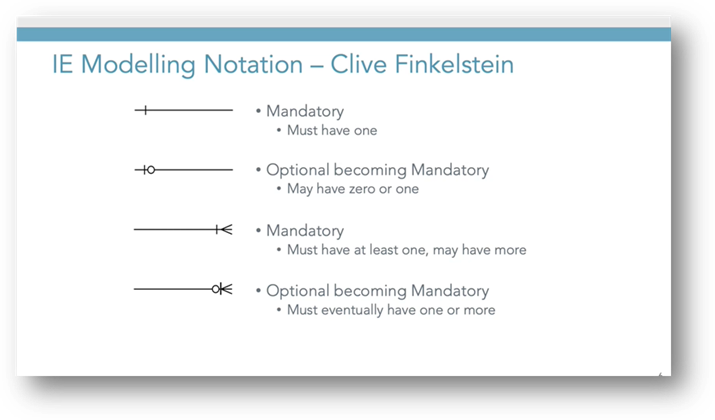
Figure 1 IE Modelling Notation – Clive Finkelstein
Data Warehouse Architecture and Data Modelling
Terry clarifies the notation for indicating optional and mandatory relationships in data models. She use a zero with a circle for optional and a straight line for mandatory, while a circle with a small circle inside means optional becoming mandatory. Terry also discussed 16 notations, eight for mandatory relationships and eight for optional relationships going in both directions. she emphasised that the choice of data warehouse architecture should align with the data warehouse strategy, not the data model. Terry mentioned two possible architectures: normalised models for quality and dimensional models for quick development. Finally, she disagreed with the notion that dimensional models are easier for business people to understand, stating that the business people She has worked with have easily understood third-normal form entity relationship diagrams.
Data Modelling and Normalization in Database Architecture
Terry prefers using third-normal form models to understand business processes better. Resolving many-to-many relationships in a data model with an associative entity in the middle may indicate a lack of understanding of the business. The cringe-worthy many-to-many relationships can be transformed into a dimensional model using the method described in a paper by Daniel Moody and Mark Kortink. Terry believes the business model should be in a third-normal form, even for data warehouse architecture based on Kimball or Vault methodologies. Discussion on newer database architectures may be more relevant to the physical than the conceptual level. However, avoiding physical modelling in the physical world may be acceptable.
Importance of Business Model and Data Architecture in Database Design
When designing a data warehousing environment, having a good business model, and understanding of the required data and its relationships is important. Different data types and business needs may require different data models, such as flat files or dimensional models. The choice of architecture depends on the data and the specific scenario at hand. The third normal form (3NF) is needed to address relationships and storage in the database, while columnar databases can achieve high performance while being in the second normal form (2NF). It is important to base the choice of database technology on the physical level, while the business model should inform the logical level. The database design should cater to data needs, storage, maintenance, and business objectives. When making technology choices, it is important to consider more than just technological considerations, as senior executives sometimes favour specific technologies without considering all factors.

Figure 2 Business Workshops to understand of the required data and its relationships is important.
The Importance of Data Modelling in Business Needs Identification
The importance of data modelling in the fast-changing technology landscape is highlighted as a communication tool between business and IT teams. Business requirements for reporting still require logical structure definition, but entity-relationship diagrams and dimensional modelling are not always necessary. A choice of data warehouse architecture is important as long as it aligns with the data warehouse strategy and fulfils business needs. Data modelling workshops are recommended to promote knowledge sharing between different business units and ensure a better understanding of what the data warehouse will deliver. Terry emphasises the need to involve the business in data modelling through workshops, where they can actively participate, learn, and validate their understanding of the data model.
The Importance of Sentence Diagramming and Data Modelling in Business Writing
Understanding the structure of language and grammar through sentence diagramming skills can lead to success in data modelling. This is because a structured approach to writing definitions and identifying relationships improves the speed of data modelling. While pictures can be informative, they often require lengthy explanations and compromise in data models. Therefore, Terry suggests using natural language and a structured approach to writing definitions when working with businesses. Incorporating experience in sentence diagramming and data modelling can greatly enhance this process.

Figure 3 Quick history lesson

Figure 4 From Diagrams to Definitions
The Benefits of Structured Definitions for Data Modelling
Writing structured definitions is a helpful strategy for creating a data model compatible with agile methods. By providing clear business rules, modelling can become less of a bottleneck and more efficient. Handing over structured definitions to a data modeller can facilitate quicker creation of a logical data model for a warehouse. To learn more about writing clear business definitions, a free web class is available. Recommended books on data modelling include “Data Modelling Essentials” by Graeme Simsion and Graham Witt and “Modelling for Data Quality” by Graeme Simsion. An analysis method outlined by Daniel Moody and Mark Kortnik can be used to convert an enterprise third normal form model into a dimensional model. Alternatively, the unified star schema from Francesco Papini is a technique for converting relational models into standardised dimensional models.

Figure 5 QR code to learn more

Figure 6 Resource list
Evolution of Dimensional Modelling and the Shift to Big Tables
The dimensional model was originally designed to improve efficiency by addressing inefficiencies in multiple joints. However, advancements in processing power have rendered some aspects of dimensional modelling obsolete. As a result, transitioning to big tables and columnar databases can significantly improve performance. While business logical structures and joints still need to be defined, the physical entities are changing. The evolution of technology can challenge business logic and create issues with data integrity. To address this, the enterprise data warehouse was created to unify data and enforce business rules across multiple applications.
The Importance of Data Modelling in Business and Technology
Business modelling remains unchanged despite technological advancements. Data storage and access methods continue to evolve, but Kimball, Inmon, and DataVault have all developed downstream data models to ensure clean and accurate reporting. Loading the entire warehouse into an in-memory database is still challenging due to cost and limitations. Compliance reporting and mistake avoidance require a focus on data cleanliness and a slower process. Different business cases, such as fraud detection and marketing systems, require different architectural approaches to accommodate specific requirements. Ad hoc development can lead to unmanageable and untrustworthy data warehouses, emphasising the importance of structured data modelling design.
Importance of Understanding and Utilizing Data Effectively
Understanding how to use data effectively is crucial for businesses. Recognising that data is historical and may not align with current business thinking is important. However, dimensional modelling and asking the right questions can provide valuable insights. Creating a conceptual data model is critical, regardless of the physical technology used. Data virtualisation can also be a helpful tool for addressing issues with data movement and meeting business needs by allowing for connections without physically moving the data.
Data virtualisation and the importance of rectangular data
Data virtualisation was initially thought to be the solution to various issues. Still, it was found to be more suitable for prototyping than for production due to loading problems with large amounts of data. However, rectangular data remained the focus despite different physical layouts, allowing for aggregation and mathematical calculations. Transforming and using data virtualisation enabled the return to a rectangular structure for measuring business performance. Discussions on cardinality and optional areas provided new insights and learning opportunities. Normalisation and understanding business rules through data modelling were valuable, even if not fully implemented.
- Executive Summary
- The Importance of Data Models in Business and the Skills of a Data Modeler
- Importance of Understanding Business for Data Modelers
- Resolving Differences and Challenges in Business Communication
- Data Warehouse Architecture and Data Modelling
- Data Modelling and Normalization in Database Architecture
- Importance of Business Model and Data Architecture in Database Design
- The Importance of Data Modelling in Business Needs Identification
- The Importance of Sentence Diagramming and Data Modelling in Business Writing
- The Benefits of Structured Definitions for Data Modelling
- Evolution of Dimensional Modelling and the Shift to Big Tables
- The Importance of Data Modelling in Business and Technology
- Importance of Understanding and Utilizing Data Effectively
- Data virtualisation and the importance of rectangular data


