
Key Takeaways
- Data Warehousing and Business Intelligence Exam: The exam covers dimensional modelling methodologies (Kimball, Inmon, and Data Vault), BI readiness assessments, and the fundamental distinctions between BI and data warehousing. It also contains a minor focus on Big Data Analytics.
- Master Data Management (MDM) Exam: Key themes include building a robust business case, distinguishing between master and reference data, and utilising data architecture dependencies to identify low-dependency domains (such as Product or Customer) for an initial MDM implementation. Candidates must also understand the differences between operational and analytical MDM models.
- Data Integration and Interoperability (DII) Exam: Candidates must distinguish between data integration (movement and consolidation) and interoperability (system communication). The exam highlights the long-term degradation risks associated with point-to-point architecture compared to the standardised efficiency of a canonical model or Enterprise Service Bus.
- Metadata Management Exam: This exam emphasises hybrid metadata architectures and critical regulatory/industry standards such as ISO 11179, BCBS 239, and SDMX. It also covers the severe risks of neglecting metadata in big-data implementations, which can turn data lakes into unusable “data swamps”.
Webinar Details
Title: How to Prepare for CDMP® Specialist exams – Ref & Master, DW & BI, I.I
Date: 2023-08-31
Presenter: Howard Diesel
Author: Howard Diesel
What is the Unified Meta-Model and Templates Project?
Howard Diesel introduces a significant new initiative focused on developing a Unified Meta-Model and Templates project. Executing a comprehensive Data Management Maturity Assessment (DMMA) requires well-defined benchmark deliverables and associated evidence. Consequently, the project aims to construct a deliverable meta-model for every DMBOK deliverable, encompassing critical data elements and quality scorecards.
What are Specialist Exams?
Before transitioning to the formal exam curriculum, Howard addresses participant inquiries regarding software tooling. In response to a direct question concerning the optimal free and paid applications for metadata modelling, the host recommends Protege, a freely available tool primarily utilised for ontology design.
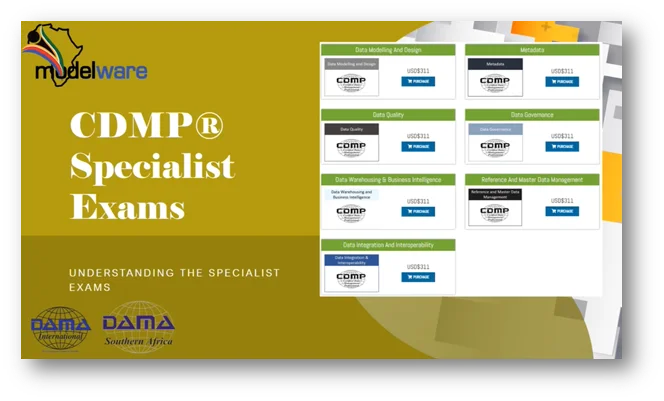
Figure 1 CDMP Specialist Exams

Figure 2 Question the Exams
What is the Data Warehousing and Business Intelligence Exam?
The initial specialist exam reviewed is Data Warehousing and Business Intelligence (BI). Essential topics encompass the reference model, the distinctions between BI and data warehousing disciplines, and the “chessboard” of key components involved in data transformation from application to staging. Candidates are expected to understand the Kimball and Inmon methodologies for dimensional modelling, as well as Data Vault architectures.
The curriculum also includes assessments of BI readiness and organisational maturity. Furthermore, Big Data Analytics is incorporated into this exam, although candidates should anticipate only a minimal number of questions—approximately three or four—on this specific subject. Howard also clarifies that attaining a “Master pass” remains valid for 3 years and requires 3 total exams to retain this advanced certification tier.

Figure 3 Key Topics for Data Warehousing and Business Intelligence
What is the Reference & Master Data Management Exam?
The subsequent focus is the Master Data Management (MDM) exam. Foundational concepts include differentiating between master and reference data and formulating a robust business case. A key technique discussed involves leveraging data architecture dependencies to determine initial implementation subject areas; domains exhibiting the fewest dependencies, such as “Product” or “Customer,” are optimal starting points.
The examination covers diverse implementation architectures, spanning from fully centralised hubs to hybrid and virtualised models. Moreover, candidates must understand the operational distinction between operational MDM, which consolidates data to uniformly update source applications, and analytical MDM, which distributes mastered data downstream to data warehouses. The presenter explicitly advises against initiating MDM programs without a definitively identified master data business problem.

Figure 4 Core Element Summary of Master Data Management

Figure 5 Understanding and Terminology of Reference and Master Data

Figure 6 Important Elements of Master Data Management
What is the Data Integration and Interoperability Exam?
The Data Integration and Interoperability (DII) exam constitutes the third area of review. A fundamental distinction is drawn between integration, defined as the movement and consolidation of data, and interoperability, which refers to the communication protocols between systems. Howard outlines the structural vulnerabilities of point-to-point integration, noting its tendency to degrade over time and reduce systems to the lowest common denominator, contrasting this with the efficacy of a canonical model.
A canonical model serves as the standardised definition for all shared organisational data, requiring applications to utilise only a single translation standard. However, Howard also acknowledges that point-to-point architecture remains appropriate for simple, two-application connections. Finally, candidates must recognise that DII significantly impacts all other data management knowledge areas.
What is the Metadata Management Exam?
The final exam overview covers Metadata Management. Candidates must demonstrate proficiency in various metadata categories beyond the standard business, technical, and operational classifications. The curriculum emphasises metadata architectures, notably the hybrid model, and critical industry standards including ISO 11179, BCBS 239, and SDMX.
The business glossary is highlighted as a vital mechanism bridging metadata operations and data governance. Howard then warns of the severe consequences of neglecting metadata in big data ecosystems; without proper metadata definitions, data lakes degrade into unusable “data swamps,” severely impeding accurate dataset alignment.

Figure 7 Keytopics of Metadata

Figure 8 Metadata Overview

Figure 9 Metadata Exam Tips
General Q&A, Data Architecture, and Quiz Progress
Following the structured exam reviews, the session transitions into a question-and-answer segment. A participant questions the availability of the Data Architecture specialist exam. Howard clarifies that the exam is currently unpublished due to prior quality-control concerns and that, despite recent reviews of updated materials, a formal release date remains undetermined. Subsequently, attendees begin the live practice quizzes.
- Key Takeaways
- What is the Unified Meta-Model and Templates Project?
- What are Specialist Exams?
- What is the Data Warehousing and Business Intelligence Exam?
- What is the Reference & Master Data Management Exam?
- What is the Data Integration and Interoperability Exam?
- What is the Metadata Management Exam?
- General Q&A, Data Architecture, and Quiz Progress


